 Ultimate guide
Workers' Comp Insurance Cost for Cleaning Business
Table of Contents
- What Workers' Compensation Insurance Costs for a Cleaning Business
- Why Payroll, Not Headcount, Sets the Base Rate
- The Factors That Move Your Premium Up or Down
- Janitorial Service Insurance Requirements Explained
- General Liability vs Workers' Compensation for Janitors
- How to Lower Workers' Comp Premiums for Cleaning Companies
- Employee Classification: 1099 vs W-2 and What It Costs You
- How to Get a Quote and What to Have Ready
- Frequently Asked Questions
Last Updated: September 21, 2026
What Workers' Compensation Insurance Costs for a Cleaning Business
The workers' comp cost for a cleaning business depends almost entirely on one number: your annual payroll. Insurers apply a rate per $100 of payroll, and that rate varies by job duties, claims history, and the state where your crews work. This guide from Rangel Janitorial breaks down what drives those rates, how janitorial service insurance requirements work, and where you can realistically reduce what you pay.
Most cleaning company owners assume headcount drives the bill. It doesn't. Two companies with ten employees each can pay wildly different premiums because one runs a low-risk day-porter operation and the other sends crews up ladders to clean gutters. Classification is everything.
Below, we'll walk through the factors that move your premium, the difference between general liability and workers' comp, how employee classification affects your costs, and what to have ready when you request a quote.
Why Payroll, Not Headcount, Sets the Base Rate
Workers' comp pricing starts with payroll, not the number of bodies on your roster. An insurer multiplies your payroll (per $100) by a class code rate to produce an annual premium. A part-time cleaner earning less contributes less premium than a full-time supervisor earning more, even though both are one employee.
For cleaning businesses, the class code assigned to your operation matters more than almost anything else. Janitorial work typically falls into a lower-risk classification than construction cleanup or window washing at height, and that difference shows up directly in the rate. If your crews do multiple types of work, the insurer splits payroll across codes, so accurate job descriptions protect you from overpaying.
The Factors That Move Your Premium Up or Down
Several variables push your premium in either direction: claims history, job duties, coverage limits, deductible selection, and state mandates. None of them operate in isolation, which is why two similar cleaning companies rarely pay the same rate.
Experience Modification Rate and Claims History
The experience modification rate, or EMR, is a number that compares your claims history to other businesses in your classification. An EMR of 1.0 is average. Below 1.0 means you've had fewer or cheaper claims than expected, and it lowers your premium. Above 1.0 raises it.
This is the single most controllable factor over time. Small claims matter. A $2,000 strain injury that runs through the policy still counts against your EMR, sometimes for three years, and the surcharge can outweigh what the insurer paid out. Many cleaning companies find that paying minor medical bills directly, where legally permitted, protects their EMR better than filing every claim.
OSHA's guidance on workplace injury reporting is worth reviewing before you decide how to handle a minor incident, because reporting obligations and insurance claims are two separate questions.
Janitorial Service Insurance Requirements Explained
Workers' compensation is a state-run system, so there is no single national rule that tells a cleaning business when coverage becomes mandatory. What exists instead is a patchwork: every state sets its own employee threshold, its own penalty schedule, and its own enforcement posture. That is why two cleaning companies with identical payroll can face completely different compliance obligations depending on which side of a state line their crews work.
The thresholds themselves range widely. A handful of states require coverage from the first employee you hire, with no minimum headcount at all. Others set the trigger at three, four, or five employees, and a few use payroll thresholds instead of headcount. Some states exempt certain categories of workers, corporate officers, sole proprietors, partners, and domestic or casual laborers are the most common carve-outs, but those exemptions are usually narrow and often require the worker to affirmatively opt out in writing. A cleaning business that assumes it is too small to need coverage is frequently wrong, and the assumption tends to surface only after an injury.
For cleaning contractors specifically, the practical trigger is rarely the state threshold. It is the client contract. Commercial property managers, janitorial subcontracts, and facility management agreements routinely require a certificate of insurance naming the client as an additional insured before a crew is allowed on site.
Because the rules differ this much, the only reliable answer is to check your own state. The two agencies that matter are your state's workers' compensation board or commission (which sets coverage rules and penalties) and your state's department of labor or insurance (which handles classification and rate filings). Both publish plain-language employer guides, and both will confirm your threshold and any exemption paperwork you need. If your crews cross state lines, you generally need coverage in each state where they work, which usually means either a multi-state policy endorsement or separate policies per state.
A short checklist before you sign your next commercial contract:
- Confirm your state's employee threshold and whether any exemption applies to you
- Verify whether your state requires an opt-out filing for officers or owners
- Check the certificate of insurance requirements in every client contract
- Confirm your policy covers every state where crews actually work
- Set a renewal reminder at least 30 days before the policy expires
General Liability vs Workers' Compensation for Janitors
These two policies cover completely different things, and confusing them is one of the most common mistakes new cleaning company owners make.
| Coverage | Who It Protects | What It Pays For | Typically Required By |
|---|---|---|---|
| General liability | Third parties and client property | Slip-and-fall claims, property damage | Client contracts |
| Workers' compensation | Your employees | Medical bills, lost wages, rehab | State law |
How to Lower Workers' Comp Premiums for Cleaning Companies
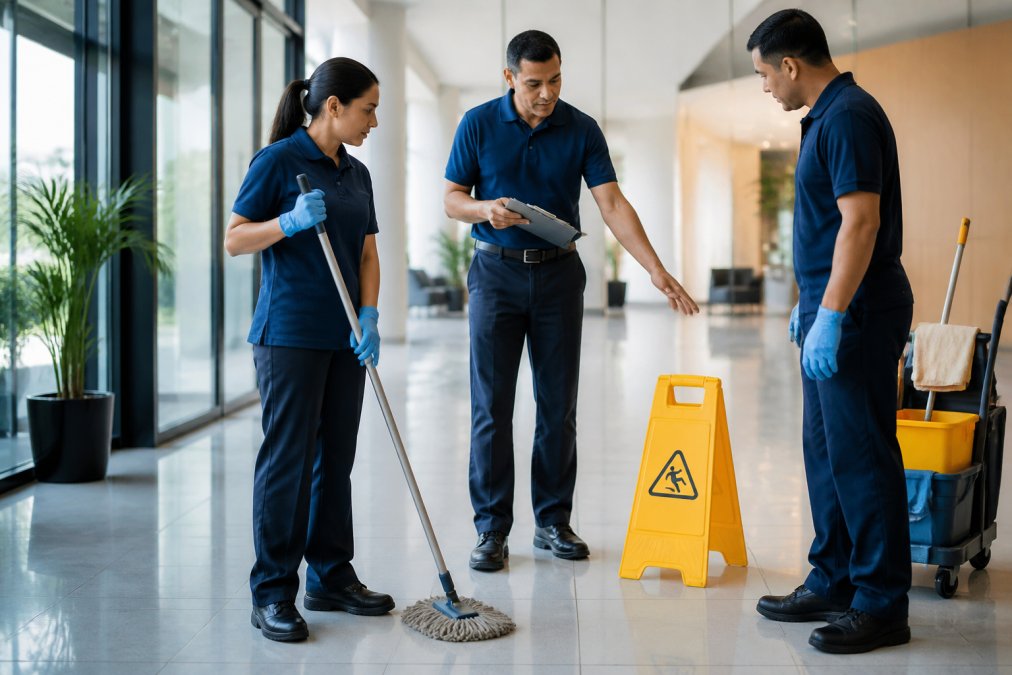
The most effective way to lower workers' comp premiums for cleaning companies is to reduce claims, because your claims history feeds directly into your EMR. But 'be safer' is not a strategy. What actually moves the number is a set of specific, documentable protocols that an underwriter can see and price. Below is how each one connects to the premium, not just to the injury rate.
What a Safety Program Actually Returns
A documented safety program does more than prevent injuries. It gives your underwriter evidence that you manage risk, which can improve how your policy is priced at renewal. The return shows up two ways: fewer claims that would raise your EMR, and a stronger negotiating position when your policy comes up for review.
Practical steps that reliably help:
- Train crews on chemical handling, ladder use, and ergonomics during onboarding, not just once
- Document every safety meeting and incident, because insurers reward a paper trail
- Provide proper equipment, including slip-resistant footwear and correct lifting aids
- Return injured workers to light duty quickly, which reduces lost-wage costs
- Shop your policy every few years, since rates and underwriting appetites shift
Employee Classification: 1099 vs W-2 and What It Costs You
Misclassifying employees as independent contractors is one of the costliest mistakes a cleaning business can make. If a worker is a 1099 contractor, you generally don't owe workers' comp premium on their pay. If they're legally a W-2 employee, you do, and treating them as a contractor to avoid premium can trigger back premiums, penalties, and audits.
How to Get a Quote and What to Have Ready
Getting an accurate quote takes less time when you have your numbers organized. Insurers want to see payroll by job duty, not a single lump sum, because they assign rates by class code.
Have these ready before you call:
- Annual payroll broken down by role (cleaners, supervisors, office staff)
- Job descriptions for each role, including any higher-risk tasks
- Your current EMR, if you've carried coverage before
- Prior claims history, including dates and amounts
- Number of locations and states where crews work
- Estimated annual revenue
Frequently Asked Questions
How much is workers' comp insurance for a cleaning business?
Workers' comp cost for a cleaning business is calculated per $100 of payroll, so two companies with the same headcount can pay very different amounts. The rate depends on your classification code, claims history, state rules, and how much of your staff does high-risk work like climbing ladders or handling chemicals. Because no two operations match, the only reliable figure comes from a quote built on your actual payroll and job duties.
Is workers' compensation insurance mandatory for cleaning businesses?
In most states, yes, once you have even one employee. Thresholds vary: some states require coverage at the first hire, others set a minimum employee count. Cleaning businesses also get pulled into the requirement indirectly, because commercial clients and property managers ask for a certificate of insurance before signing a contract. Skipping coverage can mean fines, a lost contract, or paying a workplace injury claim out of pocket.
What is the difference between general liability and workers' compensation for janitors?
General liability covers damage you cause to other people or their property, such as a scratched floor or a client's ruined carpet. Workers' compensation covers your own employees when they get hurt on the job, paying medical expenses, lost wages, and rehabilitation costs regardless of fault. Most cleaning contracts require both. General liability protects the client's building; workers' comp protects your crew.
How can cleaning businesses lower their workers' compensation insurance premiums?
Focus on three levers: reduce claims, verify payroll accuracy, and improve your experience modification rate. Documented safety protocols, new-hire training on chemical handling and ladder use, and prompt reporting of small injuries all keep claims from growing. Review your classification codes each year, since misclassified office staff can inflate your premium. A formal safety program often pays for itself through lower annual premiums.