 Ultimate guide
What Janitorial Liability Insurance Covers: A Complete Guide
Last Updated: October 29, 2026
Quick Summary
Janitorial liability insurance covers third-party bodily injury and property damage claims arising from cleaning work, including slip-and-fall accidents on wet floors and chemical damage to client property. It also pays legal defense costs, settlements, and judgments when a cleaning company is legally obligated to pay.
- Wet floors are the single most predictable claim in the cleaning industry.
- General liability often excludes damage to property in the cleaner's care, custody, or control.
- Employee theft of client property is handled by a janitorial bond or crime policy, not general liability.
- Defense costs are often paid inside the policy limit rather than on top of it.
- Ask for the additional insured endorsement page itself, not just the certificate.
Table of Contents
- What Janitorial Liability Insurance Covers and Why It Matters
- General Liability Coverage: Bodily Injury and Property Damage
- Legal Defense Costs, Settlements, and Judgments
- Cleaning Business Insurance Exclusions You Must Know
- The Care, Custody, and Control Exclusion
- Intentional Acts and Expected Damage
- Employee Injuries and the Workers' Compensation Boundary
- Employee Theft, Bonds, and Crime Coverage
- Professional Liability and Errors and Omissions
- Commercial Auto and the Vehicle Boundary
- How to Build the Coverage Stack
- Employee Injuries, Theft, and Professional Mistakes
- Janitorial Insurance Requirements for Client Contracts
- How to Read a Janitorial Insurance Certificate of Insurance
- What Drives Cleaning Business Insurance Cost
- Getting a Free Quote from Rangel Janitorial
- Frequently Asked Questions
What Janitorial Liability Insurance Covers and Why It Matters
It covers costs a cleaning company becomes legally obligated to pay when its work injures someone or damages property it does not own.
The distinction most facility managers miss: the policy protects the cleaning company's balance sheet, but the client's building is what gets made whole.
The Core Protection: Third-Party Claims
The word "third-party" does all the heavy lifting. A janitorial liability policy responds to claims from people and property outside the cleaning company itself: your tenants, your visitors, your furniture, your floors. It does not cover the cleaner's own injured back or the company's own broken vacuum.
General Liability Coverage: Bodily Injury and Property Damage
General liability insurance is the backbone of any cleaning business insurance program.
The coverage responds whether the claim is legitimate or not, because insurers also pay to defend against unfounded negligence allegations. That defense obligation is often worth more than the settlement itself.
Slip-and-Fall Accidents and Wet Floors
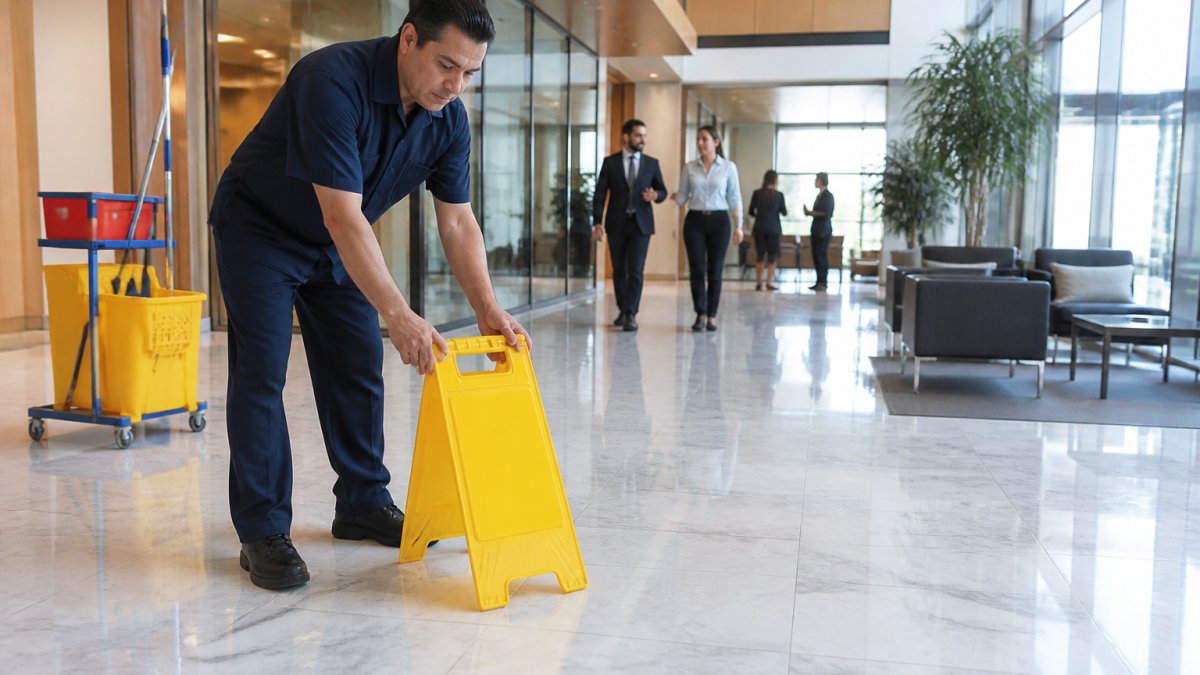
Wet floors are the single most predictable claim in the industry. A visitor walks through a lobby minutes after mopping, the floor is still slick, and the fall produces a fracture, a hospital visit, and a demand letter.
The practical defense is documentation. Cones, signs, and a logged mopping schedule reduce both the frequency of slip-and-fall accidents and the strength of a claim.
Chemical Damage and Accidental Property Destruction
Cleaning chemicals cause damage that is easy to underestimate. A concentrated disinfectant left too long on a finished hardwood floor strips the seal. A splatter etches a brushed metal elevator panel.
Accidental damage to client property falls under third-party property damage coverage. Many policies exclude damage from the cleaner's own product used contrary to the manufacturer's instructions, so mixing chemicals on site without training is a coverage risk as well as a safety one.
Legal Defense Costs, Settlements, and Judgments
Legal defense costs are covered separately from the settlement amount in most general liability policies, and that structure matters more than the headline limit.
Here is the part most contract reviews get wrong: defense costs are often paid inside the policy limit rather than on top of it.
Cleaning Business Insurance Exclusions You Must Know
Exclusions define what the policy will not pay, and they are where cleaning companies get caught. The typical general liability form excludes employee injuries, employee dishonesty, and professional advice that causes a financial loss rather than physical harm.
The Care, Custody, and Control Exclusion
The exclusion that surprises cleaning contractors most is damage to property in the cleaner's care, custody, or control.
The consequence is narrow but real. A janitor who knocks a vase off a shelf while dusting is generally covered as third-party property damage.
Policy wording varies.
Intentional Acts and Expected Damage
General liability policies exclude intentional acts and damage the insured expected or intended. The exclusion is not a loophole for accidents, a mop bucket tipped by a tired worker is still an accident. It targets conduct like deliberately using a banned chemical after being told not to.
Employee Injuries and the Workers' Compensation Boundary
Workers' compensation covers workplace injury to a cleaning crew. Requirements depend on the state and the business's employees. General liability will not pay a cleaner's medical bills for a back injury from lifting furniture, and a client contract demanding general liability alone leaves the cleaner's own people unprotected.
Employee Theft, Bonds, and Crime Coverage
Employee theft of client property is excluded from general liability and handled by a janitorial bond or commercial crime policy. A janitorial bond is not liability insurance, it is a fidelity instrument responding to dishonest acts by the cleaning company's own employees. A client contract requiring a bond is asking for a different product than a certificate of general liability shows.
Professional Liability and Errors and Omissions
Professional liability, also called errors and omissions, responds to claims that the cleaning itself was performed negligently in a way that caused a financial loss rather than physical damage. General liability typically excludes professional services and financial injury. If a contractor advises a client on a floor-care program and the client claims the advice caused a costly outcome, that claim belongs in the professional liability conversation.
Commercial Auto and the Vehicle Boundary
Commercial auto insurance covers the van that hits a client's gate on the way out of the lot. General liability usually excludes the ownership, maintenance, or use of vehicles. A cleaning company that assumes its general liability policy covers a company van striking client property is exposed on two fronts: the auto claim and the gap in its coverage stack.
How to Build the Coverage Stack
A cleaning business should treat its insurance as a stack rather than a single policy. General liability handles third-party bodily injury and property damage. Workers' compensation handles employee injuries. A janitorial bond or crime policy handles employee dishonesty. Professional liability handles financial loss from cleaning advice or negligent performance.
Employee Injuries, Theft, and Professional Mistakes
Employee theft of client property is excluded from general liability and handled by a janitorial bond or a commercial crime policy. Professional liability, also called errors and omissions, responds to claims that the cleaning itself was performed negligently in a way that caused a financial loss rather than physical damage.
Each layer of a cleaning company's coverage stack handles a risk the others exclude.
| Coverage | What it handles | Key note |
|---|---|---|
| General liability | Third-party bodily injury and property damage | Backbone of the program |
| Workers' compensation | Employee injuries | Not interchangeable with general liability |
| Janitorial bond or crime policy | Employee dishonesty and theft | Fidelity instrument, not liability insurance |
| Professional liability (errors and omissions) | Financial loss from negligent cleaning or advice | General liability typically excludes it |
| Commercial auto | Vehicles, such as a van hitting a client's gate | General liability usually excludes vehicle use |
Janitorial Insurance Requirements for Client Contracts
Most commercial cleaning contracts specify minimum coverage limits, require the client to be named as an additional insured, and demand a certificate of insurance before work begins. Property managers structuring janitorial contracts can use the Walnut Creek Property Management Cleaning Vendor RFP Guide to see how insurance requirements fit into RFPs and vendor selection.
The additional insured endorsement is the piece contractors most often overlook. Being named as an additional insured gives the property owner direct access to the cleaner's policy, rather than forcing the owner to sue the cleaner and wait for a payout.
Reading the Contract's Insurance Clause Line by Line
A cleaning contract's insurance clause usually contains four moving parts: the required policy types, the minimum limits, the additional insured requirement, and the certificate and notice obligations. Each part creates a different obligation, and a contractor who reads only the limit number misses the rest.
A common pattern is a clause that requires general liability with a per-occurrence limit, an aggregate limit, products-completed operations coverage, and additional insured status for the property owner and its lender.
Choosing Limits and Deductibles
Limits and deductibles are a trade-off, not a checkbox. A higher per-occurrence limit raises premium; a higher deductible lowers it but shifts more of each claim onto the business. A cleaning company without cash reserves should be cautious about a high deductible, because the first claim of the year can arrive before the reserve is built.
A practical framework is to start from the client's contract minimum, then ask three questions. What is the largest single property value the crew works near, a server room, a marble lobby, a data closet? What does a serious slip-and-fall claim look like in the local market, including defense costs? How much cash can the business absorb before the policy responds?
Additional Insured, Waiver of Subrogation, and Primary and Non-Contributory
Additional insured status is the most requested endorsement in commercial cleaning contracts, but it is not the only one. A waiver of subrogation prevents the insurer from pursuing the property owner after paying a claim, and a primary and non-contributory requirement makes the cleaner's policy respond first without sharing the loss with the owner's insurer.
Certificates, Endorsements, and the Paper Trail
A certificate of insurance is a snapshot, not a contract. The endorsement pages are the proof. When a client asks for additional insured status, the correct response is the endorsement page naming the client, not a certificate with a checked box.
Keep a current certificate and endorsement set for every active client, and refresh them at each renewal.
How Coverage Needs Change by Business Setup
A solo operator with no employees has a different insurance profile than a commercial janitorial company with a crew.
Residential cleaners face a different mix: homeowner contracts often require proof of insurance but rarely request additional insured status, while commercial clients almost always do.
State Rules Versus Client Rules
It is worth separating legal requirements from contract requirements. Workers' compensation requirements vary by state and depend on the business's employees. Check the rules that apply where you operate. General liability is not universally mandated by statute for cleaning companies, but it is effectively required by clients, landlords, and property managers.
How to Read a Janitorial Insurance Certificate of Insurance
A janitorial insurance certificate of insurance is a one-page summary issued by the insurer or broker that shows policy types, limits, effective dates, and the named insured.
Five things to verify on every certificate:
- Named insured matches the contracting entity exactly. A certificate issued to a parent company does not cover the subsidiary signing your contract.
- Policy dates are current. Coverage that expired last month is not coverage.
- Limits meet your contract minimums. Compare each limit line by line, not the aggregate total.
- Additional insured status is stated. If your building is not listed, the endorsement has not been confirmed.
- Certificate holder is your organization. The address and entity name should match your records.
Ask for the additional insured endorsement page itself, not just the certificate. A broker can issue a certificate in minutes; an endorsement requires the insurer's approval, which is the actual proof.
What Drives Cleaning Business Insurance Cost
Cleaning business insurance cost depends on payroll, revenue, the type of cleaning performed, the number of locations, and the claims history of the business.
Deductibles also move the premium. A higher deductible lowers the annual cost but shifts more of each claim onto the business, a poor trade for a company without cash reserves.
Getting a Free Quote from Rangel Janitorial
Rangel Janitorial has more than 30 years of experience with fully bonded and insured crews. Contact us for our certificate of insurance and endorsement documentation.
For current service details and a free quote, visit the Rangel Janitorial website. Sacramento readers can view professional janitorial services in Downtown Sacramento, CA for local service details and to call for a quote. Murrieta readers can view professional janitorial services in Murrieta, CA for local service details and to call for a quote. Walnut Creek readers can view professional janitorial services in Walnut Creek, CA for local service details and to call for a quote. Readers can also review janitorial services in Walnut Creek & the East Bay to see what Bay Area businesses should expect from their cleaning provider.
Verifying coverage is the easy part. Finding a crew that shows up, follows the schedule, and documents its work is harder.
Frequently Asked Questions
How much is liability insurance for a small cleaning business?
Costs vary based on your revenue, number of employees, payroll, and the specific coverage limits you choose. A small operation with minimal staff typically pays less than a larger commercial cleaning company with multiple crews and vehicles. Factors like whether you perform high-risk work, such as stripping and waxing floors, also affect pricing. Because rates are highly individualized, request a quote from an insurer or broker who understands janitorial operations rather than relying on generic industry averages.
Does janitorial liability insurance cover damage to a client's property?
Yes, general liability coverage typically pays for accidental damage your crew causes to a client's property, such as knocking over a computer monitor, scratching a hardwood floor, or spilling chemicals on carpet. The policy responds to third-party property damage claims, covering repair or replacement costs up to your policy limit. However, intentional damage and damage caused by your own faulty workmanship may be excluded. Always review the specific terms of your policy and report incidents promptly.
What does janitorial liability insurance usually exclude?
Common exclusions include employee injuries, which fall under workers' compensation; damage to your own equipment; employee theft; and professional errors, which require professional liability or errors and omissions coverage. Intentional acts, damage from faulty workmanship, and auto accidents while driving are also typically excluded from a general liability policy. Understanding these cleaning business insurance exclusions helps you identify gaps and purchase endorsements or separate policies to fill them.
What insurance do cleaning businesses need besides general liability?
Beyond general liability, most cleaning businesses need workers' compensation for employee injuries, commercial auto insurance for company vehicles, and a janitorial bond to protect clients against employee theft. Professional liability or errors and omissions coverage is valuable if you provide specialized services like electrostatic disinfection or consulting. Commercial property insurance protects your own equipment and supplies. The right mix depends on your services, staff size, and client contract requirements.
How do I verify a cleaning company's insurance certificate?
Request a certificate of insurance directly from the cleaning company and confirm the policy is active by calling the insurer listed on the document. Check that the coverage limits meet your contract requirements and that your organization is named as an additional insured if required. Verify the policy dates and the types of coverage listed, such as general liability and workers' compensation. A legitimate, fully bonded and insured provider will supply this documentation without hesitation.