 Ultimate guide
Medical Facility Sanitation Standards in California
Table of Contents
- Which California Rules Actually Govern Medical Facility Sanitation
- The Four Rulebooks That Apply
- Healthcare Facility Cleaning Protocols: Cleaning, Sanitizing, and Disinfecting
- A Medical Office Cleaning Checklist Built by Room Risk
- Healthcare Environmental Cleaning Frequency: How Often Is Often Enough
- Medical Waste Disposal Requirements and Bloodborne Pathogen Precautions
- Proving It Works: Verification, Records, and Staff Competency
- Conclusion
- Frequently Asked Questions
Last Updated: October 18, 2026
Which California Rules Actually Govern Medical Facility Sanitation
California does not regulate medical facility sanitation through a single statute. Compliance with medical facility sanitation standards means satisfying four overlapping rulebooks at once, and the facility that reads only one fails inspection. This guide from Rangel Janitorial maps those rulebooks, translates them into room-by-room procedures, and shows how to prove the work was done.
California regulators treat cleaning, sanitizing, and disinfecting as three legally distinct activities with different products, contact times, and documentation expectations.
The Four Rulebooks That Apply
Medical facility sanitation in California is governed by four separate authorities: Cal/OSHA, the California Department of Public Health, CalRecycle, and the federal CMS Conditions of Participation. Each covers a different slice of the problem, and none defers entirely to the others.
The four rulebooks do not apply with equal force to every facility.
| Authority | Primary Citation | What It Governs | Who It Binds Most Directly |
|---|---|---|---|
| Cal/OSHA Bloodborne Pathogens Standard | Title 8, Section 5193 | Employee exposure control plans, hepatitis B vaccination offers, PPE, labeled waste containers, training | Any employer with employees at occupational exposure risk, including dental and clinic staff |
| California Department of Public Health | Health and Safety Code licensing provisions and clinic/hospital regulations | Facility licensure, infection prevention standards enforced at survey | Licensed clinics, surgical centers, hospitals, and skilled nursing facilities |
| CalRecycle / Medical Waste Management Act | Health and Safety Code Division 104, Part 14 | Segregation, storage, transport, treatment, and documentation of regulated medical waste | Any generator of regulated medical waste, from a single dental chair to a hospital |
| CMS Conditions of Participation | 42 CFR Part 482 (hospitals) and related parts for other provider types | Medicare participation, including an infection prevention and control program with a designated leader | Facilities that bill Medicare, which in practice means most licensed providers |
Read the table by column, not by row. The Cal/OSHA standard follows the employee, not the building: a dental office with two hygienists has the same bloodborne pathogen obligations as a hospital floor nurse, scaled to exposure risk.
- Dental offices are licensed and inspected under the Dental Practice Act and Board of Dentistry regulations in addition to Cal/OSHA and the Medical Waste Management Act. They are not surveyed under the hospital Conditions of Participation but still owe employees a written exposure control plan.
- Freestanding surgical centers carry the heaviest overlap: state licensure, CMS survey if they participate in Medicare, Cal/OSHA, and medical waste rules all apply.
- Hospitals face the full stack plus the CMS infection prevention condition, which requires a designated infection preventionist and a documented program, not just a cleaning schedule.
Cal/OSHA Bloodborne Pathogens Standard, Title 8 Section 5193
Healthcare Facility Cleaning Protocols: Cleaning, Sanitizing, and Disinfecting
Healthcare facility cleaning protocols separate three activities most staff conflate. Cleaning removes soil and organic matter; sanitizing reduces bacteria to levels considered safe by public health standards; disinfecting destroys or inactivates pathogens on surfaces. You cannot skip cleaning and jump to disinfecting, because soil blocks the disinfectant from reaching the surface.
The sequence matters more than the product. A surface wiped with disinfectant while still visibly soiled has not been disinfected, regardless of the label.
Product selection follows the surface and the pathogen:
- EPA-registered hospital disinfectants for clinical contact surfaces, used at the labeled contact time
- Low-level disinfectants for general environmental surfaces not involved in patient care
- Sporicidal agents where C. difficile or other spore-formers are a concern
Dwell time is where most programs slip. A disinfectant sprayed and immediately wiped has done almost nothing. Train crews to read the label and honor the contact time, often one to ten minutes.
A Medical Office Cleaning Checklist Built by Room Risk
A medical office cleaning checklist should be organized by risk level, not room name.
Tier 1: High-risk patient care areas. Exam rooms, procedure rooms, treatment chairs, and any surface that contacts intact skin or mucous membranes.
Tier 2: Common clinical support areas. Nursing stations, break rooms, restrooms, and corridors.
Tier 3: Administrative and low-risk areas. Offices, records rooms, and storage. Cleaned on a routine schedule with standard products.
High-Touch Surfaces and Hand Hygiene Stations
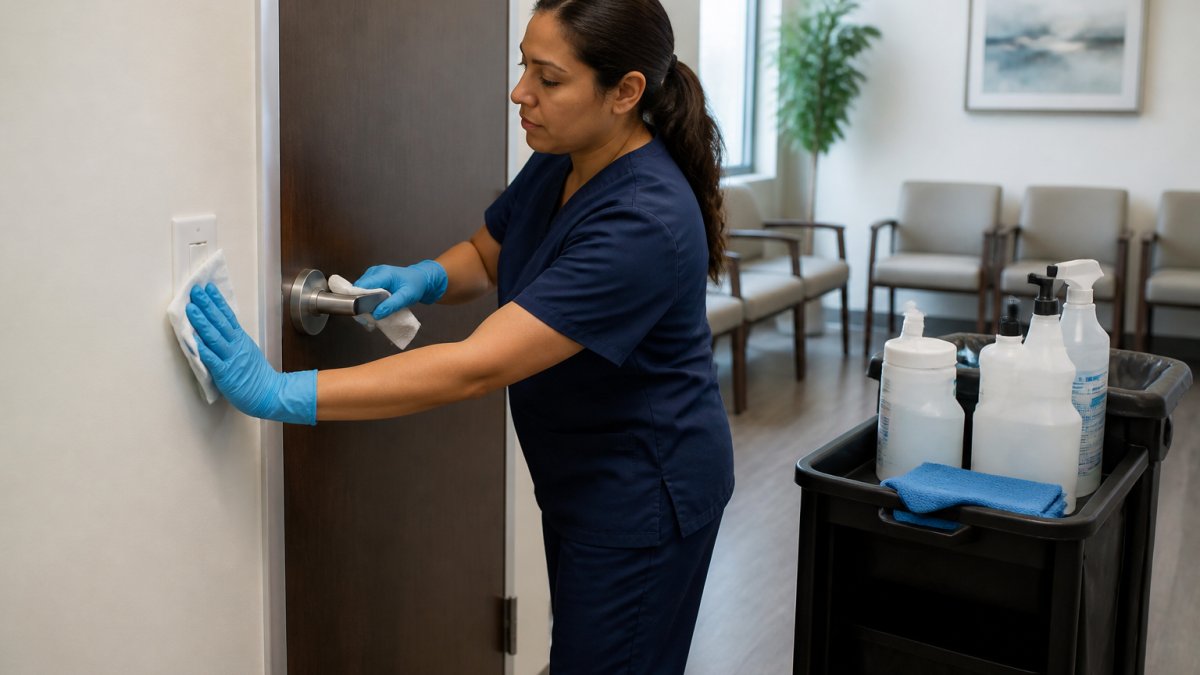
High-touch surfaces deserve their own line item because they drive most disease transmission in a medical facility. Door handles, light switches, elevator buttons, handrails, faucet handles, and shared keyboards should be on a named list with a defined frequency, not left to a cleaner's judgment.
Hand hygiene stations must be readily accessible: working dispensers, stocked soap, and paper towels at every sink, checked on the same schedule as the cleaning itself. A dispenser that runs dry between service visits is a compliance finding waiting to happen.
Healthcare Environmental Cleaning Frequency: How Often Is Often Enough
Healthcare environmental cleaning frequency is set by risk tier and the facility's own written policy, not a universal calendar. California does not publish a single "clean every X hours" number for every surface.
A defensible frequency framework looks like this:
| Area | Minimum Frequency | Trigger for More |
|---|---|---|
| Exam and procedure rooms | Between every patient | Visible soil, body fluid contact |
| High-touch surfaces in clinical areas | Multiple times daily | Outbreak or high patient volume |
| Restrooms | Daily, checked mid-shift | Heavy use periods |
| Waiting areas | Daily | Flu season, respiratory illness surge |
| Administrative offices | Routine schedule | Spills, visible soil |
The gap most facilities leave open is the escalation trigger. During a suspected outbreak, environmental cleaning should intensify, with more frequent disinfection of high-touch surfaces and a documented escalation step.
Medical Waste Disposal Requirements and Bloodborne Pathogen Precautions
Medical waste disposal requirements in California follow the Medical Waste Management Act, which classifies waste and sets handling, storage, and documentation rules. Bloodborne pathogen precautions come from Cal/OSHA and apply to any employee with occupational exposure to blood or other potentially infectious materials.
The practical requirements break down into segregation and protection:
- Segregate at the point of generation. Sharps go in rigid, puncture-resistant, labeled containers; regulated biohazard waste goes in red bags; general trash stays separate. Mixing streams creates a compliance violation and raises disposal cost.
- Label and store correctly. Containers must be labeled with the biohazard symbol and stored in a designated area with restricted access.
- Maintain an exposure control plan. The plan must be written, reviewed annually, and available to employees. It covers PPE, work practice controls, and post-exposure procedures.
OSHA Bloodborne Pathogens Standard, 29 CFR 1910.1030
Documentation is where facilities get caught. A waste manifest with a missing signature or a training log with gaps reads as a program failure, even if the handling was correct.
Proving It Works: Verification, Records, and Staff Competency
Verification separates a cleaning program from a cleaning claim. California surveyors and CMS reviewers do not watch your crew work; they read your records. If the work happened but the record is missing, the work did not happen as far as the survey is concerned.
A defensible verification layer has four parts: named ownership, a defined record set, a scheduled audit, and a corrective-action loop. Build all four or the file will not survive review.
Ownership and the Record Set
Every record needs a named role, not a department. A common pattern is to assign the following:
- Facility manager or practice administrator: owns the written cleaning schedule and signs the monthly audit summary.
- Infection prevention lead (where CMS applies): owns the infection prevention and control program and reviews disinfection records against the schedule.
- Cleaning supervisor: owns daily logs, product dilution records, and contact-time verification.
The record set that holds up under survey typically includes:
- Written cleaning and disinfection schedule by area and frequency, signed and dated by the owner.
- Daily cleaning logs listing area, task, product used, contact time honored, and initials.
- Disinfection records that name the EPA-registered product and the labeled contact time, so a reviewer can confirm the dwell time was achievable.
- Waste manifests with generator signature, transporter signature, and treatment destination.
- Training records for bloodborne pathogens at hire and annually, plus competency observations for product dilution, PPE use, and hand hygiene.
- Exposure control plan with the annual review date and the hepatitis B vaccination offer log.
Audit Cadence and Corrective Action
Records only prove something if someone checks them. A workable cadence: a daily supervisor spot-check of high-touch surfaces against the log, a weekly review of completed logs for missing initials or gaps, and a monthly audit sampling a defined number of rooms against observed conditions.
Corrective action is where most programs are thinnest. When an audit finds a missed contact time or an unsigned log, the fix should be written down with a responsible role, a due date, and a verification step.
Competency and Language Access
Training is not the same as competency. A signed roster proves attendance, not capability. Periodic observation, a supervisor watching a crew member dilute a product, honor a contact time, and doff PPE correctly, converts training into evidence.
Language access belongs here too. If your crew's primary language differs from the written procedure, the procedure is not usable. Deliver training and signage in the language staff actually read, and let the competency observation confirm the worker understood the procedure, not just attended the session.
At Rangel Janitorial, our crews are trained, bonded, and insured, and we have maintained facilities across California for more than 30 years. For facility managers who need the documentation to match the standard, that consistency is the point.
Conclusion
California's medical facility sanitation standards are demanding because they come from four authorities at once, and the facility that treats them as a single checklist will miss something. The work is manageable when you organize it by risk tier, document every step, and verify staff can follow the written procedure.
Rangel Janitorial supports medical and dental facilities with tailored cleaning plans, electrostatic disinfection for 360-degree coverage, and consistent quality across multiple properties.
Frequently Asked Questions
What sanitation standards apply to medical facilities in California?
Four sets of rules overlap. Cal/OSHA's Bloodborne Pathogens standard (Title 8, Section 5193) covers exposure control plans, PPE, and training. The California Department of Public Health licenses facilities and enforces infection-control standards through Title 22. CMS Conditions of Participation apply if the facility bills Medicare or Medicaid. Cal/OSHA's Injury and Illness Prevention Program rule (Section 3203) requires a written safety plan. A compliant medical facility sanitation program documents all four rather than treating any one as sufficient.
How often should patient-care areas be cleaned and disinfected?
Healthcare environmental cleaning frequency depends on the surface and the risk level. High-touch surfaces in patient-care areas, such as bed rails, call buttons, and door handles, generally need disinfection at least daily and more often in high-traffic or isolation rooms. Floors and low-touch surfaces typically follow a daily schedule. Terminal cleaning happens at discharge or transfer. Spills of blood or body fluids require immediate cleanup under bloodborne pathogen precautions, not the next scheduled pass.
What is the difference between cleaning, sanitizing, and disinfecting?
Cleaning removes soil, organic matter, and visible debris with soap and water or a detergent. Sanitizing reduces bacteria on a surface to levels public health codes consider safe. Disinfecting kills or inactivates most pathogens on a surface after cleaning. In a medical facility, disinfection is the standard for patient-care surfaces because sanitizing alone does not meet healthcare facility cleaning protocols. Disinfectant needs a clean surface and the labeled contact time to work, so skipping the cleaning step undermines the whole process.
How should medical facilities handle regulated medical waste?
Medical waste disposal requirements in California are set by the Medical Waste Management Act, enforced by the Department of Public Health. Facilities must segregate waste at the point of generation into labeled, closable containers: red bags for biohazardous waste and sharps containers for needles. Waste must be stored in a designated area, not held longer than the rules allow, and transferred only to a registered hauler with tracking documents. Staff handling waste need bloodborne pathogen training and PPE.
Who is responsible for maintaining sanitation in a medical facility?
Responsibility is shared and documented. The practice manager or facility manager owns the written plan, schedules, and vendor oversight. Clinical staff handle point-of-care disinfection between patients and waste segregation at the source. The cleaning contractor executes the medical office cleaning checklist and keeps records. Cal/OSHA expects a named person responsible for the exposure control plan. When a surveyor or inspector asks, the facility should be able to show who did what, when, and with which product.
How can a facility verify that cleaning and disinfection actually work?
Verification goes beyond a visual walk-through. Common methods include fluorescent marker checks on high-touch surfaces, ATP bioluminescence swabs that detect organic residue, and periodic surface sampling for specific pathogens during outbreak response. Pair these with documented logs of product, dilution, contact time, and staff initials. Training records and competency checks close the loop. If a contractor handles the work, ask for their verification results and record-keeping format before signing, not after.