 Ultimate guide
Standardizing Cleaning for Industrial Parks: 2026 Guide
Table of Contents
- Why Standardizing Cleaning for Industrial Parks Matters
- Industrial Cleaning Best Practices That Hold Up in Real Facilities
- Building a Warehouse Cleaning Checklist for Every Zone
- Facility Maintenance KPIs That Prove Cleaning Performance
- Commercial Cleaning Service Level Agreements: What to Put in Writing
- Training Crews, Auditing Results, and Emergency Response Protocols
- The ROI of Standardizing Cleaning for Industrial Parks
- Frequently Asked Questions
Last Updated: September 16, 2026
Why Standardizing Cleaning for Industrial Parks Matters
Standardizing cleaning for industrial parks means replacing ad hoc janitorial routines with documented, repeatable protocols that apply the same way across every building, shift, and crew. That consistency separates a facility that merely looks clean from one that passes an audit, protects workers, and holds its value. This guide from Rangel Janitorial draws on 30+ years of commercial cleaning experience to show how to build that system.
Industrial Cleaning Best Practices That Hold Up in Real Facilities
The best industrial cleaning best practices share one trait: they survive contact with a working facility. That means written procedures, zone-based assignments, and equipment matched to the surface.
- Written protocols for every zone and surface type
- Equipment selected for the actual square footage and soil load
- A schedule tied to traffic patterns, not convenience
- An audit loop that feeds corrections back into the protocol
Selecting Equipment for Industrial Housekeeping
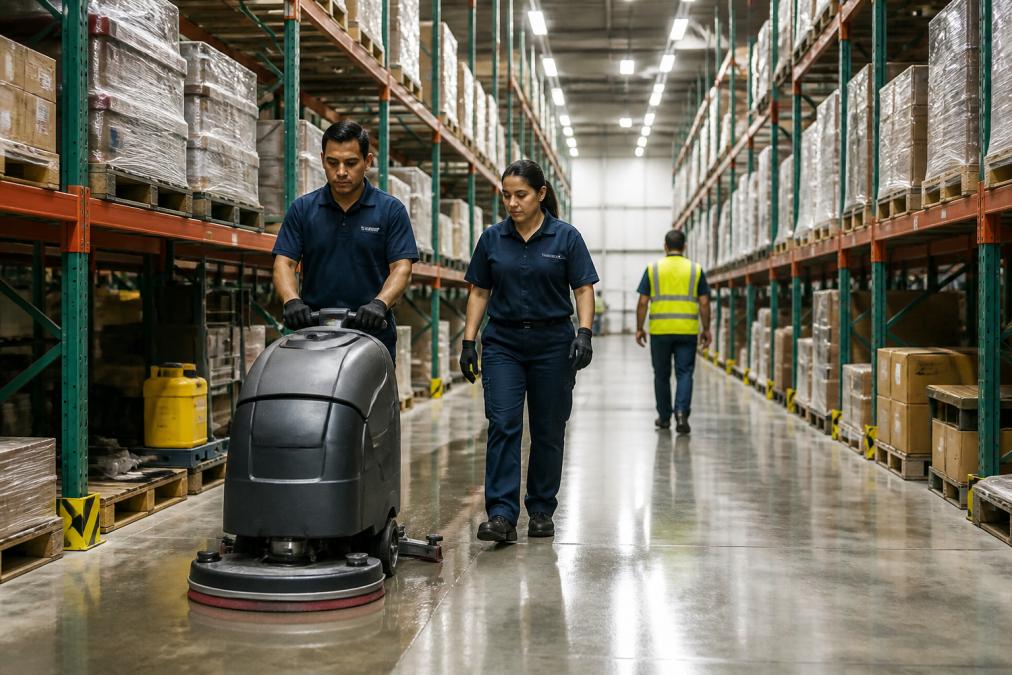
Equipment choice drives both results and labor hours. Industrial housekeeping in a large park usually needs walk-behind or ride-on floor scrubbers for expansive concrete, backpack vacuums for high shelving, and microfiber systems for offices and break rooms.
Chemical Compatibility and Disinfection Procedures
Chemical compatibility and disinfection procedures protect both surfaces and people. Using an acidic cleaner on sealed concrete, or mixing bleach with ammonia-based products, causes damage and creates genuine safety hazards.
Building a Warehouse Cleaning Checklist for Every Zone
A warehouse cleaning checklist works only when it is zone-specific. One master list covering an entire park always fails, because a loading dock and a reception area have nothing in common except a floor.
| Zone | Core Tasks | Typical Frequency |
|---|---|---|
| Warehouse floor | Scrub, sweep, spot degrease | Daily to weekly |
| Loading dock | Debris removal, spill response | Daily |
| Break rooms | Surfaces, appliances, waste | Daily |
| Restrooms | Disinfect, restock, floor care | Daily, multiple passes |
| Office suites | Dust, vacuum, glass, trash | Daily or nightly |
High-Traffic Area Maintenance and Floor Care
Floor care is where standardization shows fastest. Industrial floor care means matching the method to the material: burnishing sealed concrete, auto-scrubbing epoxy, and avoiding excess water on any coated surface.
Facility Maintenance KPIs That Prove Cleaning Performance
Facility maintenance KPIs turn "it looks clean" into a number you can defend. Without them, a facility manager cannot prove a contractor is delivering or justify the budget. The gap in most programs is not picking metrics, it is defining how each one is measured, what a passing score looks like, and where the data lives.
The Five Metrics That Actually Move the Needle
Keep the set small and make every metric auditable. A workable core set for an industrial park:
- Inspection pass rate by zone, score each zone against the same checklist the crew uses. A common pattern is a 1-5 scale per line item, with a zone passing at 90% or higher. Track by zone, not as a park-wide average, or a strong office suite will mask a failing loading dock.
- Task completion against schedule, completed tasks divided by scheduled tasks for the period. This is the earliest signal that a crew is falling behind, usually weeks before inspection scores drop.
- Response time to complaint or spill calls, clock from the call or work-order submission to crew arrival. Separate routine complaints from spill and biohazard calls, because the acceptable windows are different.
- Supply usage per square foot, total chemical concentrate consumed divided by cleanable square footage. A sudden rise usually means over-dilution, over-application, or a training gap, not a dirtier building.
- Restroom restock compliance, percentage of scheduled restock checks completed and logged. Restrooms drive the majority of tenant complaints in multi-tenant parks, so this one earns its place.
Setting Targets Without Inventing Them
Do not import benchmark numbers from a vendor brochure. Score every zone for four to six weeks, then set the target slightly above the observed median, a defensible number tied to your facility rather than a generic industry figure. Most practitioners find a 5-10% improvement per quarter is realistic once the audit loop is running; pushing harder usually means the target, not the crew, is the problem.
Digital Tools That Replace the Paper Log
This is where most industrial park programs still run on clipboards, and where the biggest operational gain sits. A basic stack:
- Mobile checklist apps, crews complete the zone checklist on a phone or tablet, with photo capture required for any line item marked failed. This eliminates the re-keying step and timestamps every task.
- Photo audit comparison, store the same three or four fixed camera angles per zone and compare week over week. Drift shows up in the images long before a formal audit catches it.
- Work-order and complaint intake, a single intake channel (QR code on the supply closet door, a phone number, or a tenant portal) so response-time data is captured automatically instead of reconstructed from emails.
- IoT and sensor inputs, restroom traffic counters, dispenser-level sensors, and floor-scrubber telematics can feed usage and completion data directly into the same system. These are optional, but they remove the manual logging burden on the highest-frequency tasks.
- Facility management software, a platform that ties checklists, work orders, and inspection scores to a building and a zone. The value is not the dashboard; it is the audit trail you can hand to a tenant or an inspector.
Reporting Cadence
Match the report to the audience. Supervisors need daily task-completion and open work orders. Facility managers need a weekly zone-level inspection score and response-time summary. Ownership and tenants need a monthly one-page rollup: pass rate trend, open corrective actions, and supply usage per square foot. If a report does not change a decision, cut it.
Commercial Cleaning Service Level Agreements: What to Put in Writing
A commercial cleaning service level agreement is the document that makes standardization enforceable. If it is not in the SLA, it is a favor, not a commitment.
Put these items in writing before signing:
- Exact scope per zone, tied to your checklist
- Cleaning frequencies and shift windows
- Inspection and audit method, with pass thresholds
- Response times for complaints and spills
- Insurance and bonding requirements
- Correction process when a task is missed
Training Crews, Auditing Results, and Emergency Response Protocols
Training and auditing keep a standardized program from decaying. Crews need onboarding on the SOPs, refreshers on chemical safety, and clear ownership of their zones.
The ROI of Standardizing Cleaning for Industrial Parks
Most guides stop at "standardization saves money", not a number a facility manager can take to ownership. The return on standardization comes from four measurable places: labor efficiency, rework reduction, surface and equipment life, and avoided compliance and complaint costs.
Step 1: Build the Baseline (Ad Hoc Cost)
Before you can show a return, you need the current cost. Pull these for the last 12 months:
- Total cleaning labor hours, including overtime and any emergency call-outs.
- Total chemical and supply spend, from invoices, not estimates.
- Rework hours, time spent re-cleaning areas that failed inspection or drew a complaint. If this is not tracked, estimate it from complaint volume and the average time to resolve.
- Floor and surface replacement or refinishing spend, coatings, carpet, and any premature replacement driven by wrong chemicals or methods.
- Complaint and escalation cost, supervisor time, tenant credits, and any inspection-driven remediation.
Step 2: Estimate the Standardized Cost
A standardized program changes the cost structure in three ways:
- Labor shifts from reactive to scheduled. The hours do not disappear; they move from rework and emergency response into planned tasks. The savings show up as fewer overtime hours and fewer call-outs, not as a smaller crew on day one.
- Supply spend drops through dilution control and correct product selection. Concentrates with measured dilution typically cut chemical spend versus ready-to-use products, and matching the chemical to the surface stops the damage that drives premature replacement.
- Audit and reporting time is added. This is a real new cost, supervisor hours for inspections, photo review, and reporting. Budget it honestly, or the program will look better on paper than it performs.
Step 3: The Payback Math
The payback period is the one-time implementation cost divided by the monthly net savings. Implementation cost typically includes:
- SOP development and checklist build-out (internal time or consultant)
- Initial training hours for every crew member
- Any equipment or chemical changes required to match the new protocols
- Software subscription for checklists, work orders, and reporting
Sustainability Metrics That Belong in the Same Model
Environmental impact is a cost line most programs ignore, and it is measurable with data you already collect:
- Chemical usage per square foot, total concentrate consumed divided by cleanable square footage. Track monthly; a rising trend signals over-application.
- Dilution accuracy rate, percentage of dispensing stations verified at the correct dilution. Wall-mounted dispensers with locked dilution ratios make this auditable.
- Waste diversion rate, percentage of cleaning-related waste (packaging, spent supplies) diverted from landfill through recycling or concentrate refill programs.
- Water usage per square foot, from floor-scrubber fill logs or submetering, where available.
What to Present to Ownership
A one-page summary works: ad hoc baseline, standardized cost, monthly net savings, payback period, and the four sustainability metrics. Include rework-hours reduction as a separate line, it most often surprises ownership and justifies the supervisor time the program adds.
Frequently Asked Questions
What are the ISSA cleaning standards for industrial facilities?
ISSA publishes cleaning standards such as the CIMS (Cleaning Industry Management Standard) framework, which covers management, operations, and performance measurement. For industrial parks, the practical takeaway is documented standard operating procedures, defined cleaning frequencies per zone, and a cleaning audit process. Pair these with OSHA requirements for chemical handling and workplace safety, and you have a framework you can write into a commercial cleaning service level agreement.
How do you measure cleaning performance in large industrial parks?
Track facility maintenance KPIs such as inspection pass rate, response time to complaints, missed-area reports, and supply cost per square foot. Walk the site weekly with a scored checklist, log findings, and compare month over month. A simple cleaning audit with photos gives you evidence to hold a vendor accountable and shows whether your warehouse cleaning checklist is actually being followed in each zone.
What OSHA regulations apply to industrial cleaning chemicals?
OSHA's Hazard Communication Standard (29 CFR 1910.1200) requires safety data sheets, labeled containers, and worker training for anyone handling cleaning chemicals. If your facility uses hazardous substances, the bloodborne pathogens standard and PPE rules may also apply. Keep SDS binders current, document training, and confirm your cleaning provider follows the same rules before crews start work in your buildings.
Is electrostatic disinfection worth it for industrial settings?
Electrostatic disinfection applies a charged mist that wraps around surfaces, including the sides and undersides of equipment that wipes often miss. For locker rooms, break areas, and shared tools in industrial parks, that 360-degree coverage reduces hygiene risks between deep cleans. It works best as a scheduled layer on top of routine cleaning, not as a replacement for daily surface decontamination.