 Ultimate guide
Specialized Cleaning for Biotech Labs: Complete Guide
Table of Contents
- Why Specialized Cleaning for Biotech Labs Matters
- Regulatory Compliance and Safety Standards for Lab Facilities
- Research Laboratory Cleaning Protocols: Step-by-Step
- Laboratory Cleaning Frequency and Scheduling
- Laboratory Disinfection Best Practices and Equipment
- Laboratory Cleaning Checklist for Audit Readiness
- Specialized Staff Training and Certification Requirements
- Quality Assurance, Microbial Monitoring, and Post-Audit Recovery
- Frequently Asked Questions
Last Updated: October 5, 2026
Why Specialized Cleaning for Biotech Labs Matters
Specialized cleaning biotech labs and research facilities is fundamentally different from standard commercial janitorial work. The stakes are higher, the regulations are stricter, and the consequences of inadequate cleaning directly impact research integrity and regulatory compliance. We understand that biotech environments require precision-level contamination control that typical office cleaning cannot deliver.
A contaminated lab surface can invalidate months of research data. Cross-contamination between experiments compromises results. Improper handling of biohazard materials creates liability. These aren't edge cases, they're operational realities that facility managers face daily.
Most facilities don't realize that general cleaning crews lack the training, protocols, and equipment needed for biotech environments. They treat a lab like an office, which is why many research facilities struggle with regulatory compliance even after routine cleaning.
Regulatory Compliance and Safety Standards for Lab Facilities
Regulatory compliance is non-negotiable in biotech. Your facility must meet standards set by the FDA, EPA, and OSHA, depending on your specific research focus.
The FDA's GMP guidelines require that facilities maintain controlled environments free from contamination (the FDA). This means your cleaning protocols must be documented, validated, and auditable. OSHA regulations govern biohazard handling and chemical decontamination procedures.
Regulatory oversight extends beyond the cleaning itself. Your facility must maintain detailed records of cleaning schedules, staff certifications, disinfectant efficacy testing, and environmental monitoring results. Auditors will request this documentation.
Standard operating procedures (SOPs) must be written, followed, and updated regularly. These SOPs define contamination control protocols, specify which disinfectants are used for which surfaces, establish cleaning frequencies, and outline staff training requirements. Without documented SOPs, you have no proof that your facility meets regulatory standards.
Research Laboratory Cleaning Protocols: Step-by-Step
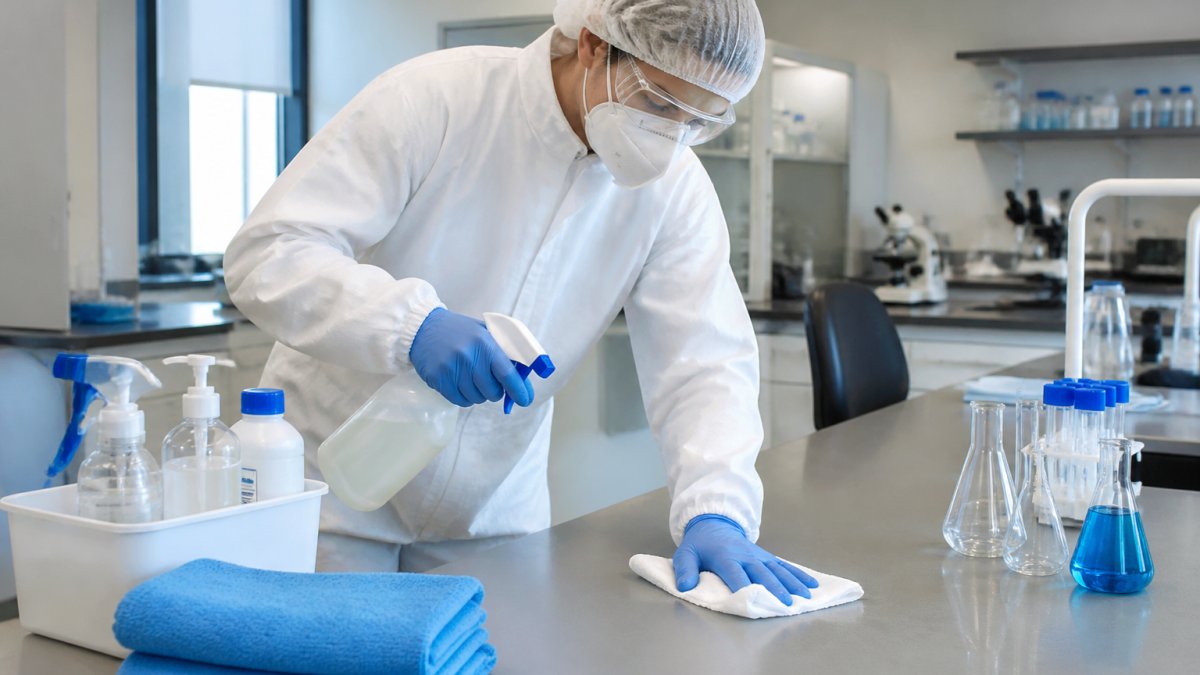
Effective laboratory cleaning follows a structured sequence designed to eliminate contamination while maintaining sterile environments.
Step 1: Pre-Cleaning Assessment and Preparation
Before any cleaning begins, assess the lab for active biohazards, chemical residues, or equipment that requires special handling. Remove or protect sensitive instruments.
Step 2: Surface Residue Removal
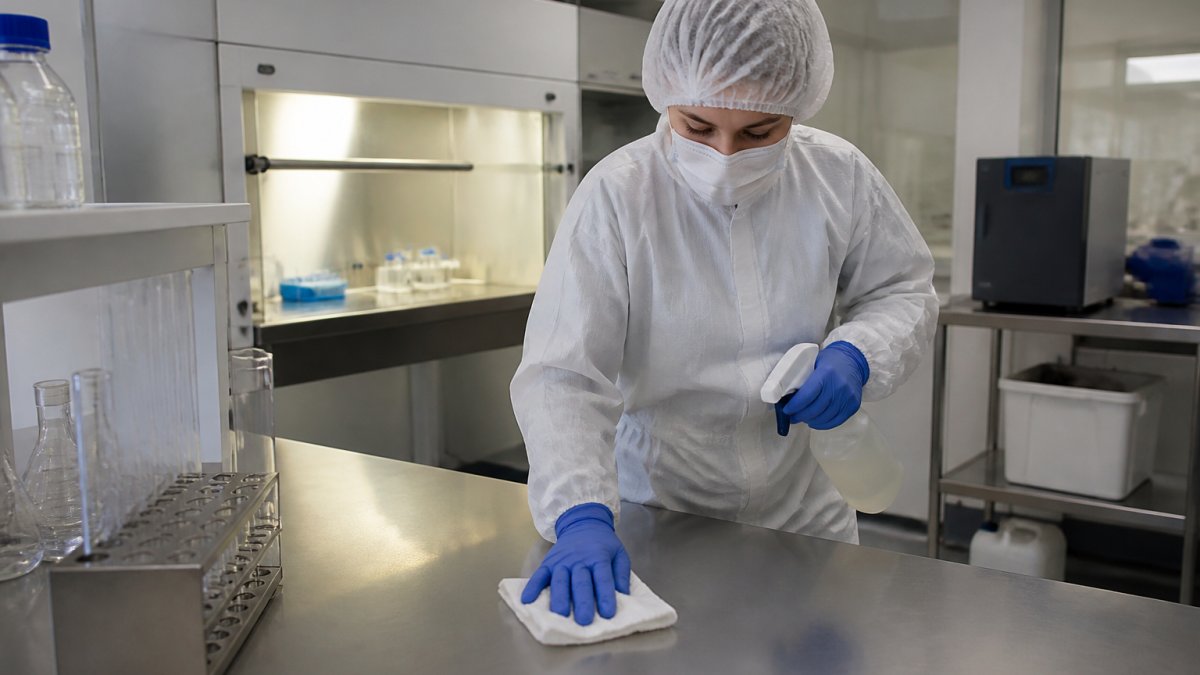
Begin by removing visible debris and surface residue using appropriate tools. This step is critical because disinfectants work more effectively on clean surfaces. Use disposable wipes or cloths to avoid transferring contamination between surfaces.
Step 3: Chemical Decontamination
Apply appropriate disinfectants based on the biohazards present. Different pathogens require different decontamination approaches. Bloodborne pathogens, for example, require different disinfectants than environmental bacteria.
Step 4: Aseptic Technique Application
Maintain aseptic technique throughout the cleaning process. This means preventing new contamination from being introduced while removing existing contamination.
Step 5: Validation and Documentation
After cleaning, validate that the process was effective. This may include microbial monitoring to confirm that pathogen mitigation was successful.
Contamination Control and Cleanroom Standards
Cleanroom protocols establish the environmental standards your facility must maintain. Contamination control goes beyond surface cleaning, it includes air quality, particulate matter management, and HEPA filtration systems that remove airborne contaminants.
A cleanroom is classified by the maximum number of particles allowed per cubic meter of air. ISO 14644 standards define these classifications. Biotech labs typically operate at ISO 7 or ISO 8 classifications, meaning strict limits on dust, microorganisms, and other particulate matter. Maintaining these standards requires coordination between cleaning protocols and HVAC systems.
Your cleaning team must understand that certain cleaning activities generate particulate matter. Dry sweeping, for example, can actually increase contamination. Wet cleaning methods are preferred in cleanroom environments because they capture particles rather than dispersing them. Staff must follow specific procedures to avoid introducing contamination during the cleaning process itself.
Biohazard Handling and Chemical Decontamination
Biohazard remediation requires specialized training and procedures. Different biological agents require different decontamination approaches. Bloodborne pathogens, for instance, demand specific disinfectants and contact times. Environmental bacteria may respond to different chemical treatments. Viral contamination requires yet another approach.
Chemical decontamination involves selecting the right disinfectant for the specific hazard, applying it at the correct concentration, maintaining adequate contact time, and ensuring proper disposal of contaminated materials.
Your facility should maintain an inventory of approved disinfectants with documented efficacy against the specific pathogens you work with. Disinfectant efficacy testing confirms that your chosen products actually work against your target organisms.
Hazardous waste disposal follows EPA guidelines (the EPA). Contaminated materials, cleaning solutions, and other waste cannot simply enter the regular trash stream. They require proper containment, labeling, and disposal through approved hazardous waste handlers.
Laboratory Cleaning Frequency and Scheduling
Cleaning frequency depends on your specific research activities, regulatory requirements, and contamination risk levels. A facility working with high-risk pathogens requires more frequent cleaning than one conducting lower-risk research. Your customized cleaning plans must reflect these differences.
Many facilities establish daily cleaning schedules for high-traffic areas and high-contamination zones, with deeper cleaning occurring weekly or monthly. Some areas may require cleaning after every experiment or procedure.
Preventative maintenance plays a crucial role in maintaining facility hygiene. Regular cleaning prevents contamination buildup that becomes harder to remove over time. Scheduling cleaning during low-activity periods minimizes disruption to research operations.
Your scheduling should account for seasonal variations, equipment maintenance windows, and audit preparation periods. During audit preparation, you may need to increase cleaning frequency or perform specialized deep-cleaning to ensure audit readiness.
Laboratory Disinfection Best Practices and Equipment
Disinfectant selection is critical. Your facility should maintain a documented list of approved disinfectants with their specific uses, concentrations, and contact times. Different surfaces may require different disinfectants. Stainless steel equipment, for example, may require different products than plastic or glass surfaces.
Electrostatic disinfection technology offers 360-degree coverage that traditional spraying cannot achieve. This method applies disinfectant in a fine mist that wraps around surfaces, reaching areas that would be missed by manual application.
Equipment selection matters as much as disinfectant selection. Microfiber cloths capture more particles than traditional cotton cloths. HEPA-filtered vacuums prevent contamination from being redistributed into the air. Automated disinfection systems ensure consistent application and contact times.
Surface Residue Removal and Validation Documentation
Surface residue removal is the often-overlooked step that determines disinfectant efficacy. Organic matter, blood, tissue, chemical residues, can shield microorganisms from disinfectants. If you don't remove this residue first, your disinfection may fail even though you followed all the right steps.
Validation documentation proves that your cleaning and disinfection processes actually work. This includes environmental monitoring data showing microbial counts before and after cleaning, records of disinfectant application, and test results confirming pathogen mitigation. This documentation is what auditors examine first.
Your validation protocols should include regular microbial monitoring of surfaces and air quality. This data demonstrates that your contamination control is effective. When regulatory inspectors review your records, they're looking for evidence that your facility maintains the controlled environment required by law.
Laboratory Cleaning Checklist for Audit Readiness
Audit readiness requires systematic documentation and adherence to established protocols. Your cleaning checklist should be comprehensive and specific to your facility's layout and research activities.
| Task | Frequency | Documentation Required | Responsible Party |
|---|---|---|---|
| Daily surface disinfection | Daily | Cleaning log with date, time, disinfectant used | Cleaning staff |
| Environmental microbial monitoring | Weekly | Lab test results with microbial counts | Lab technician |
| HEPA filter inspection | Monthly | Filter condition report and replacement record | Facilities manager |
| Disinfectant efficacy validation | Quarterly | Test results confirming pathogen mitigation | Lab director |
| Staff training updates | Annually | Training attendance records and certifications | Compliance officer |
| Deep cleanroom cleaning | Bi-annually | Detailed cleaning report with validation results | Specialized cleaning team |
| Audit preparation review | Pre-audit | Comprehensive documentation package | Facility manager |
Audit readiness means having all records organized and accessible. Inspectors will request documentation spanning months or years. If your records are scattered across different systems or incomplete, you'll struggle during the audit process. Establish a centralized documentation system where all cleaning records, validation results, staff certifications, and compliance documentation are stored and easily retrievable.
Post-audit recovery and documentation is equally important. If an audit reveals deficiencies, your response demonstrates commitment to compliance. Document the corrective actions you've taken, provide evidence that problems have been resolved, and establish preventative measures to prevent recurrence.
Specialized Staff Training and Certification Requirements
Your cleaning staff must understand biotech-specific protocols. General janitorial training is insufficient.
OSHA requires training for anyone handling bloodborne pathogens or other biohazards. This training must cover exposure prevention, proper use of PPE, bloodborne pathogen transmission, and procedures for exposure incidents. Documentation of this training is mandatory for regulatory compliance.
Certification requirements vary by facility and research type. Some facilities require staff to pass competency assessments demonstrating understanding of lab-specific protocols. Others require ongoing education to maintain certifications.
Staff turnover can compromise compliance. New employees must complete required training before working in the facility. Rangel Janitorial maintains trained professional crews, ensuring that your facility always has qualified personnel performing specialized cleaning biotech labs and research facilities.
Quality Assurance, Microbial Monitoring, and Post-Audit Recovery
Quality assurance encompasses everything from staff performance to disinfectant efficacy to environmental conditions. Regular quality audits identify gaps before regulatory inspectors do.
Microbial monitoring provides objective evidence that your contamination control is working. Regular sampling of surfaces and air identifies contamination trends.
Post-audit recovery begins immediately after an audit concludes. If deficiencies were noted, develop and document corrective action plans.
Sustainability in lab cleaning is increasingly important. Using environmentally responsible disinfectants and disposal methods reduces environmental impact while maintaining regulatory compliance.
Your facility's cleaning protocols directly impact research integrity. Contamination affects data quality. Cross-contamination invalidates results.
Rangel Janitorial brings 30+ years of experience managing facility hygiene for complex environments.
Maintaining regulatory compliance in biotech facilities requires more than routine cleaning, it demands specialized expertise, rigorous documentation, and commitment to contamination control.
Frequently Asked Questions
What are the key steps in specialized cleaning for biotech labs?
Specialized cleaning for biotech labs follows a structured protocol: preparation (removing loose materials), pre-cleaning with appropriate detergents, application of EPA-registered disinfectants with validated contact times, surface residue removal, microbial monitoring, and documentation for audit readiness. Each step targets specific contamination risks and regulatory compliance requirements. The sequence prevents cross-contamination and ensures pathogen mitigation across all work surfaces and equipment.
How often should a research laboratory be cleaned?
Research laboratory cleaning frequency depends on facility classification, work type, and regulatory requirements. High-containment areas typically require daily cleaning, while standard research spaces may need 2-3 times weekly. Cleanroom protocols demand more frequent sanitization cycles. GLP and GMP standards dictate specific frequencies based on hazard level and environmental monitoring results. A professional cleaning provider develops customized schedules aligned with your research integrity needs and regulatory oversight obligations.
What should a laboratory cleaning checklist include?
An effective laboratory cleaning checklist covers: equipment and surface disinfection, PPE disposal protocols, hazardous waste handling, HEPA filtration system checks, high-touch areas, biohazard remediation steps, chemical decontamination procedures, documentation requirements, and validation of disinfectant efficacy. The checklist must align with your facility's standard operating procedures, GMP or GLP requirements, and audit readiness standards. Include frequency notations, responsible staff, and sign-off verification to maintain regulatory compliance and demonstrate preventative maintenance.
What disinfectants are best for biotech laboratory cleaning?
The best laboratory disinfection choices depend on your specific biohazard types and surface materials. EPA-registered hospital-grade disinfectants are standard for most biotech work. Quaternary ammonium compounds work well on non-porous surfaces, while phenolic solutions handle tougher pathogens. Alcohol-based disinfectants suit electronics and sensitive equipment. Your cleaning provider should validate disinfectant efficacy against your specific organisms and follow contact time requirements precisely. Always verify compatibility with lab surfaces to prevent corrosion or residue buildup that compromises research integrity.
How does electrostatic disinfection benefit biotech facility cleaning?
Electrostatic disinfection delivers 360-degree coverage to surfaces, equipment crevices, and hard-to-reach areas that standard spraying misses. This technology ensures consistent pathogen mitigation and controlled environment integrity across your entire facility. It reduces chemical residue and contact time variability, supporting audit readiness and compliance documentation. For biotech labs, electrostatic application provides validated coverage for contamination control while maintaining aseptic technique standards and minimizing disruption to sensitive research environments.
What certifications should biotech lab cleaning staff have?
Professional cleaning staff in biotech facilities should hold certifications in biohazard remediation, bloodborne pathogen handling, and hazardous waste disposal. Many facilities require OSHA 10-hour or 30-hour cards, infection control training, and aseptic technique verification. Staff must understand GLP and GMP standards, microbial monitoring protocols, and proper PPE use. Your cleaning provider should maintain current certifications and provide ongoing training to ensure staff competency with your specific equipment, disinfectants, and standard operating procedures.
How do you prepare for a biotech facility audit?
Audit readiness requires comprehensive documentation: cleaning logs with dates, times, staff names, and products used; validation records for disinfectant efficacy; microbial monitoring results; staff training certificates; and photographic evidence of cleaned areas. Maintain a current laboratory cleaning checklist with sign-offs, environmental monitoring data, and any corrective actions taken. Your cleaning provider should support post-audit recovery by identifying gaps, updating standard operating procedures, and ensuring all documentation aligns with regulatory oversight requirements and your facility's compliance obligations.