 Ultimate guide
Preventing Employee Illness With Cleaning: 2026 Guide
Table of Contents
- The Link Between Cleanliness and Reduced Absenteeism
- High-Touch Surface Disinfection Checklist
- Electrostatic Disinfection for Small Businesses Guide
- OSHA Workplace Sanitation Standards
- Preventing Employee Illness With Cleaning: A Step-by-Step Routine
- Preventing Employee Illness With Cleaning in High-Traffic Facilities
- Frequently Asked Questions
Last Updated: September 10, 2026
The Link Between Cleanliness and Reduced Absenteeism
Preventing employee illness with cleaning starts with understanding that absenteeism is rarely random. When shared surfaces carry pathogens, a single sick employee can seed an entire floor. This guide from Rangel Janitorial breaks down the practical steps facility managers can take to cut sick days through better hygiene protocols.
The logic is straightforward: fewer pathogens on surfaces means fewer germ transmission events, which means less sick leave. A common approach is to prioritize high-touch surfaces over visible dirt, because a desk that looks clean can still harbor viral particles and bacteria. Many workplaces find that shifting cleaning frequency toward shared equipment delivers more sick leave reduction than a deeper clean of low-contact areas.
The psychological effect matters too. Teams working in visibly maintained spaces report higher confidence in their workplace, and that confidence supports workplace wellness and employee productivity. Cleaning is not just a facilities task; it is an occupational health investment.
High-Touch Surface Disinfection Checklist
High-touch surface disinfection is the practice of cleaning the specific objects people contact most often, multiple times per day, to interrupt cross-contamination. Standard nightly cleaning misses these surfaces entirely because they get recontaminated within hours.
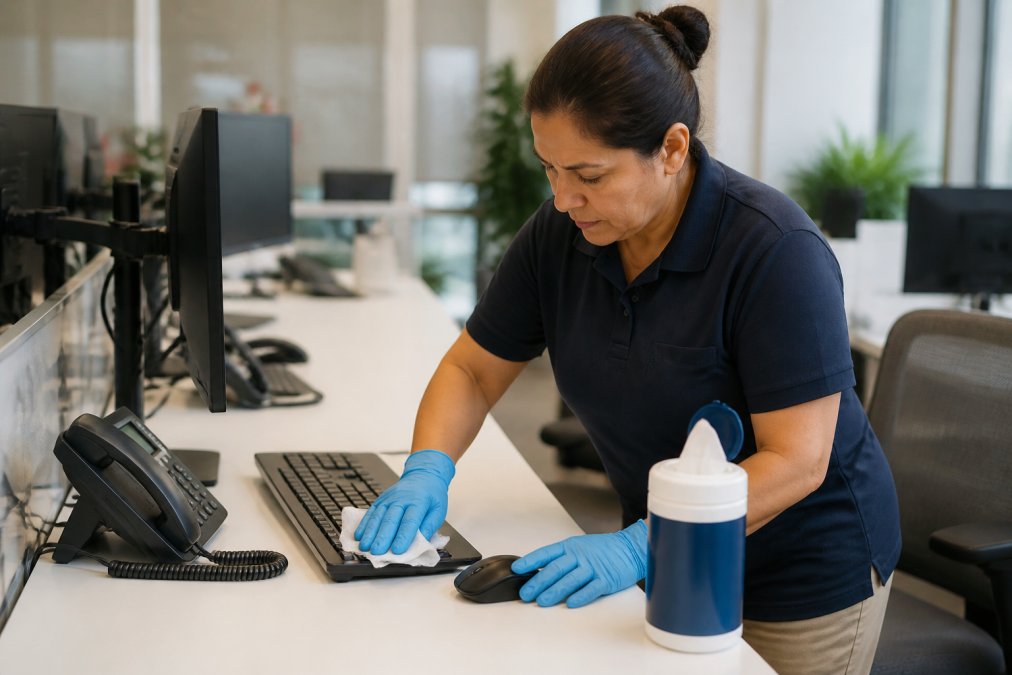
Use this checklist for daily surface decontamination:
- Door handles, push plates, and elevator buttons
- Shared keyboards, mice, and touchscreens
- Break room counters, faucets, and coffee stations
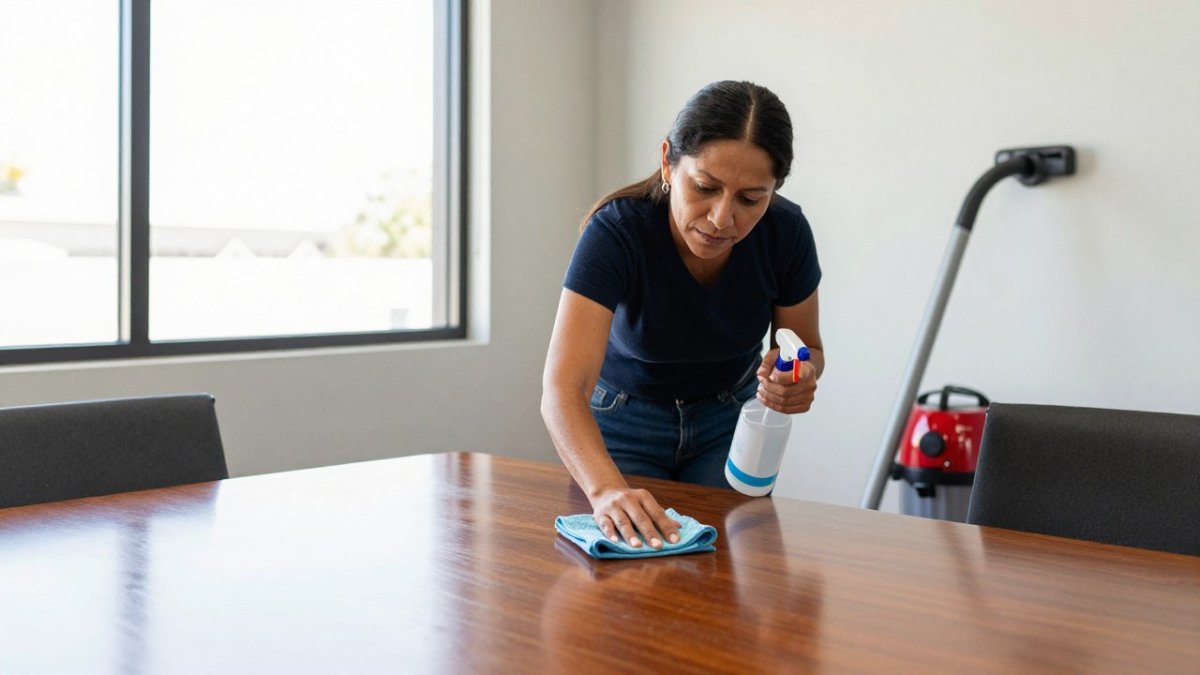
- Conference room tables and chair armrests
- Shared printers, copiers, and badge readers
- Restroom fixtures, dispensers, and light switches
The order matters. Clean first to remove soil, then disinfect to reduce microbial load. Skipping the cleaning step leaves residue that can blunt your cleaning agents.
Electrostatic Disinfection for Small Businesses Guide
Electrostatic disinfection for small businesses is a spray-based method that applies disinfectant with an electrical charge, so the solution wraps around surfaces rather than only coating what it hits directly. That 360-degree coverage reaches the undersides of desks, chair backs, and equipment edges that a cloth never touches.
For teams without a dedicated cleaning staff, this matters because it shortens the time required to treat a whole room. Instead of wiping every surface by hand, one trained operator can cover a floor in a fraction of the time. Rangel Janitorial uses specialized electrostatic disinfection for exactly this reason: it delivers consistent coverage across offices, medical suites, and mixed-use facilities.
It is not a replacement for routine cleaning. Electrostatic application works best after surfaces are free of heavy soil. Think of it as the finishing layer, not the whole protocol.
OSHA Workplace Sanitation Standards
OSHA workplace sanitation standards live in 29 CFR 1910.141, the agency's general industry sanitation rule (osha.gov). The OSHA sanitation requirements for workplaces set a floor, not a ceiling: potable drinking water, clean and sanitary toilet and washing facilities, waste disposal, and a workplace kept "clean, orderly, and sanitary." For facility managers, the practical question is what that floor actually requires you to do, document, and train.
Here is how the rule maps to a cleaning program:
- Potable water. Drinking water must be potable and dispensed with single-use cups or a sanitary fountain. Shared cups and open containers are non-compliant.
- Washing facilities. Hand-washing stations need hot and cold running water, soap, and single-use towels or air dryers. In food-handling and medical-adjacent spaces, this is non-negotiable.
- Toilet facilities. They must be kept clean, in working order, and stocked. A restroom that runs out of soap mid-shift is a sanitation failure, not a supply-closet problem.
- Waste disposal. Garbage must be stored in covered, leak-proof containers and removed often enough to prevent nuisance and pest attraction.
- Vermin control. The employer must maintain a program to keep the workplace free of rodents, insects, and other vermin.
Where many facilities quietly fall short is chemical handling. Every cleaning agent on site needs a safety data sheet (SDS) accessible to workers during their shift, and every container must be labeled, including secondary spray bottles. Dilution ratios matter: overconcentrated disinfectant wastes product, leaves residue that re-soils surfaces faster, and can irritate skin and airways. Train staff on the manufacturer's dwell time, because a disinfectant wiped off after ten seconds does not achieve the kill claim on the label.
Documentation is the part most programs skip. Keep a cleaning log with date, area, product used, and initials. If an illness cluster or an inspection ever surfaces, that log is your evidence that the sanitation program is real and not aspirational. Pair it with a written exposure control plan if any employee handles blood or other potentially infectious materials, since that triggers a separate OSHA requirement under 29 CFR 1910.1030.
Preventing Employee Illness With Cleaning: A Step-by-Step Routine
Preventing employee illness with cleaning works best as a repeatable daily routine rather than an occasional deep clean. Build the following into your schedule, and adjust frequency based on how many people share each space.
- Empty and reline waste bins. Remove food waste before it attracts pests or grows bacteria.
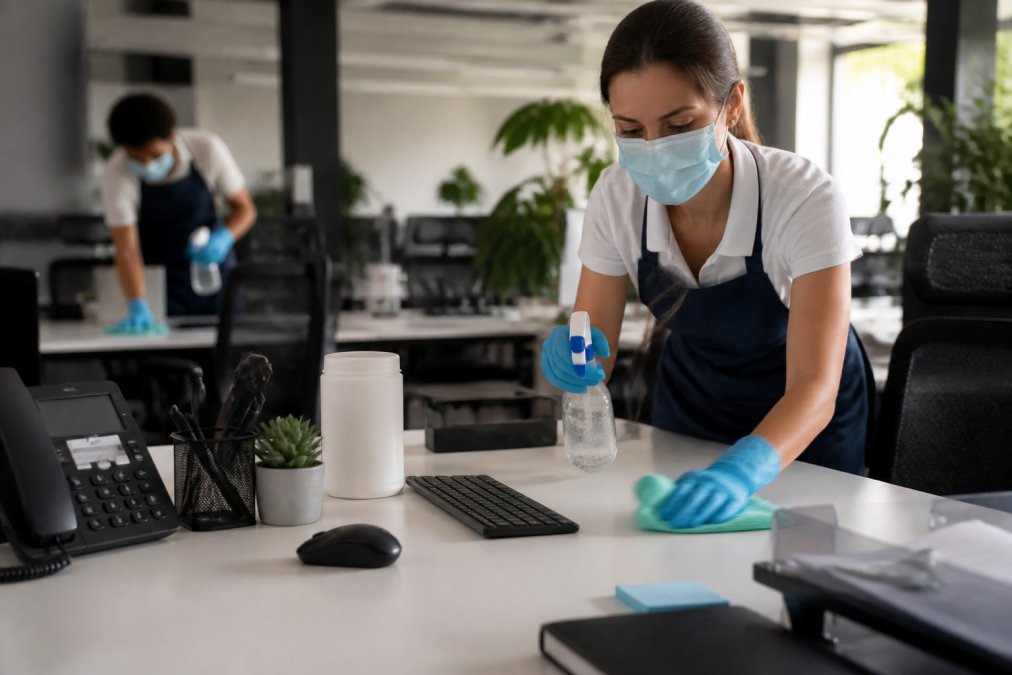
- Clean high-touch surfaces. Wipe then disinfect in that order, using fresh cloths per zone to avoid cross-contamination.
- Treat restrooms with dedicated tools. Color-code cloths and mops so restroom equipment never touches break room surfaces.
- Apply electrostatic disinfection to shared areas. Cover conference rooms, lobbies, and equipment rooms after cleaning.
- Check indoor air quality. Replace HVAC filters on schedule and keep vents clear to support respiratory health and allergen control.
- Log the work. Record what was cleaned and when, so you can spot patterns if illness clusters appear.
A common mistake is treating all areas as equal. A private office used by one person needs less frequent disinfection than a shared break room used by fifty.
Preventing Employee Illness With Cleaning in High-Traffic Facilities
High-traffic facilities need cleaning frequency that matches footfall, not a fixed calendar. Gyms, industrial parks, and multi-tenant buildings concentrate people and equipment in ways that accelerate viral spread and bacterial growth. But the harder question for a facility manager is not how often to clean, it is whether the spend pays for itself. That is where most cleaning programs go unmeasured.
Start with the cost of the problem. A single unplanned sick day carries a loaded cost well beyond the hourly wage: coverage, overtime, lost output, and the downstream risk of one infection seeding a team. Most practitioners find that when they add up coverage labor and lost productivity, the true cost of an absence runs several times the employee's daily wage. Multiply that by your average annual sick days per employee and you have a rough annual exposure figure, before you count the morale hit when a team is chronically short-staffed.
Now compare that to cleaning spend. A simple framework:
- Estimate annual absence cost. (Average loaded daily cost of an employee) × (average sick days per employee) × (headcount).
- Estimate current cleaning spend. Contract cost plus in-house labor plus product.
- Estimate the reduction. If a targeted high-touch program cuts sick days by even a modest fraction, the savings often exceed the incremental cleaning cost, but only if the program is actually targeted.
- Track the delta. Compare sick-day rates before and after a protocol change, by department if possible.
That fourth step is the one almost nobody does. Without a before-and-after number, cleaning is a cost center; with one, it is an investment with a return.
In high-traffic settings, preventative maintenance and infection control go together. Locker rooms, shared equipment, and common areas should be sanitized on a rotating schedule throughout the day, not only after hours. CDC guidance on cleaning to prevent disease spread recommends prioritizing frequently touched surfaces and cleaning them more often when illness is circulating. In a gym, that means equipment wipe-downs between users and a deeper disinfection on a fixed rotation. In a multi-tenant building, it means lobby touchpoints, elevator banks, and shared restrooms get the highest frequency, while private suites get less.
Managing multiple properties adds another layer. Different layouts need different plans, and consistency across buildings is what keeps standards from slipping. This is where a partner with commercial cleaning standards and a track record across varied facilities helps. Rangel Janitorial has served over 500 businesses with tailored plans for offices, medical facilities, and industrial sites.
| Facility Type | Priority Area | Cleaning Frequency | Key Method |
|---|---|---|---|
| Corporate office | Shared desks, break rooms | 2-3x daily | Wipe and disinfect |
| Medical/dental | Exam rooms, waiting areas | Between patients | Electrostatic disinfection |
| Gym/fitness | Equipment, locker rooms | Hourly rotation | Sanitization plus disinfection |
| Industrial park | Break rooms, touchpoints | 2x daily | High-touch protocol |
The table above is a starting point, not a fixed rule. Match frequency to actual occupancy, adjust when illness rates rise, and revisit the ROI math each quarter so the program stays funded on evidence rather than habit.
Frequently Asked Questions
How does professional cleaning reduce employee absenteeism?
Professional cleaning reduces the microbial load on high-touch surfaces like door handles, keyboards, and elevator buttons, which are common points of germ transmission. When these surfaces are disinfected regularly, fewer pathogens transfer between employees, lowering the rate of colds, flu, and other infections. That directly cuts sick leave and keeps teams at full strength. A consistent commercial cleaning schedule also addresses shared equipment and break areas where cross-contamination spreads fastest.
What are the CDC guidelines for disinfecting high-touch surfaces in offices?
The CDC recommends cleaning high-touch surfaces at least once daily, and more often when someone is sick. Use an EPA-registered disinfectant that matches the pathogens you are targeting, and follow the label's contact time, the wet duration needed to kill germs. For offices, that means door handles, light switches, shared keyboards, printers, and break room counters. A high-touch surface disinfection checklist helps crews hit every point consistently rather than relying on memory.
How can electrostatic disinfection improve workplace health?
Electrostatic disinfection uses a charged mist that wraps around surfaces and hard-to-reach areas, giving 360-degree coverage that manual wiping can miss. It reaches the undersides of desks, chair crevices, and equipment backs where pathogens collect. For workplaces with shared equipment or high traffic, this method cuts the time needed for thorough disinfection while improving consistency. It is especially useful in medical offices, gyms, and multi-tenant buildings where hygiene expectations are high.
What is the difference between cleaning, sanitizing, and disinfecting?
Cleaning removes dirt, dust, and organic matter from surfaces. Sanitizing lowers the number of bacteria to a safe level set by public health standards. Disinfecting kills or inactivates most pathogens on a surface after cleaning. All three matter: disinfectant cannot penetrate a layer of grime, so cleaning must come first. In an office setting, routine cleaning handles visible soil, while targeted disinfection addresses high-touch surfaces and shared equipment where germ transmission is most likely.