 Ultimate guide
Janitorial Service Quality Control Strategies That Work
Table of Contents
- What Janitorial Quality Control Actually Means for Your Building
- Building a Janitorial Quality Assurance Checklist That Gets Results
- How Commercial Cleaning Inspection Software Keeps Standards Consistent
- Janitorial Staff Training Best Practices That Stick
- Using Data to Track Performance Metrics and Client Satisfaction
- Electrostatic Disinfection for Small Businesses Guide
- Handling Service Gaps and Client Disputes
- Conclusion
- Frequently Asked Questions
Last Updated: September 5, 2026
Facility managers often discover that the real challenge with janitorial service quality control strategies isn’t finding a crew, it’s verifying the work actually meets your standards day after day. A clean building on inspection day is easy; a consistently clean building requires a deliberate system. At Rangel Janitorial, we’ve spent over 30 years refining these systems for corporate offices, medical facilities, and industrial parks across California, and we’ve learned that consistency comes from process, not promises.
Quality control in this industry is a management discipline, not a cleaning task. Janitorial service quality control strategies are the documented processes, checklists, and feedback loops that ensure cleaning standards are met consistently across every shift, every site, and every service visit.
What Janitorial Quality Control Actually Means for Your Building
Janitorial quality control is the systematic process of verifying that cleaning services meet agreed-upon standards through regular inspections, documented performance metrics, and clear accountability at every level of the service team.
For a Class A office building or a medical practice, this distinction matters. A general wipe-down of surfaces is not the same as a documented disinfection protocol. Quality control ensures the right tasks happen at the right frequency and that any gaps are caught and corrected quickly rather than compounding over weeks.

The core elements include defined cleaning standards, inspection schedules, staff training, and a communication loop for corrective action. Without all four, you are relying on hope rather than management.
Building a Janitorial Quality Assurance Checklist That Gets Results
A janitorial quality assurance checklist is only as good as the detail behind each line item. Generic checklists that say “clean restrooms” leave too much room for interpretation. High-performing checklists specify the task, the frequency, the expected outcome, and who verifies the work.
Start by dividing your facility into zones: restrooms, break rooms, entrances, conference rooms, and high-touch surfaces. For each zone, list the specific tasks and their frequency. A restroom checklist, for instance, should include restocking supplies, disinfecting high-touch points like faucets and door handles, and verifying floor cleanliness.
Frequency matters as much as detail. Daily checklists catch routine issues, while weekly and monthly deep-dive inspections evaluate areas that accumulate grime slowly, like baseboards, air vents, and under furniture.
How Commercial Cleaning Inspection Software Keeps Standards Consistent
Commercial cleaning inspection software has evolved from simple digital checklists into the central nervous system of modern quality control. While the table below outlines the baseline features every credible platform should offer, the real competitive advantage in 2026 comes from how this software integrates with the physical building itself.
| Software Feature | What It Does | Why It Matters |
|---|---|---|
| Custom checklists | Tailors inspection criteria per site | Ensures relevant tasks are verified |
| Photo evidence | Documents issues at time of inspection | Provides proof and clarity for corrective action |
| Geofencing | Confirms crew arrival and departure | Validates service delivery and hours |
| Automated reporting | Sends inspection results to stakeholders | Keeps clients informed without manual follow-up |
The Shift from Manual Checks to Sensor-Based Verification
Most top-ranking guides stop at digitizing the manual checklist. That approach still relies on a human being physically walking the space and making a subjective judgment. The most forward-thinking facility managers are now layering IoT and sensor-based cleaning data on top of their inspection software to close the gap between what is reported and what is actually happening.
Consider the following mechanisms now available in commercial buildings:
- Occupancy sensors in restrooms and conference rooms can trigger a cleaning work order the moment a space is vacated, shifting quality control from a fixed schedule to a demand-driven model.
- Touchless dispenser telemetry from soap, paper towel, and sanitizer dispensers transmits real-time low-supply alerts, preventing the most common restroom complaint, empty dispensers, before a human inspector arrives.
- Air quality monitors measuring particulate matter (PM2.5) or volatile organic compounds (VOCs) can flag areas needing more intensive cleaning or ventilation adjustments, providing an objective cleanliness metric that visual inspection cannot capture.
Building a Data Feedback Loop That Drives Action
The software's value is not in the data it collects but in the speed at which that data becomes a corrective action. A robust system should automatically generate a work order when an inspection score falls below a set threshold or when a sensor sends an alert, closing the loop instantly.
For multi-site property managers, this integration creates a powerful comparative dataset. You can benchmark performance across buildings, identify which sites have recurring issues with specific tasks, and isolate whether the root cause is a training gap, a scheduling problem, or a faulty piece of equipment.
Evaluating Your Provider's Technology Stack
When assessing a janitorial provider, ask pointed questions about their software's integration capabilities. Do they have API access to your building's existing IoT infrastructure? Can their system receive alerts from your smart dispensers, or do they require their own proprietary hardware?
Most practitioners find that the ideal setup is not a single monolithic platform but a middleware layer that aggregates data from cleaning inspection software, building management systems, and work order platforms.
Ultimately, the goal is to move from reactive verification to predictive management. By integrating sensor data with your inspection software, you can anticipate issues before they become visible problems.
Janitorial Staff Training Best Practices That Stick
Training is where janitorial service quality control strategies succeed or fail. The most detailed checklist means nothing if staff do not know how to execute the task or why the standard matters.
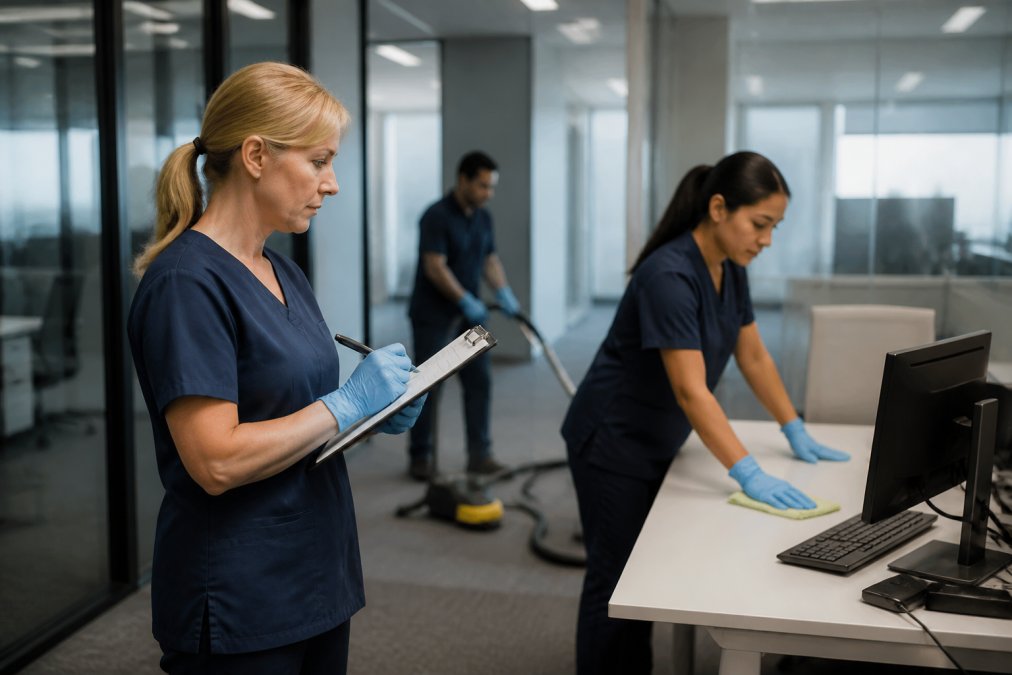
A common mistake is treating training as a one-time event. High-performing programs include initial onboarding, periodic refresher sessions, and cross-training so staff can cover multiple zones. Training should cover not just how to clean, but how to inspect their own work before a supervisor arrives.
For specialized services like medical facility hygiene or electrostatic disinfection, training must include equipment handling and safety protocols. Staff need to understand why dwell time matters for disinfectants and how to achieve 360-degree coverage with electrostatic equipment (the EPA).
Using Data to Track Performance Metrics and Client Satisfaction
Performance metrics are the language of accountability in janitorial services. Without them, quality control is just an opinion. But the most common failure in this area is tracking the wrong numbers or collecting data without a clear decision-making framework.
A Tiered Metrics Framework for Actionable Insights
Rather than drowning in a sea of dashboards, leading facility managers structure their metrics into three tiers.
Tier 1: Operational Execution Metrics (Daily/Weekly) These are the leading indicators of quality. They measure whether the work was performed as scheduled.
- Task Completion Rate: Percentage of scheduled tasks marked complete within the designated shift.
- Inspection Score: Average score across all zones, typically on a 0-100 scale, derived from your digital checklist.
- First-Pass Yield: Percentage of inspections that pass without any corrective action needed. This is a powerful measure of crew effectiveness.
Tier 2: Outcome Metrics (Monthly) These measure the results of the cleaning program on the facility itself.
- Open Issue Aging: The average time an unresolved issue remains in the work order system. A healthy target is under 24 hours for non-critical items (ifma.org).
- Repeat Issue Rate: Percentage of issues that recur in the same zone within 30 days of being marked resolved. A high rate here signals a root-cause failure, not a one-off miss.
- Client Satisfaction Score (CSAT): A simple post-service survey (e.g., 1-5 scale) sent to the facility manager or office manager after key service visits.
Tier 3: Strategic Relationship Metrics (Quarterly/Annual) These assess the long-term health of the partnership.
- Net Promoter Score (NPS): A measure of how likely the client is to recommend your provider. This is a strong predictor of contract renewal.
- Contract Compliance Rate: Percentage of contractual obligations (e.g., specific frequencies, supply restocking levels) met without exception.
The Service Recovery Playbook: Using Data When Quality Fails
Even with perfect metrics, service gaps will occur. The differentiator is not prevention but recovery. A robust quality control strategy must include a documented, data-driven response protocol.
When a client files a formal complaint, follow this five-step recovery sequence:
- Acknowledge and Log Immediately: Within one business hour, acknowledge the complaint in writing and log it in the work order system with a unique ticket number.
- Deploy Corrective Action: Dispatch a supervisor or dedicated crew to the site within 24 hours (or sooner for health or safety issues) to rectify the specific problem.
- Conduct a Root-Cause Analysis (RCA): Within 48 hours, use your data to identify why the failure occurred. Was it a training gap (checklist scores low in that zone)? A scheduling error (geofencing shows late arrival)? Or a standards issue (the checklist itself was ambiguous)?
- Present a Preventive Action Plan: Share the RCA findings with the client and outline the specific process change you are implementing to prevent recurrence. This could be a retraining module, a revised checklist, or a new scheduling protocol.
- Follow Up and Verify: One week after the corrective action, conduct an unscheduled inspection of the affected area and share the results with the client.
Formalizing the Feedback Loop
Client satisfaction should be measured formally, not assumed. A quarterly business review (QBR) is the standard mechanism for this. In the QBR, review the Tier 1 and Tier 2 metrics side-by-side with the client, showing trend lines, not just the current snapshot.
This data-driven approach to service recovery transforms disputes from adversarial conflicts into collaborative problem-solving sessions. By presenting objective data, you move the conversation away from subjective complaints and toward verifiable facts.
Electrostatic Disinfection for Small Businesses Guide
Electrostatic disinfection is a cleaning method that applies a charged spray to surfaces, allowing the disinfectant to wrap around and coat all sides of an object for 360-degree coverage (the CDC). This makes it significantly more effective than traditional spray-and-wipe methods for high-touch areas.
For small businesses, the question is whether to invest in the equipment or hire a provider that offers the service. The equipment requires training and maintenance, and the disinfectant solutions must be applied correctly to meet dwell time requirements. For most small businesses, partnering with a provider is more practical than building that capability in-house.
This method is particularly valuable for high-traffic locker rooms and fitness equipment, where standard cleaning can miss the undersides of benches or the crevices of machines. Electrostatic disinfection complements, rather than replaces, routine cleaning.
Handling Service Gaps and Client Disputes
Service gaps happen even with strong systems. The difference between a good provider and a poor one is how quickly and transparently the gap is resolved. A clear escalation protocol should exist before problems occur.
When a client reports a missed area or equipment damage, the response should follow a documented path. First, acknowledge the issue and log it in the work order system. Second, dispatch a supervisor or crew to correct the issue within an agreed timeframe. Third, investigate the root cause to prevent the same issue from recurring.
Effective communication prevents most disputes from escalating. Regular reporting that shows completed tasks, inspection scores, and any open issues keeps the client informed and reduces surprises.
Conclusion
Consistent janitorial quality is not an accident. It requires defined cleaning standards, detailed checklists, staff training, inspection software, and a transparent feedback loop that turns data into corrective action.
At Rangel Janitorial, we back this framework with 30 years of experience, fully bonded and insured professional crews, and a satisfaction guarantee on every service. Our trained teams use tailored cleaning plans and real-time facility upkeep to keep your building spotless, and our specialized electrostatic disinfection delivers the 360-degree coverage that medical and high-traffic facilities demand. Get a free quote today and see how consistent quality feels when it is managed, not promised.
Frequently Asked Questions
What is the difference between quality assurance and quality control in janitorial services?
Quality assurance is proactive: it covers the systems, training, and checklists that prevent cleaning problems before they happen. Quality control is reactive: it involves inspecting completed work to catch issues. A strong janitorial quality control plan uses both. Your provider should document their standards upfront (QA) and then verify work through regular site inspections (QC).
How do you measure cleaning performance in commercial facilities?
Use objective performance metrics tied to your janitorial quality assurance checklist. Score each zone on visible cleanliness, disinfection coverage, and supply levels. Track inspection scores over time, response time to reported issues, and client satisfaction survey results. Commercial cleaning inspection software can automate this tracking and provide data-driven insights.
Can electrostatic disinfection replace daily cleaning?
No. Electrostatic disinfection is a supplement to, not a replacement for, routine cleaning. It is highly effective for covering high-touch surfaces and hard-to-reach areas with disinfectant, but surfaces must be cleaned of visible dirt first. For small businesses, adding this service monthly or after illness outbreaks provides an extra layer of protection.
What should a janitorial quality assurance checklist include?
A solid checklist covers the specific zones in your facility: restrooms, break rooms, entrances, and workspaces. For each zone, list tasks like trash removal, surface disinfection, and floor care. Include a scoring system (pass/fail or 1-5) and space for photo evidence. Review and update the checklist at least quarterly to reflect changing needs.