 Listicle
Top 5 Electrostatic Disinfection Services for Medical Offices
Table of Contents
- Quick Comparison Table
- How We Evaluated These Services
- 1. Rangel Janitorial: 360-Degree Coverage for Multi-Site Facilities
- 2. Office Pride: Fast Application with Minimal Downtime
- 3. The Budd Group: Efficiency for Large Medical Complexes
- 4. Corvus Janitorial: Integrated Health-Focused Maintenance
- 5. ABS Commercial: Professional-Grade Equipment for Safer Workplaces
- Benefits of Electrostatic Spraying in Healthcare Settings
- Frequently Asked Questions
Last Updated: September 26, 2026
Quick Comparison Table
| Service Provider | Best For | Key Strength | Coverage Type |
|---|---|---|---|
| Rangel Janitorial | Multi-site medical facilities | 360-degree coverage, 30+ years experience | Comprehensive disinfection |
| Office Pride | Small to medium medical offices | Fast application, minimal downtime | Even surface distribution |
| The Budd Group | Large medical complexes | Cost efficiency, labor reduction | Advanced spray technology |
| Corvus Janitorial | Integrated health maintenance | High-touch surface focus | Customized protocols |
| ABS Commercial | Health-centric workplaces | Professional-grade equipment | Facility-wide disinfection |
How We Evaluated These Services
When choosing electrostatic disinfection services for your medical office, you must decide: hire a professional service or purchase equipment and train staff in-house? This article focuses on professional services, which most medical practices choose after weighing the equipment-versus-service trade-off.
Service vs. Equipment: The Hidden Cost Analysis
Commercial-grade electrostatic sprayers cost $1,500-$8,000, but the true cost of in-house disinfection includes factors many practice managers underestimate:
-
Staff Training and Certification: Training costs $500-$2,000 per employee and requires ongoing refresher courses. Staff turnover means retraining replacements.
-
Chemical Storage and Handling: EPA-registered disinfectants require compliant storage and disposal following EPA and state regulations, adding cost and liability.
-
Equipment Maintenance and Downtime: Regular maintenance and equipment failure risk patient care disruption. Service providers maintain backup equipment; you do not.
-
Liability and Compliance Documentation: Liability for incorrect disinfection falls on your practice. Professional services carry liability insurance and maintain compliance documentation.
-
Occupational Safety: Staff must wear PPE and follow OSHA protocols, adding labor time and occupational health oversight.
Why Medical Practices Typically Choose Professional Services
Most medical offices outsource electrostatic disinfection services because in-house equipment costs exceed professional service costs within 18-24 months. More importantly, professional services eliminate compliance risk by assuming responsibility for regulatory adherence and efficacy verification.
We evaluated providers on: healthcare experience and infection control expertise; comprehensive coverage capabilities; compliance documentation (disinfection logs, ATP results, certificates); commercial-grade equipment quality; scalability across single or multi-site operations; and scheduling flexibility around patient care.
Each service brings different strengths: speed, customized multi-site solutions, or compliance documentation. Choose based on your facility's needs and priorities.
1. Rangel Janitorial: 360-Degree Coverage for Multi-Site Facilities
Rangel Janitorial delivers consistent, comprehensive disinfection across multiple locations. With 30+ years of experience and fully bonded and insured crews, they understand healthcare infection control demands.
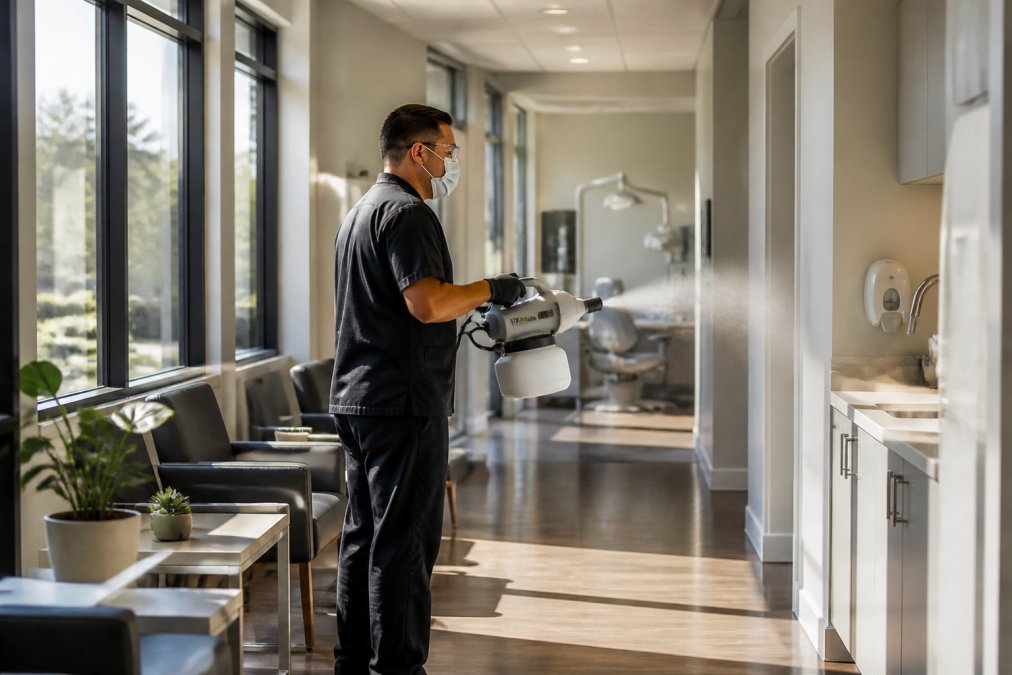
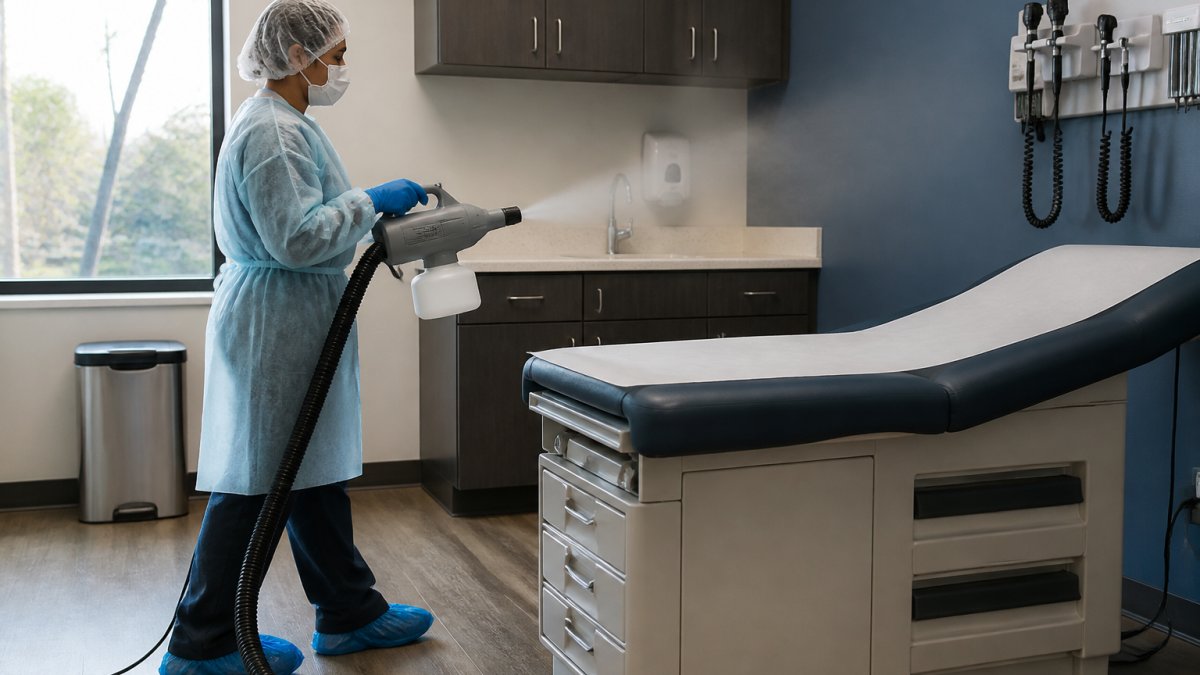
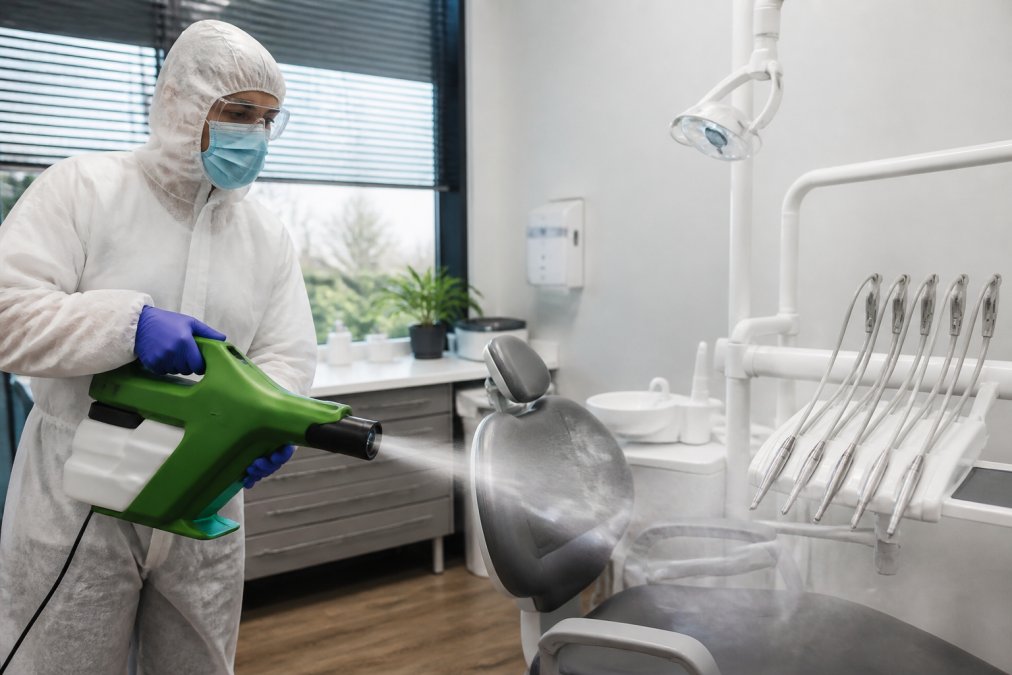
Their electrostatic disinfection offers 360-degree coverage, with positively charged particles clinging to surfaces throughout the room, corners, under furniture, and around medical equipment, ensuring even distribution that manual cleaning misses.
They assess facility layout, traffic patterns, and high-touch areas to design a customized disinfection schedule. For multi-office practices, this consistency across properties is invaluable.
Their satisfaction guarantee reflects confidence in their work. If you're managing a medical practice concerned about compliance and patient safety, this combination of experience, specialized equipment, and accountability makes them the strongest choice for comprehensive protection.
2. Office Pride: Fast Application with Minimal Downtime
Some services complete electrostatic disinfection quickly, allowing your facility to return to normal operations faster than traditional fogging, critical for small to medium-sized offices with tight patient schedules.
Some electrostatic sprayers create an aerosolized mist that reaches high-touch areas consistently, especially valuable in waiting rooms, examination areas, and reception desks.
Some crews are professional and bonded, which meets the baseline requirements for medical facility work. They understand that in healthcare settings, timing is everything. A cleaning service that respects your schedule and completes work efficiently without cutting corners builds trust quickly.
Pricing for some services varies based on facility square footage, so you'll need a custom quote. For practices under 5,000 square feet, speed advantage often justifies the cost. Larger facilities might find more economical options elsewhere.
3. The Budd Group: Efficiency for Large Medical Complexes
Some services specialize in advanced electrostatic spray technology designed specifically for rapid disinfection of large spaces. If you operate a multi-doctor practice, dental complex, or medical facility with significant square footage, their efficiency advantage becomes meaningful.
Some technologies reduce labor time compared to traditional fogging, which translates to lower operational costs for high-volume facilities. Advanced spray devices deliver consistent coverage across expansive clinical environments, making them ideal for healthcare facilities with multiple treatment areas or large common spaces.
What makes some services effective is their focus on compliance-driven cleaning protocols. They understand that medical facilities must meet specific sanitation standards, and their disinfection methods align with those requirements. For practice managers responsible for OSHA compliance and healthcare sanitation standards, this attention to regulatory requirements is essential.
The main consideration is that some services require professional scheduling. This isn't a drop-in cleaning service. You'll need to coordinate timing with your facility operations, which works well for planned maintenance but requires advance planning.
4. Corvus Janitorial: Integrated Health-Focused Maintenance
Some services take a different angle: they integrate electrostatic spraying into comprehensive health-focused facility maintenance programs.
One limitation: service availability depends on local franchise operations. If a service doesn't serve your area, this option isn't available. Before committing, confirm they operate in your region.
5. ABS Commercial: Professional-Grade Equipment for Safer Workplaces
Some services position themselves around a core principle: creating healthier, safer workplaces through professional disinfection. Their focus on health-centric cleaning standards appeals to practice managers who view infection control as a competitive advantage and patient safety differentiator.
Benefits of Electrostatic Spraying in Healthcare Settings
Electrostatic disinfection delivers specific advantages that matter in medical environments. Understanding these benefits, and how to verify they're actually being delivered, helps you evaluate whether this technology is worth the investment for your practice and ensures your provider is meeting regulatory expectations.
Pathogen Reduction and Cross-Contamination Prevention
Touchless Application and Occupational Safety
Compliance with Healthcare Standards: A Practical Checklist
-
EPA-Registered Disinfectants Only: Confirm the provider uses disinfectants on the EPA's List N (antimicrobials effective against SARS-CoV-2) or equivalent approved for healthcare use (the EPA). Ask for the product Safety Data Sheet (SDS) and EPA registration number. Generic or unregistered disinfectants do not meet regulatory standards.
-
Contact Time Documentation: Electrostatic disinfectants require a specific dwell time (typically 10 minutes for most EPA-registered products) to achieve stated efficacy. Your provider should document when disinfection began and confirm surfaces remained wet for the required duration. If they're rushing the process, efficacy drops and compliance fails.
-
High-Touch Surface Identification: OSHA and CDC guidance emphasize high-touch surfaces as transmission vectors. Your provider should have a written protocol identifying which surfaces in your facility receive priority: door handles, light switches, examination table controls, computer keyboards, reception counters, and restroom fixtures. A generic "spray the whole room" approach misses the regulatory intent.
-
Pre-Disinfection Cleaning: Electrostatic disinfection is most effective on clean surfaces. Dirt and organic matter can shield pathogens from disinfectant contact. Your provider should confirm that high-touch areas are cleaned before electrostatic application, not just sprayed over existing grime.
-
Post-Disinfection Verification: This is where most providers fall short. Ask whether they perform ATP (adenosine triphosphate) testing after disinfection. ATP testing detects organic residue and confirms that disinfection actually reduced microbial load. Results above 15 RLU (relative light units) indicate inadequate disinfection. A provider willing to ATP-test their work demonstrates confidence in their process and gives you objective proof of compliance.
Post-Disinfection Verification and Peace of Mind
- A written disinfection log noting date, time, areas treated, disinfectant product and concentration, and dwell time
- ATP test results from high-touch surfaces before and after disinfection
- Photographic or video documentation of the disinfection process (optional but increasingly expected)
- A certificate of compliance signed by the technician
Frequently Asked Questions
How does electrostatic disinfection differ from traditional cleaning methods?
Electrostatic disinfection uses positively charged particles that wrap around surfaces and reach areas traditional spraying misses, including undersides of equipment and crevices. The technology provides wraparound effect coverage in one pass, reducing application time by up to 50% compared to manual methods. Traditional cleaning requires contact with each surface individually, making it slower and less effective at preventing cross-contamination in high-traffic medical environments.
What OSHA standards apply to electrostatic disinfection in medical offices?
OSHA requires medical facilities to maintain infection control protocols under the Bloodborne Pathogens Standard (29 CFR 1910.1030) and General Duty Clause. Electrostatic disinfection services must use EPA-registered disinfectants and follow manufacturer dwell times for pathogen reduction. Facilities must document sanitization protocols and ensure crews are trained on occupational safety. Compliance verification includes maintaining records of disinfectant application, dwell times, and surface coverage validation to reduce healthcare-associated infections (HAI).
How often should a medical office undergo electrostatic disinfection?
Frequency depends on patient volume and high-traffic areas. Most medical offices benefit from weekly or bi-weekly electrostatic disinfection of common areas, patient rooms, and equipment. High-touch surfaces like doorknobs, reception desks, and waiting room chairs should be treated more frequently. Facilities with high infection risk or immunocompromised patients may require daily application. Your service provider should assess your specific layout and patient flow to recommend a customized sanitization schedule.
Is electrostatic spraying safe for sensitive medical equipment?
Yes, when performed by trained professionals using appropriate disinfectants. Electrostatic equipment applies a fine aerosolized mist that does not damage electronics or medical devices when applied correctly. Providers should use EPA-registered, medical-grade disinfectants formulated to be safe on equipment surfaces. Always inform your service provider about sensitive equipment so they can use compatible solutions and follow manufacturer guidelines. Professional crews understand equipment protection protocols and can verify no damage occurs after application.
What certifications or qualifications should I verify before hiring an electrostatic disinfection service?
Verify that the service provider is fully bonded and insured with liability coverage for your facility. Crews should be trained on EPA-registered disinfectant application, OSHA compliance, and infection control standards. Ask for documentation of staff certifications in bloodborne pathogen training and hazardous chemical handling. The company should provide proof of experience with healthcare facilities and references from medical offices. Request their cleaning validation procedures to confirm they meet healthcare sanitation standards and can document disinfectant efficacy.