 Listicle
Electrostatic Disinfection for Clinics: Key Benefits
Table of Contents
- What Electrostatic Disinfection Is and Why Clinics Need It
- How Electrostatic Sprayers Work: The Science Behind Charged Droplets
- 360-Degree Coverage: Reaching Hard-to-Access Surfaces in Medical Spaces
- Clinic Disinfection Best Practices: Integration With Routine Cleaning
- Disinfectant Contact Time and Dwell Requirements for Healthcare Compliance
- Electrostatic Spraying vs. Traditional Disinfection: Speed, Efficiency, and Results
- Infection Prevention and Outbreak Response in High-Traffic Healthcare Environments
- Frequently Asked Questions
Last Updated: October 14, 2026
What Electrostatic Disinfection Is and Why Clinics Need It
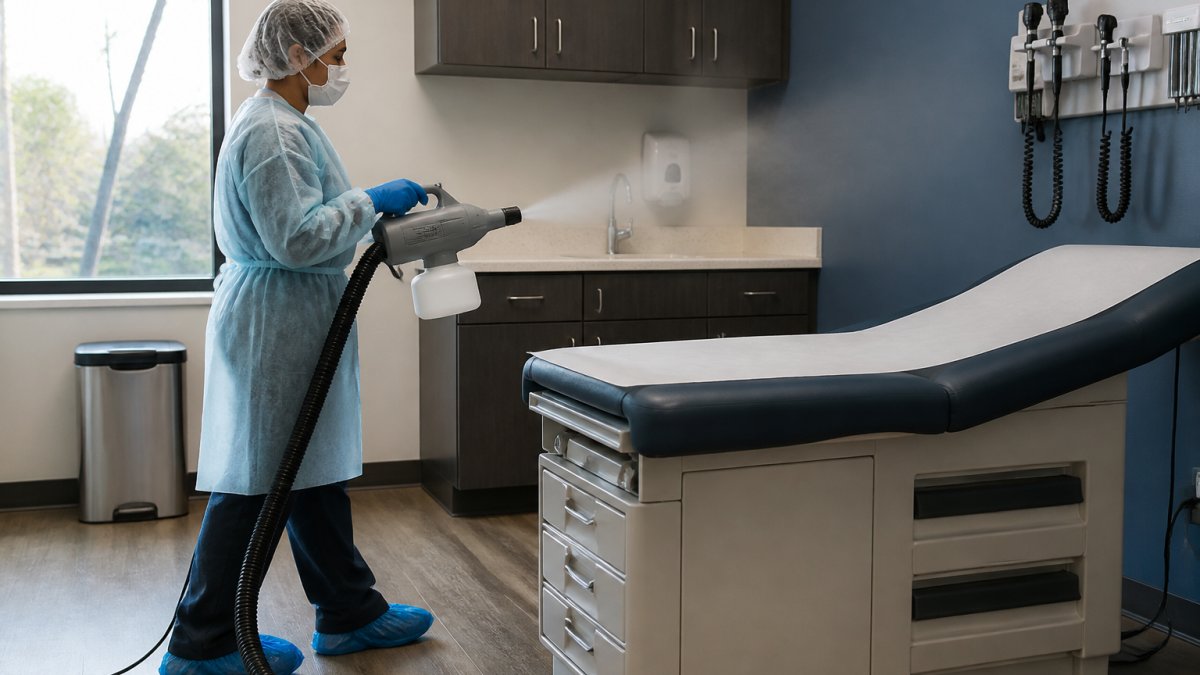
Electrostatic disinfection applies liquid disinfectant as charged droplets that cling to and coat surfaces with minimal manual effort.
For electrostatic disinfection clinics, infection prevention is non-negotiable.
At Rangel Janitorial, we provide specialized electrostatic disinfection that offers 360-degree coverage, ensuring a pristine and professional environment. Deployed correctly, it accelerates disinfection without replacing manual cleaning that removes visible soil.
The technology isn't new, but adoption in healthcare has accelerated. Clinics managing high-traffic patient flows, shared equipment, and strict compliance requirements increasingly recognize electrostatic spraying as a practical layer in infection prevention.
How Electrostatic Sprayers Work: The Science Behind Charged Droplets
Electrostatic sprayers charge disinfectant droplets as they exit the nozzle.
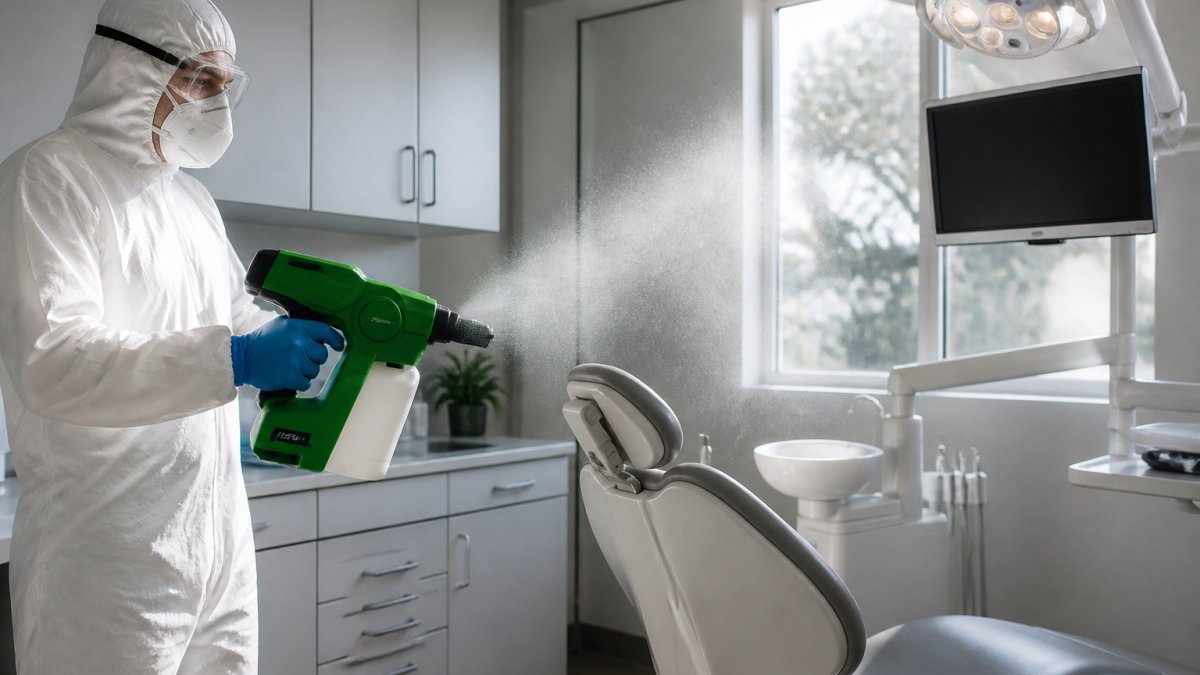
The result is adhesion without pooling: droplets wrap around edges, cling to vertical surfaces, and reach into recesses. A single pass treats surfaces that would otherwise require multiple manual applications.
The charge also repels droplets from one another, preventing clumping and producing finer, more uniform coverage with less waste, faster room turnover and more efficient disinfectant use.
One important distinction: electrostatic application is not fogging.
360-Degree Coverage: Reaching Hard-to-Access Surfaces in Medical Spaces
The defining benefit of electrostatic disinfection for clinics is comprehensive surface coverage.
Electrostatic spraying delivers charged droplets that coat these areas automatically, wrapping around corners and reaching into crevices. One operator can treat an entire exam room in 5-10 minutes with even coverage.
This is especially valuable in high-traffic environments. Waiting rooms with multiple seating surfaces, shared reception desks, and common restrooms benefit from the speed and consistency, with contact time applied uniformly.
For clinics managing outbreak response or seasonal surges, the gain is measurable: faster disinfection cycles mean rooms are ready sooner, reducing appointment delays without compromising hygiene.
Clinic Disinfection Best Practices: Integration With Routine Cleaning
Electrostatic disinfection for clinics works best as part of a layered approach, not as a replacement for routine cleaning. Manual cleaning removes visible soil, blood, body fluids, and other organic material; electrostatic spraying then applies disinfectant to clean surfaces, maximizing pathogen contact.
A practical clinic workflow looks like this:
- Remove visible soil - Staff manually clean surfaces with detergent and water or appropriate cleaning agents, following standard precautions
- Allow surfaces to dry - Wet surfaces reduce the effectiveness of charged droplet adhesion
- Apply electrostatic disinfectant - Operator uses the sprayer to coat all surfaces in the room
- Observe contact time - Allow the disinfectant to remain on surfaces for the duration specified on the product label (typically 1-10 minutes depending on the agent)
- Ventilate if needed - Some products require air circulation; follow product instructions
- Room ready - After contact time and any required drying, the space is safe for patient use
This sequence removes pathogens (manual cleaning) then kills them (electrostatic disinfectant). Skipping the manual step or spraying soiled surfaces reduces efficacy and wastes product.
Scheduling matters too: many clinics apply electrostatic disinfection between appointments or at day's end to meet contact time without disrupting operations, while others build it into terminal cleaning for high-risk areas.
Disinfectant Contact Time and Dwell Requirements for Healthcare Compliance
Contact time, also called dwell time or wet contact time, is the period a disinfectant must remain visibly wet to achieve the kill claims on its label. Apply the product, let it dry, and you have cleaned, not disinfected. Honoring contact time is where most clinic protocols fail.
Where the Requirements Actually Come From
Three layers of authority govern what a clinic can legally and practically use:
- EPA registration. Surface disinfectants are registered pesticides under FIFRA, and the EPA registration number is the product's legal identity. Using a product in conflict with its label, different dilution, surface, or contact time, is misuse under FIFRA.
- FDA-cleared devices. The sprayer may be regulated as a medical device if marketed for disinfecting medical equipment or patient-care surfaces. Ask the vendor whether the unit is FDA-cleared for that use or sold only as a general-purpose applicator.
- CDC and OSHA guidance. CDC's environmental cleaning recommendations and OSHA's bloodborne pathogens standard (29 CFR 1910.1030) shape how clinics handle contaminated surfaces, PPE, and exposure control plans. Electrostatic application exempts a clinic from none of these.
Reading the Label Before You Spray
Every EPA-registered disinfectant label carries a master list of claims. Before adopting a product for electrostatic use, verify:
- Contact time per pathogen. A product may kill one organism in 1 minute and require 10 for another. Your target pathogens, often Staphylococcus aureus, Pseudomonas aeruginosa, and enveloped viruses, determine the number that matters.
- Wet-contact requirement. Some labels specify "must remain wet for the full contact time." If the surface dries early, the claim is void. Electrostatic droplets sit longer than a hand-wiped film, but a warm, ventilated exam room can still dry a surface prematurely.
- Surface compatibility. Quaternary ammonium compounds are generally fine on stainless steel and most plastics but can cloud some acrylics and degrade certain electronics if applied heavily. Check equipment manufacturers' cleaning instructions before spraying near monitors, keyboards, or sensitive housings.
- Electrostatic-specific directions. A growing number of labels include directions for electrostatic or fogging application, sometimes at a different dilution than manual use. If the label does not mention electrostatic application, using it that way is off-label.
Documentation That Survives a Survey
Accreditation bodies and state health departments expect clinics to demonstrate that disinfection happened and was done correctly. A defensible log records:
- Date, time, and room or area treated
- Product name and EPA registration number
- Dilution used and who prepared it
- Application method (electrostatic, manual, or both)
- Time application began and time the surface was considered ready for use
- Initials of the operator
If a patient or staff member raises an infection-control concern, the log is the clinic's evidence the protocol was followed.
Why Electrostatic Application Helps, and Where It Doesn't
Charged droplets resist runoff, which can extend the wet period compared with a trigger-spray film that beads and drips, a real advantage on vertical and irregular surfaces. But it is not a substitute for reading the label: a 10-minute contact time is still 10 minutes, and a surface that dries in 4 because the HVAC is running has not met it. Clinics that treat contact time as a checkbox are most likely to fail a survey or believe a room is safe when it is not.
Electrostatic Spraying vs. Traditional Disinfection: Speed, Efficiency, and Results
Traditional disinfection methods, manual wiping, trigger spraying, and conventional fogging, each have limitations that electrostatic spraying addresses.
Manual wiping is thorough for visible surfaces but labor-intensive and inconsistent.
Trigger spraying is faster than wiping but requires aiming at each surface individually, so coverage is uneven and hard-to-reach areas are often skipped.
Conventional fogging reaches all surfaces but requires staff evacuation, extended air-out time, and careful setup, effective but impractical between appointments.
For clinics, the practical difference is significant: faster room turnover, fewer missed areas, and greater confidence in infection prevention.
Infection Prevention and Outbreak Response in High-Traffic Healthcare Environments
Most articles on electrostatic disinfection for clinics stop at "it covers more surfaces faster." Decision-makers need three things beyond that: an honest read on the evidence, a realistic cost picture, and the safety and training requirements of putting a sprayer in a patient-care space.
What the Evidence Supports, and What It Doesn't
Electrostatic sprayers demonstrably improve surface coverage versus trigger spraying and manual wiping. Studies and manufacturer testing consistently show more uniform deposition on complex geometries, undersides of exam tables, backs of chairs, gaps around cabinet hardware. That coverage claim is well supported.
The leap that is not well supported is from coverage to reduced infection rates.
A realistic framing for a clinic's infection prevention committee:
- Supported: more consistent surface coverage, faster room turnover, reduced operator variability, less product waste.
- Plausible but unproven at the clinic level: contribution to lower environmental pathogen burden when combined with manual cleaning and correct contact time.
- Not supported: claims that electrostatic disinfection "eliminates" infection risk or replaces other precautions.
Clinics that present the technology honestly get better adoption than those that oversell it: when a nurse sees a headline claim that does not match what they observe, the whole program loses credibility.
Cost and Return: A Realistic Framework
Electrostatic disinfection is a capital and operating expense, not a free upgrade. Rather than promising savings, model the inputs against clinic size and cleaning frequency.
Equipment. Handheld and backpack sprayers range widely in price depending on build quality, tank size, and FDA clearance.
Consumables. Disinfectant concentrate, dilution equipment, and PPE are recurring costs.
Labor. Usually the largest line.
Maintenance and training. Nozzles clog, electrodes need cleaning, and batteries degrade. Factor in replacement parts and periodic retraining.
A defensible ROI case rests on faster room turnover, more consistent coverage, and reduced rework, not speculative infection-prevention savings.
Operational Safety and Staff Training
Electrostatic sprayers are not benign office equipment. A clinic adopting them needs a written program covering:
- PPE. Operators should wear the PPE specified on the disinfectant label, typically gloves, eye protection, and sometimes a respirator. OSHA's PPE standards (29 CFR 1910 Subpart I) apply.
- Ventilation and re-entry. Some products require increased ventilation during and after application. The label specifies re-entry intervals; staff and patients should not be in the room until they are met. This is a scheduling constraint, not a formality.
- Electrical safety. The sprayer generates a high-voltage charge. Inspect units for damaged cords and electrodes, and never spray near open flames or flammable vapors.
- Exposure response. Staff need to know what to do if disinfectant contacts skin or eyes, and where the safety data sheet (SDS) is kept. OSHA's Hazard Communication standard (29 CFR 1910.1200) requires SDSs be accessible.
- Training and competency. A one-time demonstration is not training. Assess operators on dilution accuracy, spray technique, contact-time awareness, and documentation, and retrain after equipment changes or product switches.
Fitting It Into Outbreak Response Without Disrupting Care
During a seasonal surge or confirmed exposure, the value of electrostatic application is speed across many surfaces at once.
The discipline is sequencing: pre-clean visible soil, apply disinfectant electrostatically, observe contact time, ventilate per the label, then reopen.
Electrostatic disinfection clinics represent a useful tool in infection prevention, not a shortcut around the fundamentals, and not a substitute for the judgment that decides when, where, and whether to use it.
Frequently Asked Questions
How does electrostatic disinfection work in a clinic?
Electrostatic disinfection applies a negative electrical charge to disinfectant droplets as they exit the sprayer. These charged droplets are attracted to surfaces and wrap around hard-to-reach areas, irregular surfaces, and equipment. The charged particles adhere to objects more effectively than conventional spraying, creating more complete coverage in examination rooms, waiting areas, and high-touch surfaces. This method reduces the time staff spend on manual disinfection while improving surface contact.
What is the difference between electrostatic spraying and traditional disinfection methods?
Traditional disinfection relies on manual wiping or conventional spraying, which covers only surfaces the applicator directly targets. Electrostatic spraying uses charged droplets that wrap around objects and reach irregular surfaces, crevices, and hard-to-access areas that manual cleaning often misses. Electrostatic application is faster, covering a typical clinic room in minutes versus 30+ minutes of manual wiping, and uses less disinfectant while achieving more even coverage on high-touch surfaces.
How long should disinfectant remain wet on a surface in a clinic?
Contact time varies by disinfectant product and the pathogens being targeted. Most hospital-grade germicides require 30 seconds to 10 minutes of wet contact on surfaces to achieve effective pathogen elimination. Always follow the specific disinfectant label instructions for contact time, as this determines efficacy. Electrostatic application helps maintain consistent wet contact across all treated surfaces simultaneously, ensuring compliance with product requirements and infection prevention protocols.
Can electrostatic disinfection replace routine cleaning in a clinic?
No. Electrostatic disinfection complements routine cleaning but does not replace it. Manual cleaning removes visible dirt, debris, and organic matter that can shield pathogens from disinfectants. Best practice integrates both: staff perform routine manual cleaning first, then apply electrostatic disinfection to treat all surfaces with germicide. This two-step approach ensures both cleanliness and pathogen elimination, meeting healthcare facility standards and outbreak response protocols.