 How-to
Sustainable Cleaning Solutions for Large Facilities
Table of Contents
- Why Sustainable Cleaning Solutions Matter for Large Facilities
- Step 1: Assess Your Current Cleaning Operations and Environmental Impact
- Step 2: Select Eco-Friendly Commercial Cleaning Products
- Step 3: Implement Water-Saving Cleaning Equipment
- Step 4: Build Your Green Cleaning Program Checklist
- Industrial Facility Cleaning Best Practices
- Step 5: Measure Results and Calculate ROI
- Common Implementation Mistakes to Avoid
- Frequently Asked Questions
Last Updated: October 20, 2026
Why Sustainable Cleaning Solutions Matter for Large Facilities
Large facilities face bigger spaces, higher traffic, and stricter environmental standards. Traditional cleaning wastes water, uses harsh chemicals, and drives up costs. Sustainable cleaning solutions for large facilities offer a better path forward.
At Rangel Janitorial, we've spent over 30 years helping facility managers reduce their environmental footprint while maintaining spotless spaces. The shift cuts operational costs, improves worker safety, and meets the expectations of tenants and customers who care about green practices.
This guide walks you through a five-step process: audit your operations, select eco-friendly products, invest in water-saving equipment, measure your impact, and avoid common pitfalls.
Step 1: Assess Your Current Cleaning Operations and Environmental Impact
Document your current cleaning methods, product usage, water consumption, and waste output. This baseline becomes your measurement tool later.
Walk through your facility and note:
- How much water your cleaning crew uses daily
- What cleaning products you currently buy and how often
- How much waste (packaging, used materials) you generate
- Which areas consume the most resources
- Staff complaints about current products or processes
Talk to your cleaning team. They know where inefficiencies hide. Ask them what takes the most time, what products work best, and what frustrates them about current workflows.
Review invoices from the past 12 months for supplies, water, waste disposal, and labor. This financial snapshot helps you calculate ROI later.
Step 2: Select Eco-Friendly Commercial Cleaning Products
Start with third-party certifications, not marketing language
Terms like "natural," "eco-friendly," and "green" are largely unregulated. Third-party certifications carry more weight because an outside body reviews the formulation and, often, performance testing. Common programs include:
- Green Seal certification for institutional and industrial cleaners, which reviews environmental and performance criteria.
- UL ECOLOGO certification, which covers reduced environmental impact across a product's life cycle.
- EPA Safer Choice, which reviews ingredient safety for human health and the environment.
- Cradle to Cradle certification, which evaluates material health, recyclability, and social fairness.
A credible label names the certifying body, standard version, and a certification number you can look up in the certifier's public directory.
Read the safety data sheet, not just the front label
Every commercial cleaning chemical should come with a Safety Data Sheet (SDS) in the current 16-section format. Focus on:
- Section 2 (Hazard Identification): look for signal words such as "Danger" or "Warning" and hazard statements. A product with no hazard pictograms and no signal word is generally lower-risk, but confirm it still meets your cleaning performance needs.
- Section 3 (Composition): check for ingredient disclosure. Full disclosure is a stronger signal than "proprietary blend."
- Section 8 (Exposure Controls): note required gloves, eye protection, and ventilation. If the SDS requires respiratory protection for routine use, that is a red flag for large-area application.
- Section 9 (Physical Properties): pH and flash point help you match the product to the surface and storage conditions.
HMIS or NFPA ratings are a quick hazard summary, not a substitute for the SDS, a 0-0-0 rating doesn't confirm environmental performance.
Evaluate concentrated products on cost per ready-to-use gallon
Concentrates are only a sustainability win if dilution is controlled. Compare products on cost per ready-to-use gallon, not cost per container:
- Note the dilution ratio on the label (for example, 1:64 or 1:256).
- Calculate ready-to-use gallons per container.
- Divide the purchase price by ready-to-use gallons.
- Add the cost of dispensers, water, and any calibration service.
A higher-priced concentrate can be cheaper per ready-to-use gallon than a ready-to-use product.
Screen supplier claims with a short verification checklist
Before adding a product to your program, ask the supplier for:
- The current SDS and a technical data sheet.
- Certification listings with lookup instructions.
- Dilution ratios and dispenser compatibility.
- Recommended dwell times and surface compatibility.
- Packaging take-back or recycling options.
- A sample for a controlled pilot in one zone.
Pilot before you scale
Test two or three candidates in a single restroom bank, break room, or corridor for two to four weeks.
Step 3: Implement Water-Saving Cleaning Equipment
Water consumption is a major cost driver in large facilities. Modern equipment reduces water use without sacrificing cleanliness.
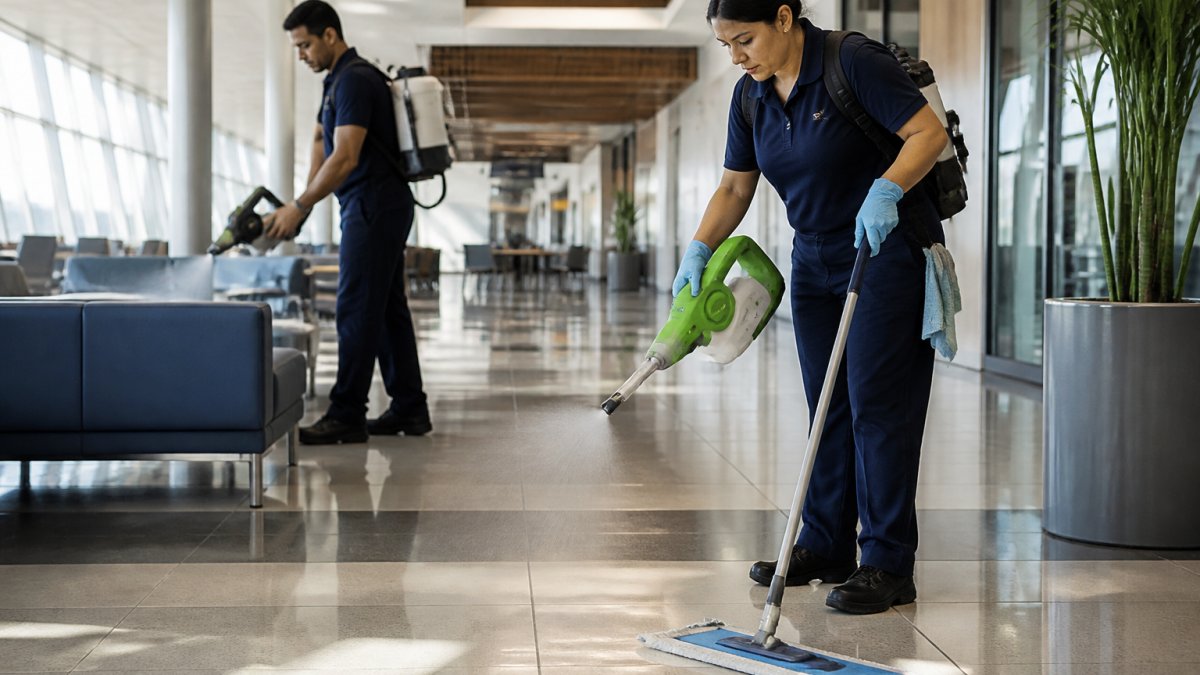
Key equipment upgrades:
- Electrostatic sprayers: These apply a fine mist of disinfectant that clings to surfaces and reaches crevices traditional spraying misses. They use 60-80% less liquid than conventional methods.
- Microfiber towels and mops: These trap dirt and bacteria more effectively than cotton, meaning your crew uses less water per cleaning pass.
- High-pressure cleaning systems: For heavy-duty industrial facility cleaning, pressure washers clean faster and use water more efficiently than manual scrubbing.
- Automated floor cleaning equipment: Robotic cleaners and automated scrubbers reduce labor time and water waste on large floor areas.
Rangel Janitorial uses specialized electrostatic disinfection that delivers 360-degree surface coverage, cutting water consumption while improving hygiene, especially valuable for medical facilities and high-traffic public areas.
Start with the biggest water users, restrooms, break rooms, and high-traffic corridors, to show quick wins and build support for broader changes.
Step 4: Build Your Green Cleaning Program Checklist
A formal checklist keeps your sustainable cleaning solutions for large facilities on track. It documents standards, assigns responsibilities, and creates accountability.
| Element | Action | Frequency |
|---|---|---|
| Product audit | Review all cleaning products for Green Seal or equivalent certification | Quarterly |
| Water usage | Monitor water consumption and compare to baseline | Monthly |
| Waste tracking | Record packaging waste and disposal costs | Monthly |
| Crew training | Refresh staff on dilution ratios, equipment use, and safety | Quarterly |
| Equipment maintenance | Service electrostatic sprayers, filters, and dispensers | Monthly |
| Performance testing | Verify cleaning quality meets standards | Weekly |
| Cost reconciliation | Compare spending to budget and prior months | Monthly |
Distribute this checklist to your cleaning supervisor and facility management team. Assign owners for each task. Schedule reviews monthly to discuss progress and address issues.
Industrial Facility Cleaning Best Practices
Industrial spaces, warehouses, manufacturing areas, and loading docks, have unique cleaning demands. Sustainable approaches work here too, but require tailored strategies.
Heavy equipment accumulates grease, dust, and debris. Start with a deep clean using concentrated alkaline degreasers, then transition to a maintenance routine with less aggressive products.
Ventilation matters in industrial spaces.
Schedule industrial facility cleaning around production schedules.
For large warehouse floors, automated equipment becomes cost-effective: robotic cleaners and high-pressure systems handle vast areas faster than manual crews, reducing labor costs and water waste.
Step 5: Measure Results and Calculate ROI
A sustainability program without measurement is just a set of purchases.
Define a small set of KPIs and calculate them the same way every month
Pick metrics you can actually collect from invoices, dispenser logs, utility bills, and inspection records.
| KPI | How to calculate | Data source |
|---|---|---|
| Chemical intensity | Ready-to-use gallons used ÷ cleanable square feet | Dispenser logs, purchase records |
| Concentrate efficiency | Ready-to-use gallons produced ÷ concentrate gallons purchased | Dispenser calibration records |
| Water intensity | Gallons used for cleaning ÷ cleanable square feet | Submeter or utility bill allocation |
| Waste diversion | Pounds recycled or diverted ÷ total cleaning waste pounds | Hauler reports, packaging logs |
| Labor productivity | Cleanable square feet ÷ cleaning labor hours | Timekeeping, work orders |
| Quality score | Passed inspection points ÷ total inspection points | Inspection app or checklist |
| Safety incidents | Recordable incidents per 200,000 labor hours | Incident reports |
Build a defensible baseline
Calculate total cost of ownership, not just purchase price
A facility-level TCO for a cleaning program includes:
- Product and concentrate purchase costs.
- Dispenser and equipment purchase, installation, and maintenance.
- Water and wastewater costs attributable to cleaning.
- Waste disposal and recycling fees.
- Labor hours, including training and supervision time.
- Consumables such as microfiber, pads, and filters.
- Downtime and replacement costs for equipment.
Compare TCO per cleanable square foot before and after the program.
Run a simple payback calculation
- Add the one-time costs: equipment, dispensers, training, and pilot supplies.
- Add the change in recurring monthly costs: supplies, water, waste, and labor.
- Subtract recurring savings from recurring costs to get net monthly savings.
- Divide one-time costs by net monthly savings to get payback in months.
If net monthly savings are negative in the first quarter, that is common during training and transition.
Report results in a format decision-makers use
A one-page monthly scorecard beats a long narrative. Include:
- Each KPI with current value, baseline, and percent change.
- A short note on any data gap or assumption.
- One or two operational actions taken that month.
- A forward-looking note on the next pilot or upgrade.
Avoid the most common measurement errors
- Comparing a partial year to a full-year baseline.
- Mixing gross and cleanable square footage.
- Counting recycled packaging as diversion without confirming the hauler actually diverts it.
- Ignoring water and labor because they sit in different budget lines.
- Reporting percentages without the underlying counts.
A measurement system doesn't need to be complex, just consistent, documented, and reviewed on schedule.
Common Implementation Mistakes to Avoid
Mistake 1: Switching to cheaper "green" products without testing
Budget-friendly eco-friendly options sometimes underperform. Your crew may compensate by using more product or spending extra time cleaning.
Mistake 2: Underestimating training needs
Your crew knows the old system. New products, dilution ratios, and equipment require hands-on training. Invest time upfront.
Mistake 3: Ignoring water quality
Hard water can interfere with some eco-friendly products.
Mistake 4: Overcomplicating the program
Don't try to change everything at once. Pick one or two high-impact areas. Build momentum and expand.
Mistake 5: Neglecting equipment maintenance
Electrostatic sprayers, dilution systems, and automated equipment require regular maintenance. Schedule preventive service.
Mistake 6: Setting unrealistic timelines
Behavior change takes time. Your crew has used the same products and methods for years. Allow 3-6 months for full adoption.
The payoff is significant: lower costs, safer working conditions, reduced environmental impact, and facilities that meet modern sustainability expectations. Our 30+ years of experience, fully bonded and insured crews, and specialized electrostatic disinfection technology make the shift smoother and faster. Get a free quote to learn how we can help your facility transition to sustainable cleaning solutions that deliver results.
Frequently Asked Questions
How can large facilities make their cleaning practices more sustainable?
Start by auditing water, chemical, and energy consumption in your current cleaning operations. Switch to concentrated, eco-friendly commercial cleaning products that reduce packaging waste and transportation emissions. Invest in water-saving equipment like electrostatic sprayers and microfiber tools. Implement a documented green cleaning program with staff training, track consumption metrics monthly, and measure ROI through reduced chemical and water bills.
What are the best eco-friendly cleaning products for commercial facilities?
Look for products with Green Seal certification or HMIS 0-0-0 ratings, indicating minimal health and environmental hazard. Always verify certifications and dilution ratios before purchasing to ensure compatibility with your facility's cleaning equipment and surfaces.
How do you measure the results of a sustainable cleaning program?
Track three key metrics: chemical consumption (gallons per month), water usage (gallons per square foot cleaned), and energy consumption (kilowatt-hours). Compare baseline data from your pre-implementation audit against monthly readings for 6-12 months. Calculate cost savings by multiplying reduced consumption by current unit prices. Monitor cleaning performance through staff feedback and facility inspections to ensure quality hasn't declined.
What equipment helps make commercial cleaning more sustainable?
Water-saving cleaning equipment includes electrostatic sprayers, high-pressure cleaning systems that reduce water consumption per square foot, and automated dispensing systems that prevent chemical overdosing. Microfiber towels and reusable cleaning materials eliminate single-use waste. Robotic cleaners and automated equipment improve labor productivity while reducing manual handling and chemical exposure.