 How-to
How Do You Vet Commercial Cleaning Liability Insurance?
Last Updated: November 12, 2026
Quick Summary
To vet cleaning liability insurance, first request the certificate of insurance and check its named insured, limits, and dates against the company's legal name. Then verify the policy number directly with the carrier, using contact details you find yourself rather than those on the certificate. Confirm your organization is named as an additional insured and that workers' compensation is active before work begins.
- Ask for the certificate of insurance before signing any contract.
- Call the carrier using a number you find independently, not the one on the certificate.
- Confirm the policy number, named insured, limits, and effective dates match the certificate exactly.
- Make sure your organization is listed as additional insured, with the endorsement in hand.
- Insurance covers accidents, while a surety bond covers failure to perform; a vetted company should carry both.
Table of Contents
- Step 1: Request and Read the Certificate of Insurance
- How to Verify a Certificate of Liability Insurance Directly With the Carrier
- Bonded vs. Insured: What Each Protects You From
- What Is an Additional Insured Endorsement in Janitorial Contracts?
- COI Red Flags and State-Specific Requirements to Check in California
- Verification Checklist to Use Before You Sign
- Booking Your Next Step With a Fully Insured Crew
- Frequently Asked Questions
Before a janitorial crew sets foot in your building, you need to know one thing: if something goes wrong, who pays? Rangel Janitorial serves corporate offices, medical facilities and industrial parks across California, and a missing or expired insurance certificate can turn a minor mishap into a costly dispute. Cleaning liability insurance is the coverage that protects your facility when a cleaning company's work damages property or injures someone. Vetting that coverage properly is one of the most important steps in choosing a cleaning partner.
Many facility managers assume a signed contract is enough protection. It is not. A contract only shows what the cleaning company agreed to do, not whether it can pay for damage it causes. Verifying the paperwork before work begins gives you a clear answer to that question. For a fuller set of vetting factors, read how to choose the right commercial cleaning company.
Step 1: Request and Read the Certificate of Insurance
A certificate of insurance (COI) is a one-page summary that a cleaning company provides to show its coverage. Ask for it before you sign anything. A COI is not the policy itself, and it does not change the policy's terms. It simply states what coverage exists on the date it was issued.
Read the certificate with a few specific questions in mind. Check the general liability limits, the policy effective dates, the name of the insurer, and whether your facility is listed as a certificate holder. Look for the policy number so you can verify it later. Make sure the named insured matches the exact legal name of the company you plan to hire.
Watch out: a COI can be issued for a company that does not carry the coverage listed. Treat the certificate as a starting point, not as proof.
How to Verify a Certificate of Liability Insurance Directly With the Carrier
Verifying a certificate with the insurer is the step most managers skip, and it is the one that catches problems. A COI is prepared by an insurance agent or broker, not by the carrier's underwriting department, which means the document reflects what the agent entered into the system, not necessarily what the underwriter bound. Calling the carrier closes that gap.
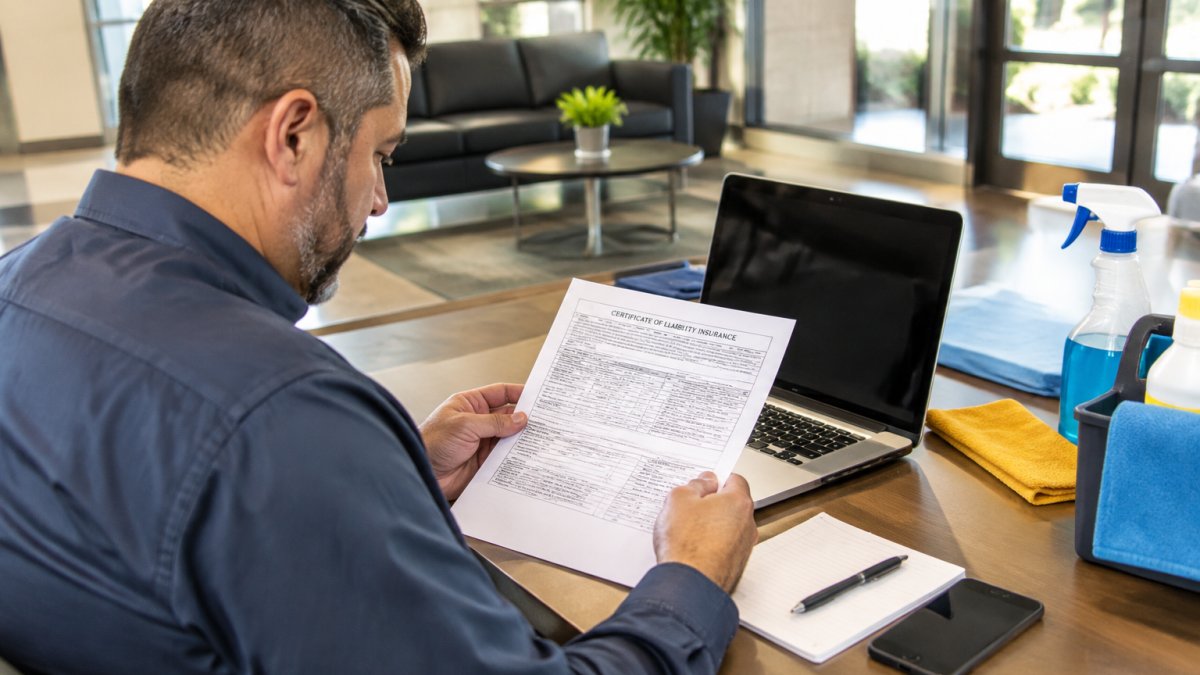
Start by finding the carrier's claims or policy-service phone number independently. Do not use the number printed on the certificate, because a fraudulent or altered COI can carry a disconnected or look-alike number. Carrier directories, the insurer's own website, and your own broker are all better sources. If the cleaning company is represented by an independent agency, you can also ask the agency to confirm the policy in writing on its letterhead.
When you reach the carrier, identify yourself as a prospective certificate holder and ask a short, specific set of questions:
- Is the policy number on the certificate active as of today's date?
- What are the named insured and the policy effective and expiration dates?
- What general liability limits apply per occurrence and in the aggregate?
- Is there a workers' compensation policy, and does it cover the classifications the crew actually performs?
- Has any cancellation or non-renewal notice been issued, and what is the notice period?
- Is an additional insured endorsement on file, and does it name your organization?
Most carriers will confirm active/inactive status and basic limits to a certificate holder; many will not read back endorsement language or loss runs without the insured's authorization. A common pattern is that the carrier confirms the policy exists but declines to discuss claims history, that is normal, not a red flag. What matters is that the policy number, named insured, limits, and dates match the certificate exactly.
Document the call. Note the date, the representative's name or reference number, and what was confirmed. If the policy is close to expiration, ask when the renewal will be bound and calendar a re-verification for that date. A certificate that is valid today can be worthless in 30 days if the policy is not renewed.
Watch out: a certificate can list a policy that was cancelled for non-payment mid-term, and the COI will still look current until someone calls. Carrier confirmation is the only reliable way to catch a lapsed policy before a claim surfaces.
For a clearer picture of what certificates do and do not prove, the Insurance Information Institute guidance on certificates of insurance offers a useful overview.
Bonded vs. Insured: What Each Protects You From
Cleaning companies often advertise that they are "bonded and insured," and the two terms are not interchangeable. Insurance protects you when the cleaning company causes damage or injury. A surety bond protects you when the cleaning company fails to meet its contractual obligations, such as abandoning a job or failing to pay its workers in a way that creates liability for you.
Put simply, insurance covers accidents, while a bond covers failure to perform. A fully vetted cleaning company should carry both. Rangel Janitorial's crews are fully bonded and insured. If you are looking for a local guide to janitorial services and the questions to ask, see what to look for in Sacramento janitorial services.
What Is an Additional Insured Endorsement in Janitorial Contracts?
An additional insured endorsement is a policy addition that extends the cleaning company's liability coverage to a named third party, usually your building owner or property manager. Without it, you may have little recourse if a claim arises from the cleaning company's work on your property.
Make sure the endorsement names your organization specifically, not just "any party required by written contract." Ask for a copy of the endorsement itself, since a COI alone does not confirm that the endorsement exists.
COI Red Flags and State-Specific Requirements to Check in California
A certificate of insurance can be fake, altered, or stale, which is the failure mode property managers actually encounter. The red flags below are the ones worth building into your review process.
Document-level red flags. Look at the certificate form itself. A legitimate COI is issued on a standard ACORD 25 form (or the ACORD 25 fillable equivalent) and carries the producer's name, address, and phone number. Warning signs include a form that has been cropped or re-typed, a producer block with no address, a policy number that does not follow the carrier's usual format, fonts that do not match the rest of the document, and a certificate issued by an entity whose name does not match the agency that should be representing the cleaner.
Coverage-level red flags. Be cautious if general liability limits look unusually low for the size of your facility, if the policy effective dates are expired or expire within weeks, if the insurer name is unfamiliar and cannot be confirmed, or if the certificate lists a different legal entity than the one you are contracting with. A certificate that names 'any party required by written contract' instead of your organization specifically is a gap, not a convenience.
Behavioral red flags. A cleaning company that resists giving you the policy's endorsement pages, delays the carrier confirmation, or supplies a certificate only after repeated requests is telling you something. Legitimate operators expect this scrutiny and usually have a certificate package ready.
Workers' compensation specifics. Workers' compensation coverage is required for most employers in California, and a worker injured on your property without it can create claims against you (DWC employer information). Confirm the policy is active and that the classification codes match the work being performed, a janitorial classification is not the same as a landscaping or construction classification, and a mismatch can mean the crew on your site is not actually covered.
What to do when a certificate fails review. Do not sign. Send the cleaner a written list of the deficiencies, request a corrected certificate and the underlying endorsement pages, and re-verify with the carrier before work begins. If the cleaner cannot produce a compliant certificate within a reasonable window, treat that as a decision point rather than a paperwork delay.
The California Department of Industrial Relations and the California Department of Insurance consumer resources both publish guidance on coverage requirements worth reviewing before you finalize a contract.
Verification Checklist to Use Before You Sign
Use this list to confirm each item before work begins:
- Certificate of insurance received and dated within the current policy period
- Named insured matches the cleaning company's exact legal name
- General liability limits reviewed and suitable for your facility
- Policy number and insurer confirmed directly with the carrier
- Your organization listed as additional insured, with the endorsement in hand
- Workers' compensation coverage confirmed for all crew members
- Surety bond in place, separate from insurance
- Cancellation notice requirements written into the contract
- Certificate reverified at each contract renewal
Keeping this checklist on file makes future renewals faster and more reliable.
The checklist below lays out each item to confirm before work begins, and the table condenses the key checks from the article.
| Check | What to confirm | Why it matters |
|---|---|---|
| Certificate of insurance | Dated within the current policy period | Shows coverage is active |
| Named insured | Matches the exact legal name | Confirms the right company is covered |
| General liability limits | Suitable for your facility | Sets the amount available for claims |
| Carrier confirmation | Policy number and insurer verified directly | Catches cancelled or altered certificates |
| Additional insured | Your organization named, endorsement in hand | Extends coverage to you |
| Workers' compensation | Active and covers all crew members | Prevents claims against your property |
| Surety bond | In place, separate from insurance | Covers failure to perform |
| Cancellation notice | Written into the contract | Gives you time to react |
Booking Your Next Step With a Fully Insured Crew
Once you have verified the paperwork, the next step is choosing a crew you can trust to show up and perform. Rangel Janitorial provides commercial cleaning across California, including Sacramento (Downtown and Midtown), Temecula and Murrieta, with fully bonded and insured professional crews and specialized electrostatic disinfection. You can book a janitorial services consultation to discuss your facility's needs and request a quote for your building.
Verify before you sign, and let the paperwork work for you. Rangel Janitorial is ready to put a fully insured team in your building, with coverage you can confirm. Get your free quote today and see what consistent, professional cleaning looks like.
Frequently Asked Questions
What kind of insurance does a commercial cleaning company need?
A commercial cleaning company should typically carry general liability insurance for third-party bodily injury and property damage, workers' compensation as required by California law, and commercial auto coverage if crews drive company vehicles. Many clients also require professional liability or a business owner's policy. Ask for a certificate of insurance listing these coverages and their limits before you sign, and confirm the policies are active by checking with the carrier or agent.
How do I verify a certificate of liability insurance?
Start by confirming the insurer name, policy number, policy dates, and coverage limits on the certificate. Then contact the agent or carrier directly, using contact details you find independently rather than those printed on the certificate, and ask them to confirm the policy is in force. Check that the named insured matches the cleaning company's legal name and that any additional insured wording matches your contract requirements.
Is a $1,000,000 general liability policy enough for a large facility?
A $1,000,000 per occurrence limit is a common contract minimum, but it may fall short for large office buildings, medical facilities, or high-traffic gym spaces where a single incident could cause significant damage or injury. Review the per occurrence and aggregate limits, consider whether an umbrella policy is in place, and compare the limits to your property's risk profile. Limits are a negotiated decision, so discuss them with your risk advisor or legal counsel.