 How-to
7 Steps to Scaling Commercial Cleaning Services Regionally
Last Updated: October 30, 2026
Quick Summary
Scaling commercial cleaning services regionally comes down to route density, pricing discipline, and consistent quality across every site. Map demand by zip code, fill your closest route ring before adding the next, and build every multi-site bid from a defensible cost stack. Run each site against a scored quality control checklist so standards hold as you add markets.
- Rank each area by target facility count, distance from current routes, and competition density.
- Fill your closest ring first and add the next ring only when the first is 80% full.
- Price each location in a multi-site bid separately, then bundle, so no losing building is hidden.
- Keep a bench of trained, on-call workers so a new contract does not become a crisis.
- A site scoring below your threshold, often 90%, triggers a re-inspection within 48 hours.
Table of Contents
- Step 1: Map Regional Demand Before You Add a Single Client
- Step 2: Build Route Density That Protects Your Margins
- Step 3: Master Commercial Cleaning Contract Pricing for Multi-Site Bids
- Step 4: Win Larger Accounts With a Multi-Location Commercial Cleaning Services Playbook
- Step 5: Hire and Train Crews Before the Contracts Land
- Step 6: Run Every Site Against a Commercial Cleaning Quality Control Checklist
- Step 7: Choose Software That Matches Your Growth Stage
- Request a Multi-Site Walkthrough From Rangel Janitorial
- Frequently Asked Questions
Step 1: Map Regional Demand Before You Add a Single Client
Scaling commercial cleaning services for regional businesses starts with a map, not a sales pitch. Most owners add clients wherever the phone rings, then wonder why margins vanish. Regional demand mapping fixes that before it costs you.
Here is the practical version. List every zip code you already serve. Mark how many buildings sit in each one. Note the drive time between stops. Then rank each area by three factors:
- Number of target facilities (offices, clinics, warehouses, gyms)
- Distance from your current routes
- Competition density you can realistically undercut
A common mistake is chasing the biggest metro area first. Bigger markets mean longer drives and thinner margins. Density beats size every time.
Readers mapping demand often want a real example of how a provider positions itself across a region, which is why commercial cleaning across the Inland Empire is worth studying as a model.
U.S. Census Bureau business data can help you size facility counts by area before you commit a single crew.
Step 2: Build Route Density That Protects Your Margins
Route density is the number of billable buildings your crew can service within one shift without wasting drive time. It is the single biggest lever on commercial cleaning profitability, and most regional operators ignore it.
Think about it this way. Two buildings ten minutes apart cost you far less in labor and fuel than two buildings an hour apart. Same revenue. Very different margin.
So build routes in rings:
- Fill your closest ring first (under 15 minutes between stops).
- Add the next ring only when the first is 80% full.
- Never accept a client that forces a crew to skip a ring.
This is where growth rate and labor costs collide. Every extra minute of driving is a minute you pay for and cannot bill.
U.S. Department of Energy fuel economy guidance explains how vehicle costs scale with mileage, which matters when you run multiple crews across a region.
Step 3: Master Commercial Cleaning Contract Pricing for Multi-Site Bids
Commercial cleaning contract pricing is where regional growth is won or lost. Price too low and you cannot staff the job. Price too high and the bid dies on the table. Most bidders copy a per-square-foot number from a competitor and hope it holds.
Build every bid from the ground up with a cost stack you can defend line by line:
- Labor hours. Walk the space and time each task by frequency. Do not use a square-footage rule of thumb; a 10,000 sq ft open office and a 10,000 sq ft clinic with exam rooms are not the same job.
- Burdened labor rate. Take the hourly wage, add payroll taxes, workers' compensation, benefits, and paid time off, then divide by billable hours. This is the number that actually hits your P&L.
- Supplies and equipment. Cost per visit, not per month. Include consumables (liners, paper, chemicals) and equipment amortization (auto scrubbers, vacuums, carts).
- Drive time and fuel. Allocate route time to each account. A building 40 minutes away carries more labor cost than the same building next door.
- Overhead. Insurance, bonding, supervision, software, office staff, and vehicle maintenance. Allocate by revenue share or by site count, pick one method and use it consistently.
- Margin. Set a target that survives a slow month and a lost account.
For multi-site bids, price each location separately, then bundle. A single blended rate hides the building that loses money.
A few pricing mechanics separate profitable regional bidders from busy ones:
- Minimum visit charge. Set a floor per visit so small accounts still cover drive time and setup.
- Escalation clause. Build an annual increase into the contract tied to a published index or a fixed percentage, so you are not renegotiating from scratch every year.
- Scope-change pricing. Put a rate card in the contract for add-on work (floor stripping, event cleanup, post-construction) so extras are billed, not donated.
- Fuel and supply surcharge. A modest, disclosed surcharge protects margin when input costs move.
Watch out: bidding to win on price alone is the fastest way to lose money at scale. A contract you cannot staff is worse than no contract.
Step 4: Win Larger Accounts With a Multi-Location Commercial Cleaning Services Playbook
Multi-location commercial cleaning services demand a playbook, not a handshake. Large property managers want proof you can deliver the same standard across every building, every visit.
Here is the playbook we would run:
- Audit every site first. Walk each location and document square footage, traffic, and pain points.
- Build one scope, customized per site. Shared standards, tailored tasks.
- Assign a single point of contact. Property managers hate chasing five phone numbers.
- Report monthly. Show what was done and what was fixed.
- Offer a pilot. Start with one building, prove quality, then expand.
Before pitching a multi-site account, it helps to know how to choose the right commercial cleaning company, including the insurance, references, and red flags that property managers check. Use that same checklist on yourself before you bid.
Referral programs fit here too. A property manager who trusts your multi-site delivery will introduce you to their other buildings. Ask for that introduction directly.
Step 5: Hire and Train Crews Before the Contracts Land
Hiring and training must run ahead of sales, not behind it. Sign a big contract with no crew ready and quality collapses in week one.
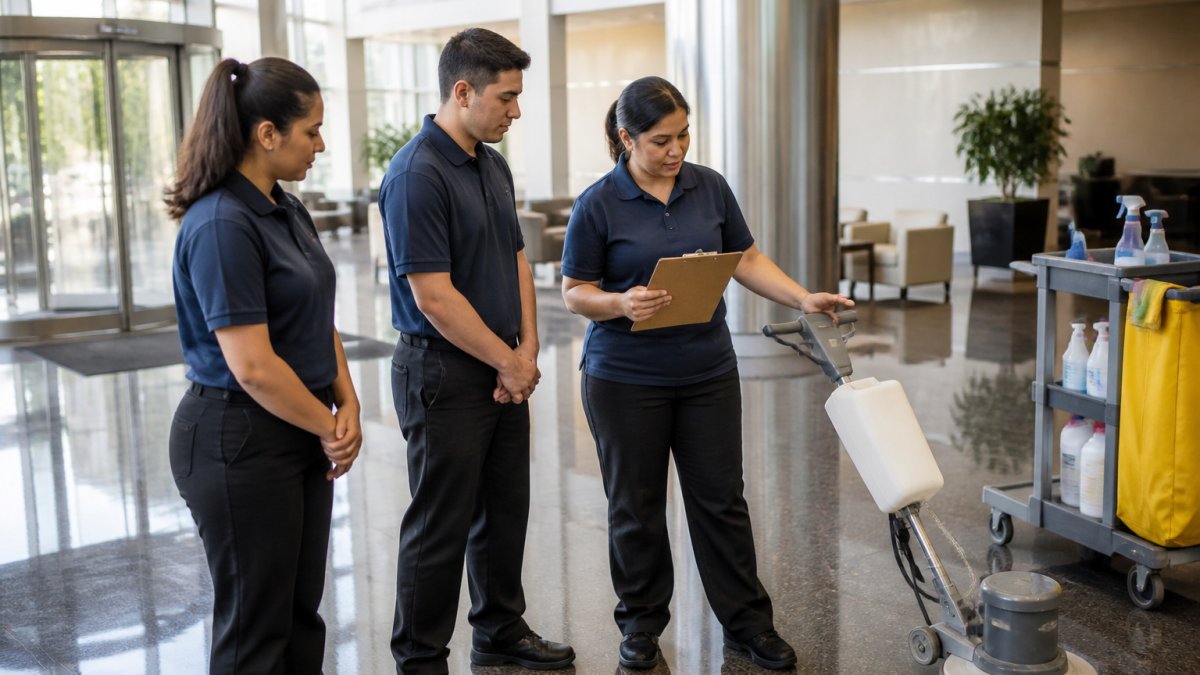
Commercial cleaning staff training should cover more than mopping. New hires need to learn your inspection standard, your supply system, and your client communication rules. A structured onboarding does three things:
- Sets the quality bar on day one
- Reduces turnover, which protects client relationships
- Lets you staff a new site without scrambling
Staffing is a regional puzzle. Keep a bench of trained, on-call workers so a new contract does not become a crisis. The thing nobody tells you about scaling is that your hiring pipeline is your real growth ceiling.
Step 6: Run Every Site Against a Commercial Cleaning Quality Control Checklist
A commercial cleaning quality control checklist turns "looks clean" into a measurable standard.
Build the program in four layers: the standard, the inspection, the score, and the escalation.
Layer 1: The standard. Write one scope document per account type (office, medical, industrial, retail) and customize per site. The scope defines task, frequency, and acceptance criteria.
Layer 2: The inspection. Supervisors inspect on a fixed cadence, not when they have time. A workable pattern is weekly for the first 30 days of a new account, then every other week, with a monthly joint walk with the client. Use a scored checklist:
- Floors swept, mopped, or vacuumed per scope
- Restrooms sanitized, stocked, and odor-free
- High-touch surfaces wiped (handles, switches, rails)
- Trash emptied and liners replaced
- Breakrooms and common areas spotless
- Entry glass and partitions clean
- Supplies restocked and logged
- Floor care and specialty scope inspected separately
Layer 3: The score. Score each line pass or fail and convert to a percentage. Track the score by site, by crew, and by month.
Layer 4: The escalation. Define what happens when a score fails or a client complains:
- Supervisor re-inspects within 24-48 hours and documents the correction.
- Crew lead is retrained on the specific failed task.
- If the same line fails twice in a month, the account manager joins the next inspection.
- If it fails three times, the site moves to daily supervision until it stabilizes.
Cross-site reporting. For multi-location accounts, roll site scores into one monthly report: average score, sites below threshold, open corrections, and trend by month. Property managers with buildings across a region want one number and one narrative, not five separate emails.
Specialized work belongs on the same checklist. Floor care, for example, needs its own inspection line, and professional floor care services show how a specialized scope fits into a broader quality standard.
Step 7: Choose Software That Matches Your Growth Stage
Cleaning software should fit where you are now, not where you hope to be in five years. Buy too early and you pay for features nobody uses.
Match the tool to the stage:
| Growth Stage | What You Need | Example Tools |
|---|---|---|
| 1-5 buildings | Scheduling, quoting, invoicing | Jobber, Markate |
| 5-20 buildings | Inspections, time tracking, client portal | Janitorial Manager, Swept |
| 20+ buildings | Reporting, dispatch, analytics | ServiceTitan, Janitorial Manager |
Two rules keep software from becoming a money pit. First, automate scheduling and invoicing before anything else; that is where manual work eats your week. Second, connect your field tool to accounting so revenue and job costs stay in one place.
Automation should free supervisors to inspect sites, not bury them in dashboards. If a tool adds admin work, it is the wrong tool for your stage.
Scaling a regional cleaning operation comes down to density, pricing discipline, and consistency across every site. Rangel Janitorial brings 30+ years of experience, fully bonded and insured crews, and tailored plans for corporate offices, medical facilities, and industrial parks across California.
Request a Multi-Site Walkthrough From Rangel Janitorial
Ready to see how a multi-site program actually runs? Trusted by 500+ California businesses, our bonded and insured crews deliver spotless facilities and real-time upkeep. Get your free quote and request a multi-site walkthrough from Rangel Janitorial today.
Frequently Asked Questions
How do you scale a commercial cleaning business without losing quality?
Quality holds when you standardize before you grow. Build a written quality control checklist, train every crew against it, and inspect each site on a fixed schedule. Add clients only after the systems that support them are in place. Route density matters too: cluster new accounts near existing ones so supervisors can reach more buildings in a day. Rangel Janitorial brings over 30 years of experience to multi-property cleaning.
How should a commercial cleaning company price multi-site contracts?
Price each site on its own square footage, fixture count, and frequency, then apply a multi-site discount only where route density genuinely lowers your cost. Build in labor cost increases and supply inflation rather than absorbing them later. Commercial cleaning contract pricing should reflect the actual cost of delivering consistent service at every location, not a flat rate per building. For current pricing, pricing depends on quantity, dates, and delivery; visit the Rangel Janitorial website or request a quote.
How can a cleaning company expand to serve multiple locations?
Start with one regional cluster where travel time between buildings stays short. Hire and train a dedicated crew for that cluster before signing the second or third site, so service never depends on stretched staff. Use a commercial cleaning quality control checklist at every location so inspections and schedules stay visible across sites. Multi-location commercial cleaning services succeed when the back office scales at the same pace as the client list.
What systems help manage a growing commercial cleaning operation?
Three systems carry most of the load: scheduling and time tracking with GPS check-ins, inspection reporting that produces a record for each site, and supply inventory tied to client locations. Pair whichever you choose with accounting software so revenue per contract stays visible as you add buildings.