 blog
Sanitizing vs. Disinfecting Medical Rooms
Table of Contents
- Sanitizing vs. Disinfecting: Core Definitions
- How Sanitizing and Disinfecting Differ in Medical Rooms
- Medical Surface Disinfectant Contact Time Requirements
- High-Touch Surface Disinfection in Healthcare Settings
- Cleaning and Disinfection Between Patients
- Selecting EPA-Registered Hospital Disinfectants
- When Sanitizing Falls Short in Medical Environments
- Frequently Asked Questions
Last Updated: October 12, 2026
Sanitizing vs. Disinfecting: Core Definitions
Understanding the difference between sanitizing vs disinfecting medical rooms is essential for healthcare facility managers. At Rangel Janitorial, we've worked with medical facilities across California for over 30 years, and this distinction shapes how we approach surface treatment.
Sanitizing reduces microorganisms on a surface to safe levels through chemical or physical means. It doesn't eliminate all germs, it lowers their count to levels considered safe for public health.
Disinfecting goes further. It kills a specific list of pathogens and microorganisms on a surface, as verified by EPA-registered products.
The key difference: sanitizing reduces germs to safe levels, while disinfecting kills targeted pathogens outright. In medical rooms, this distinction determines which surfaces get which treatment and when.
How Sanitizing and Disinfecting Differ in Medical Rooms
In a medical room, the sanitizing vs disinfecting decision is not a preference, it is driven by three variables: the surface's contact profile, the patient population using the room, and where the room sits in the turnover cycle.
The three variables that drive the decision
**1.
2. Patient population. A general-practice exam room serving healthy adults has a different risk floor than an infusion suite, dialysis bay, or oncology clinic where immunocompromised patients are present. Where host defenses are compromised, disinfection becomes the default rather than the exception.
3. Position in the turnover cycle. Routine end-of-day cleaning, between-patient turnover, and terminal cleaning after a discharge or procedure are three different jobs with three different standards. Treating them as one process is the most common operational error in medical rooms.
Surface-by-surface guidance for a typical exam room
| Surface | Routine cleaning | Between patients | Terminal / high-risk event |
|---|---|---|---|
| Exam table (upholstered) | Clean; sanitize if product is compatible | Disinfect with an EPA-registered product labeled for the upholstery | Disinfect; replace or discard if torn or non-cleanable |
| Countertops and work surfaces | Clean; sanitize | Disinfect high-touch edges and items placed on them | Disinfect full surface |
| Floors | Clean; sanitize per facility policy | Spot-clean soiled areas | Disinfect if contaminated with blood or body fluids |
| Door handles, light switches, drawer pulls | Clean; sanitize | Disinfect | Disinfect |
| Shared equipment (stethoscope, otoscope, BP cuff) | Clean | Disinfect between patients per manufacturer instructions | Disinfect; follow device-specific reprocessing guidance |
| Computer keyboard and mouse | Clean | Disinfect with a product compatible with electronics | Disinfect |
Two rules govern this table. First, cleaning always precedes sanitizing or disinfecting when soil is visible, organic material inactivates many active ingredients. Second, the product label overrides the table: if a surface is incompatible, it needs a different product, not a heavier application.
Why the distinction matters operationally
Sanitizing is faster, uses lower concentrations, and is gentler on materials, which is why it fits routine maintenance of low-risk, low-touch surfaces. Disinfecting requires higher concentration or longer dwell time and is harder on some finishes, so it is reserved for surfaces where pathogen transfer matters. A medical room is rarely all-sanitize or all-disinfect; it is a layered protocol using both processes on different surfaces at different times.
Medical Surface Disinfectant Contact Time Requirements
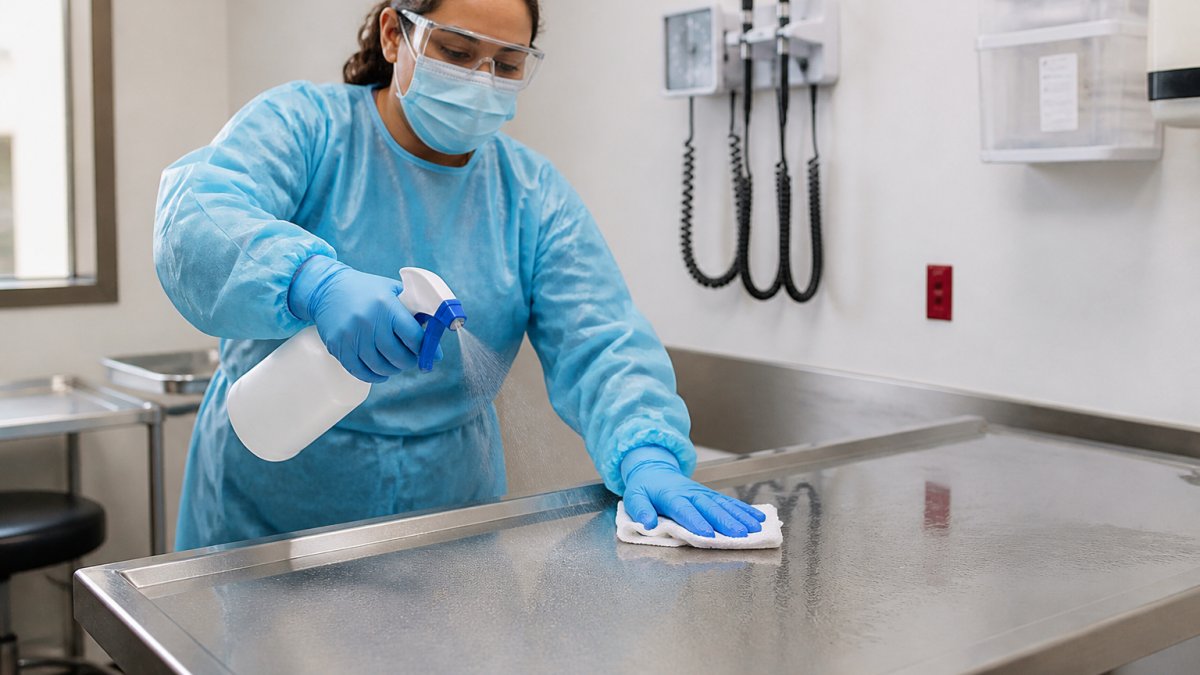
Contact time, also called dwell time or wet time, is where many facilities make mistakes.
EPA-registered disinfectant labels specify contact time for each product, commonly 30 seconds to 10 minutes depending on the chemical and target organisms.
Temperature affects contact time too. Cold surfaces may need longer dwell time. Warm environments can reduce it slightly. Always check the specific product label, it's the legal standard for that disinfectant's effectiveness.
Verification matters. Staff must confirm surfaces remain wet for the full contact time; if a surface dries early, disinfection fails. Proper training and clear protocols prevent cross-contamination.
| Disinfectant Type | Typical Contact Time | Best For |
|---|---|---|
| Hospital-grade disinfectant | 3-10 minutes | High-risk surfaces, operating rooms |
| General disinfectant | 30 seconds to 3 minutes | Examination tables, door handles |
| Quaternary ammonium (quat) | 30 seconds to 2 minutes | Nonporous surfaces, routine use |
| Bleach solution | 10 minutes | Heavily contaminated areas, C. difficile |
High-Touch Surface Disinfection in Healthcare Settings
High-touch surfaces are where pathogens spread fastest. Door handles, light switches, bedrails, computer keyboards, and equipment controls get touched hundreds of times daily.
Medical rooms require disinfection of all high-touch surfaces between patients, this is the standard of care.
Identify high-touch areas systematically:
- Door handles and push plates
- Bedrails and headboard controls
- Sink handles and faucets
- Light switches and equipment buttons
- Armrests and chair surfaces
- Shared medical equipment
- Computer mice and keyboards
Each surface needs the right disinfectant for its material, stainless steel handles different products than plastic or fabric.
Frequency matters too. Between patients, all high-touch surfaces must be disinfected.
Electrostatic disinfection offers an advantage here. Our teams at Rangel Janitorial use electrostatic technology to coat high-touch surfaces with disinfectant, ensuring 360-degree coverage.
Cleaning and Disinfection Between Patients
The sequence matters. Many facilities skip a critical step: pre-cleaning. Visible dirt, blood, or other organic material reduces disinfectant effectiveness. The EPA requires pre-cleaning before disinfection when surfaces are visibly soiled.
Here's the proper sequence:
- Remove gross contamination. Wipe away visible blood, body fluids, or debris with paper towels.
- Pre-clean the surface. Use a detergent or general cleaner to remove soil and impurities.
- Rinse if required. Some disinfectants need a rinse after pre-cleaning; check the label.
- Apply disinfectant. Use an EPA-registered product appropriate for the surface.
- Maintain contact time. Keep the surface wet for the full dwell time specified on the label.
- Allow to air dry. Do not wipe or rinse unless the label permits it.
Timing is critical between patients. Most medical facilities have 15-30 minutes to turn over a room. This requires trained staff, the right products, and clear protocols. Rushing through disinfection creates gaps in infection prevention.
Documentation matters. Facilities should track which surfaces were disinfected, when, and by whom. This creates accountability and helps identify problems if infection rates spike.
Selecting EPA-Registered Hospital Disinfectants
Not all disinfectants are created equal. The EPA registers disinfectants based on efficacy testing against specific organisms. A product labeled "hospital disinfectant" has met stricter standards than a general disinfectant.
Check the product label for these details:
- EPA registration number. This confirms the product is registered and the claims are verified.
- Organism claims. The label lists which bacteria, viruses, and fungi the product kills.
- Contact time. How long the surface must stay wet.
- Surface compatibility. Which materials the product is safe for.
- Dilution instructions. Concentrated products must be mixed correctly.
- Safety precautions. Gloves, ventilation, and other protective measures required.
Quaternary ammonium compounds (quats) are common in healthcare, effective, fast-acting, and safe on most surfaces.
For medical facilities, EPA-registered hospital disinfectants are the standard. They've proven effectiveness against a broader range of pathogens than general disinfectants. The investment is worth it because the product's claims are verified and legally defensible.
When Sanitizing Falls Short in Medical Environments
Most guidance stops at "disinfect when risk is high" without defining high. A usable framework ties the decision to two axes: the likelihood a surface is contaminated with a pathogen of concern, and the consequence if that pathogen reaches the next patient. Sanitizing is defensible only when both are low; when either rises, disinfection is the floor, not the ceiling.
A two-axis decision framework
Axis 1, Contamination likelihood.
- Low: surfaces in low-traffic, non-clinical zones; surfaces not touched by patients or staff during care.
- Moderate: routine exam-room surfaces touched by staff but not by patients' mucous membranes or broken skin.
- High: surfaces touched by patients, by staff gloves during care, or by anything that contacts blood, body fluids, or non-intact skin.
Axis 2, Consequence of transmission.
- Low: healthy ambulatory patients, brief contact, intact immune function.
- Moderate: mixed populations, older adults, patients with chronic conditions.
- High: immunocompromised patients, patients with invasive devices, surgical and procedural settings, outbreak or cluster conditions.
When both axes are low, sanitizing after cleaning is generally sufficient. When either axis is moderate, disinfection of high-touch surfaces between patients is the working standard. When either axis is high, full disinfection of the room, not just high-touch points, is the appropriate response, and terminal cleaning protocols apply.
Situations where sanitizing is not enough
- Immunocompromised or high-acuity patients. Where host defenses are reduced, residual organisms that a sanitizer leaves behind are a meaningful risk. Disinfection is the default.
- Known or suspected infectious patients. After care of a patient with a communicable infection, the room requires disinfection, and in some cases enhanced protocols for organisms such as C. difficile or norovirus that resist many routine products.
- Procedural and high-risk areas. Operating rooms, procedure rooms, isolation rooms, and intensive-care spaces operate under disinfection standards for all patient-contact surfaces.
- Between patients with different diagnoses. Cross-contamination risk is the reason between-patient turnover exists as a distinct step rather than a lighter version of end-of-day cleaning.
- Patient-care equipment. Devices that contact skin or mucous membranes, stethoscopes, blood pressure cuffs, otoscope specula, ultrasound probes, require disinfection or reprocessing between uses according to the device manufacturer's instructions.
- Visible contamination with blood or body fluids. Cleaning followed by disinfection with a product labeled for the relevant organism is the standard; sanitizing alone does not meet it.
Room turnover: three tiers, three standards
A practical way to operationalize the framework is to define three turnover tiers for every medical room and assign a standard to each.
- Routine cleaning (end of day or low-traffic interval). Clean all surfaces; sanitize low-risk, low-touch surfaces; disinfect high-touch surfaces per facility policy.
- Between-patient turnover. Clean visible soil; disinfect all high-touch surfaces and any equipment used during the prior encounter; verify contact time before the next patient enters.
- Terminal cleaning (discharge, procedure end, or known contamination). Clean and disinfect the entire room, including floors, curtains, and any surface that may have been contacted; follow any organism-specific guidance for the suspected or confirmed pathogen.
How to decide in the moment
When staff face a surface not explicitly covered by the room's protocol: identify the surface's contact profile, identify the patient population, check the product label for the appropriate claim and contact time, and choose the higher of the two processes when in doubt. Documenting the decision turns a one-off judgment call into a repeatable protocol and gives the facility a record if infection rates are later reviewed.
Frequently Asked Questions
What is the difference between sanitizing and disinfecting in a medical room?
Sanitizing reduces microorganisms to safe levels using heat or chemicals. Disinfecting kills pathogens more aggressively, eliminating a higher percentage of harmful microorganisms. In medical rooms, disinfecting provides the germ-killing power needed to prevent cross-contamination and infection.
How long should a medical surface disinfectant contact time be?
Contact time (also called dwell time or wet time) varies by product and organism claim. Most EPA-registered hospital disinfectants require 1 to 10 minutes of wet contact on the surface. Always check the product label for the specific contact time, as it determines whether the disinfectant will kill the claimed pathogens. Shorter contact times are faster for high-traffic areas, but longer contact times may be required for certain viruses or bacteria. Following label instructions ensures compliance and effective microorganism reduction.
When should a medical room be disinfected instead of sanitized?
Disinfection should occur between patients, after visible contamination, and as part of routine environmental surface protocols. Sanitizing may be acceptable for non-patient-care areas or administrative spaces, but surfaces in patient rooms, examination areas, or shared equipment zones often require disinfection. Healthcare standards and infection prevention practices demand disinfection to eliminate pathogens that sanitizing alone cannot reliably control.
Do medical rooms need to be disinfected between patients?
Yes. Cleaning and disinfection between patients is a core infection prevention practice. After a patient is discharged or moved, all high-touch surfaces (door handles, bed rails, exam tables, equipment) and environmental surfaces must be cleaned to remove soil and impurities, then disinfected to kill pathogens. This protocol prevents cross-contamination and protects the next patient. The frequency and intensity depend on the room type and patient risk category. Medical facilities should follow their infection control policies and EPA-registered disinfectant labels to ensure adequate contact time and organism coverage.