 blog
Eco-Friendly Disinfectants for Electrostatic Sprayers
Table of Contents
- Eco-Friendly Disinfectants for Electrostatic Sprayers: What Actually Works
- Electrostatic Sprayer Disinfectant Compatibility: How to Verify Before You Buy
- EPA Safer Choice Disinfectants: What the Certification Does and Doesn't Mean
- Disinfectant Contact Time: The Variable Most Buyers Overlook
- Electrostatic Sprayer Safety Precautions for Facility Teams
- Hard Surfaces, High-Touch Points, and Where Coverage Efficiency Drops
- Cost, Environmental Impact, and Choosing a Verified Shortlist
- Conclusion: Building a Defensible Disinfection Program
- Frequently Asked Questions
Last Updated: October 16, 2026
Eco-Friendly Disinfectants for Electrostatic Sprayers: What Actually Works
Choosing eco-friendly disinfectants for electrostatic sprayers comes down to one non-negotiable: the product label must list electrostatic application as an approved use. At Rangel Janitorial, we have spent more than 30 years cleaning commercial buildings and have watched teams buy "green" disinfectants never meant for their equipment.
"Eco-friendly" is a marketing phrase, not a regulatory category. The EPA registers disinfectants as pesticides, and what you can actually verify is narrower: the active ingredient, the contact time on the label, and whether electrostatic use appears in the directions.
Below: how to verify compatibility before you buy, what EPA Safer Choice actually certifies, and how to build a disinfection program you can defend in an audit.
Electrostatic Sprayer Disinfectant Compatibility: How to Verify Before You Buy
Electrostatic sprayer disinfectant compatibility means the product's EPA-registered label explicitly permits application through electrostatic equipment. If the directions for use do not mention electrostatic spraying, the product is not verified for your sprayer, regardless of distributor claims.
Verification takes about ten minutes per product:
- Find the EPA registration number on the label (format: EPA Reg. No. 00000-00).
- Pull the full registered label from the EPA's pesticide product label system.
- Search the directions for use for "electrostatic," "electrostatic sprayer," or "charged spray."
- Confirm the approved surfaces match what you actually clean.
- Check the contact time requirement for each pathogen you care about.
A manufacturer can hold separate registrations for a concentrate and a ready-to-use version, and electrostatic approval may apply to only one.
Reading the Label for Electrostatic Use Restrictions
Restrictions live in the directions, not the marketing copy. Look for language limiting application to specific equipment, requiring a particular dilution, or prohibiting use on food-contact surfaces. A label approving electrostatic application for hard, non-porous surfaces does not automatically approve porous materials like unfinished wood or fabric.
EPA Safer Choice Disinfectants: What the Certification Does and Doesn't Mean
EPA Safer Choice disinfectants carry a certification that evaluates ingredient chemistry against the Safer Choice Standard. The program reviews human health and environmental profiles of ingredients, not whether the product kills a specific pathogen.
That distinction matters. Safer Choice is a certification mark, not an EPA registration. A product can be Safer Choice certified and still require registration as a disinfectant, and the two reviews are separate. According to the EPA's Safer Choice program page, the label helps buyers identify products with safer chemical ingredients, but it does not replace the pesticide registration review.
For facility teams, the takeaway: Safer Choice tells you something real about ingredient chemistry, but nothing about electrostatic compatibility. You still have to check the registered label.
What "Eco-Friendly" Actually Means, and How to Score It
Most buying guides treat "eco-friendly" as a single yes/no badge. It is not, it is a bundle of separate claims, each verifiable independently.
1. Ingredient hazard profile. Does the product carry a third-party certification (Safer Choice, Design for the Environment, or equivalent)? If not, pull the Safety Data Sheet and read Section 3.
2. Biodegradability and environmental fate. Check whether the label or SDS states the product is readily biodegradable.
**3.
4. Contact time and reapplication. A short labeled dwell time may need fewer passes and less chemistry per surface than a long soak.
5. Label restrictions. A product prohibited on food-contact surfaces or restricted to certain sites may force a second chemistry, doubling packaging and inventory. Fewer SKUs usually means less waste.
Building a Verified Shortlist Instead of a Wish List
The query that brought most readers here is not "what is eco-friendly", it is "which eco-friendly disinfectant can I actually put in my electrostatic sprayer." The second question has a short, verifiable answer.
A verified shortlist is a document, not a feeling. For each candidate product, record:
- Product name and EPA Reg. No., the exact registration, not the brand family.
- Formulation type, concentrate or ready-to-use. Electrostatic approval may attach to only one.
- Electrostatic language, quote the exact line from the directions for use.
- Approved surfaces, hard non-porous only, or broader.
- Contact time by organism, list the pathogens you care about and the labeled dwell time for each.
- Required PPE and re-entry time, from the label, not the sales sheet.
- Dilution ratio, if concentrate, the exact mix and the resulting cost per ready-to-use gallon.
Build the shortlist by pulling each product's registered label from EPA's pesticide product label system and reading the directions for use line by line.
This is the step most guides skip: they hand you green-sounding products and leave you to guess whether any are cleared for your equipment. A shortlist built this way answers the real question and gives you a document you can hand to an auditor.
A distributor's verbal assurance that a product "works in electrostatic sprayers" is not verification. The only source that counts is the registered label. If a rep cannot point you to the exact line in the directions for use, treat the product as unverified.
Disinfectant Contact Time: The Variable Most Buyers Overlook
Disinfectant contact time is the number of minutes a treated surface must stay visibly wet to achieve its labeled kill claim. Spray it, let it flash dry in fifteen seconds, and you have cleaned without disinfecting.
Contact times vary widely by product and by pathogen. A formulation might list a short dwell time for one organism and a much longer one for another. The CDC's guidance on cleaning and disinfecting is clear that the label's dwell time governs, not the speed of application.
Electrostatic spraying changes the math in your favor: charged droplets wrap around surfaces and reach angles a trigger sprayer misses. But coverage is not contact time, your crew still has to leave the surface wet for the full labeled duration.
The most common failure we see is a crew that sprays a high-touch surface, wipes it dry immediately, and logs the room as disinfected. That is a cleaning pass, not a disinfection pass, and it will not hold up if an inspector asks for your protocol.
Electrostatic Sprayer Safety Precautions for Facility Teams
Electrostatic sprayer safety precautions start with the product label and equipment manual, because both can restrict who may apply the product and what protective equipment is required. Many disinfectants require eye protection, gloves, and respiratory protection.
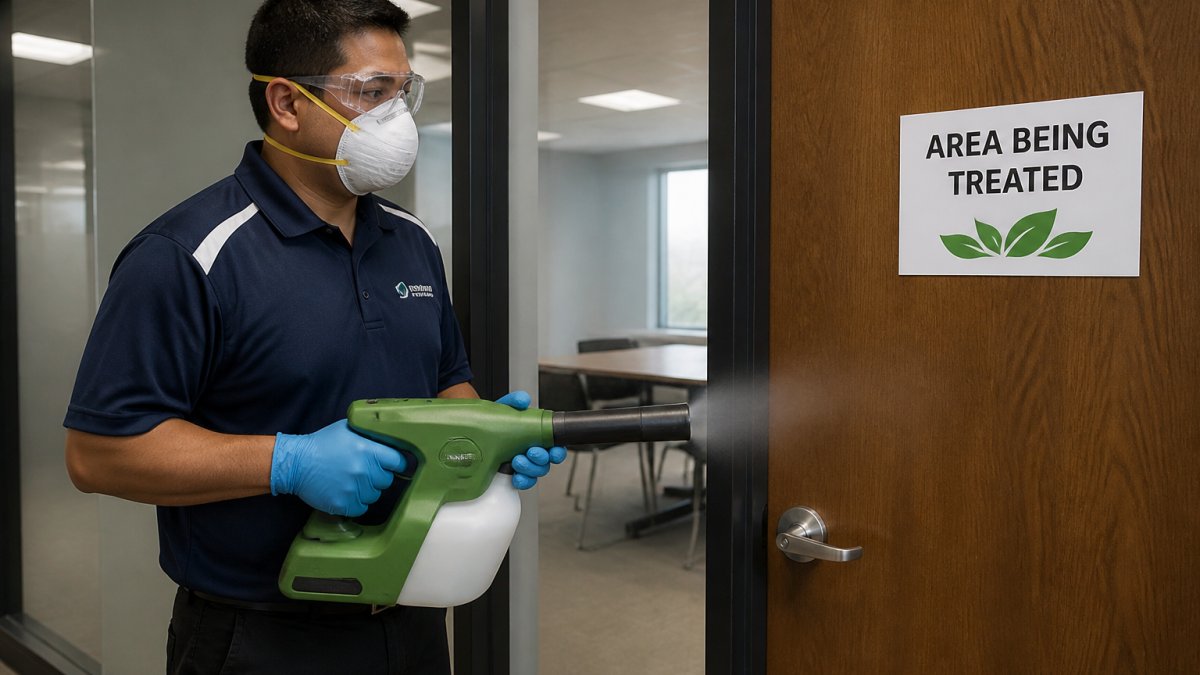
Occupant protection matters as much as applicator protection. A common mistake is treating an occupied office or waiting room mid-shift. Most labels require the area to be vacated and ventilated before people and pets return, build that into your schedule.
Equipment care is the other half. Residue accumulates on nozzles, and a clogged nozzle produces uneven coverage that looks complete but is not. Rinse and inspect after each use.
Hard Surfaces, High-Touch Points, and Where Coverage Efficiency Drops
Hard, non-porous surfaces hold disinfectant where it can work. Porous materials absorb the product and coverage efficiency drops sharply, a chemistry and physics problem, not a sprayer problem.
Prioritize high-touch points: door handles, light switches, elevator buttons, shared keyboards, breakroom counters, and locker room benches, where pathogen transfer actually happens and electrostatic application earns its keep.
| Surface Type | Electrostatic Performance | Why It Matters |
|---|---|---|
| Stainless steel, glass, laminate | Strong | Non-porous, holds dwell time |
| Sealed concrete, vinyl flooring | Strong | Even wrap on flat planes |
| Upholstered fabric, carpet | Weak | Absorbs product, no dwell time |
| Unfinished wood, cardboard | Weak | Porous, may be label-restricted |
| Electronics with open vents | Restricted | Check label and equipment manual |
Cost, Environmental Impact, and Choosing a Verified Shortlist
Cost per treated square foot is the number that matters, and it is almost never the price tag. It is built from four inputs: product cost per ready-to-use gallon, application rate, contact-time labor, and reapplication frequency.
The Cost-Per-Treated-Area Math
Start with cost per ready-to-use gallon. A concentrate is priced per gallon of concentrate, so divide its price by the ready-to-use gallons it yields.
Next, application rate. Electrostatic sprayers apply a fine, charged mist, so volume per square foot is typically lower than a trigger or pump sprayer for the same coverage.
Then, labor. Contact time is paid time. A short labeled dwell time frees the crew to move on sooner; a long soak holds them in place or forces a second pass.
Finally, reapplication frequency. High-touch points in a busy facility may need daily or multiple-daily treatment. A cheaper product applied three times a day can cost more than a pricier one applied once.
Build a spreadsheet with one row per candidate product and columns for cost per RTU gallon, ounces per 1,000 square feet, labeled contact time, and applications per week. The lowest sticker price is rarely the lowest cost per treated square foot.
Environmental Trade-Offs You Can Actually Measure
Environmental impact is a set of trade-offs, not a single score. Concentrates cut plastic packaging waste per treated area but add mixing labor and dilution-accuracy risk, an over-diluted batch underperforms, and an over-concentrated batch wastes product and increases exposure. Ready-to-use products remove the mixing risk but multiply packaging.
Active-ingredient fate matters too. Hydrogen peroxide-based chemistries break down into water and oxygen, a favorable profile, but can be corrosive to certain metals. Sodium chlorite-based chemistries behave differently in wastewater and carry their own handling requirements.
Packaging is the most visible lever and easiest to quantify. Count containers per month for a concentrate program versus an RTU program at the same treated area, a concrete environmental number for your report, not a claim.
Turning the Shortlist Into a Program
A verified shortlist is only useful if it survives a real shift. The deliverable that matters is a program document: products with confirmed electrostatic approval, labeled contact times that fit your schedule, safety requirements your crew can meet, and a cost-per-treated-area figure you can defend to a budget owner.
Pricing for professional disinfection programs depends on square footage, surface mix, frequency, and site access, so we quote each facility individually. What we can publish is the method: verify the label, score the environmental criteria, run the cost math, and document the result, the difference between a wish list of green-sounding products and a program that holds up to inspection and budget review.
Conclusion: Building a Defensible Disinfection Program
The hard part is not picking a product, it is keeping the program consistent across every building, shift, and crew member. Document the label, train to the dwell time, and audit coverage.
This is where Rangel Janitorial does its best work. We bring 30+ years of commercial cleaning experience, fully bonded and insured crews, and specialized electrostatic disinfection that delivers 360-degree coverage across corporate offices, medical facilities, and industrial sites. Our teams are trained, our quality is consistent across multiple properties, and our work is backed by a satisfaction guarantee.
Get a free quote from Rangel Janitorial and build a disinfection program that holds up to inspection.
Frequently Asked Questions
Can any eco-friendly disinfectant be used in an electrostatic sprayer?
No. Sprayer manufacturers and disinfectant label directions must align. Some formulations, particularly those with certain sodium chlorite or quaternary ammonium chemistries, have specific electrostatic application instructions or restrictions. Check the product label for electrostatic use language and confirm the sprayer's manual lists that formulation type as compatible before mixing.
Are eco-friendly disinfectants effective against viruses and bacteria?
When they carry an EPA registration and are used at the listed contact time on the correct surface, yes. EPA-approved disinfectants must demonstrate efficacy against specified pathogens, including SARS-CoV-2 where listed. The key is matching the product's kill claims and contact time to your facility's risk level and the surfaces you treat.
What safety precautions should facility teams follow when using electrostatic sprayers?
Clear the treated area of people and pets, wear appropriate PPE including eye protection and a respirator if the label requires it, ensure ventilation, and follow the label's re-entry time. Train crews on the specific formulation and sprayer model, and post signage during application. Never spray toward faces or directly onto skin.
How do I verify a disinfectant is compatible with my electrostatic sprayer?
Cross-reference two sources: the disinfectant's EPA-registered label for electrostatic application directions, and the sprayer manufacturer's list of approved or compatible formulations. If either is silent, contact the manufacturer. Using an incompatible product can damage the sprayer, reduce charged droplet formation, and void warranties.