 How-to
Managing Cleaning Services for Multiple Locations
Table of Contents
- Why Managing Cleaning Services Across Multiple Locations Breaks Down
- Step 1: Build Site-Specific SOPs Before You Scale
- Step 2: Choose the Right Commercial Cleaning Management Software
- Step 3: Use a Janitorial Service Quality Control Checklist at Every Site
- Step 4: Coordinate Field Staff and Dispatch Management
- Step 5: How to Handle Janitorial Service Complaints Across Sites
- Step 6: Automate Invoicing, Recurring Jobs, and Client Communication
- Managing Cleaning Services for Multiple Locations: When to Consolidate Providers
- Frequently Asked Questions
Last Updated: August 24, 2026
Managing cleaning services for multiple locations is one of those operational challenges that looks manageable until you're actually doing it. At Rangel Janitorial, we've worked with facility managers, property managers, and operations directors across California for over 30 years, and the pattern is consistent: what works for one site quietly falls apart when you add a second, third, or fifth location. Missed areas, inconsistent crews, and complaint response gaps compound fast. Below, we'll walk through exactly how to prevent that from happening, covering everything from SOPs and software to dispatch coordination and complaint resolution.
Why Managing Cleaning Services Across Multiple Locations Breaks Down
The core problem is not effort. It's the absence of systems that scale.
A single-location operation can run on verbal instructions, a manager's memory, and a direct relationship with one cleaning crew. Add more sites, and that informal structure collapses. Site-specific requirements get lost in translation. Crews rotate without briefing. Quality drops at the locations nobody is watching closely that week.
According to BOMA International's facility management resources, inconsistent service standards across facilities is one of the most common drivers of vendor turnover in commercial real estate. The fix is almost never "more oversight." It's standardization before scale.
Three failure points show up repeatedly in multi-location operations:
- No documented site-specific instructions. Every location has unique access codes, layout quirks, and priority areas. Without written records, that knowledge lives in one person's head.
- Reactive quality control. Teams catch problems only after a complaint, not before.
- Fragmented communication. Dispatch, crew, and client are all using different channels, and nothing is logged.
Step 1: Build Site-Specific SOPs Before You Scale
Standard Operating Procedures for multi-site cleaning operations are the single most important investment you can make before adding locations. An SOP is a written document that tells any trained crew member exactly what to do at a specific site, without needing to ask.
What Each SOP Should Cover
Each site SOP should include:
- Site profile: Address, access codes, key contacts, alarm instructions, and parking details
- Scope of work: Room-by-room task list with frequency (daily, weekly, monthly)
- Priority areas: High-traffic zones, restrooms, or compliance-sensitive spaces that require extra attention
- Approved products: Specific cleaning agents, dilution ratios, and any restricted chemicals for that site
- Inspection checkpoints: The specific areas a supervisor should verify before sign-off
- Emergency protocols: What to do if equipment is damaged, a spill occurs, or access fails
Keep SOPs in a shared digital system, not a binder at the site. Crews need access from their phones, and managers need to update them without reprinting.
Cross-Location Inventory and Supply Management
Supply chain management across multiple sites is an underestimated operational overhead. Running out of a specific disinfectant at a medical facility mid-shift is not a minor inconvenience. It's a compliance risk.
A practical cross-location inventory approach:
- Assign a baseline supply par level for each site based on square footage and service frequency
- Conduct a weekly digital inventory check through your management software
- Centralize ordering through one purchasing account to consolidate costs and track usage by location
- Flag sites that are consuming supplies faster than expected. That's often the first signal of a quality control problem or product misuse.
Step 2: Choose the Right Commercial Cleaning Management Software
Commercial cleaning management software is a platform that centralizes scheduling, dispatch, time tracking, quality control, and client communication for cleaning operations. The right tool eliminates the manual coordination overhead that breaks down at scale.
Software Comparison: Which Tool Fits Your Operation
Here's how the leading platforms compare for multi-location cleaning operations:
| Software | Starting Price | Best For | Key Limitation |
|---|---|---|---|
| Swept | $24/mo (1-15 locations) | Janitorial-specific teams | No free trial; geofencing on higher tiers only |
| Connecteam | $29/mo (first 30 users) | Staff communication and scheduling | No invoicing or CRM built in |
| Jobber | $29/mo (1 user) | Client-facing operations, quoting | Weak location-specific reporting |
| Housecall Pro | $59/mo (1 user) | Mobile-first small/mid operations | Per-user fees scale quickly |
| Clean Smarts | $100/mo (first 10 users) | Scheduling, time tracking, QC in one | Limited enterprise-depth |
| ServiceTitan | $245-$300/technician/mo | Large franchises and enterprises | High cost; 12+ month contract required |
Swept is a purpose-built option for commercial cleaning companies. Its location-specific instruction storage, GPS geofencing for clock-in verification, and multi-language support for diverse crews address the exact pain points that generic field service tools ignore.
Connecteam is a choice if your primary gap is crew communication and scheduling, and you're comfortable handling invoicing separately.
ServiceTitan is an enterprise platform. The per-technician pricing and implementation costs make it viable only for large multi-location franchises with complex reporting needs.
Step 3: Use a Janitorial Service Quality Control Checklist at Every Site
Quality assurance in janitorial operations is the practice of verifying that completed work meets defined standards before the client notices a problem. Reactive quality control, where issues surface through client complaints, is the most expensive model possible.
A janitorial service quality control checklist is the operational backbone of proactive QA. It should be completed digitally, tied to the specific site SOP, and submitted through your management software so results are logged and trackable.

Core checklist categories for commercial sites:
- Restrooms: fixtures, floors, dispensers restocked, odor check
- High-touch surfaces: door handles, light switches, elevator buttons disinfected
- Common areas: floors vacuumed/mopped, trash removed, glass cleaned
- Break rooms: counters wiped, appliances cleaned, trash emptied
- Reception/lobby: floors, glass, furniture dusted
- Site-specific areas: per the location SOP (server rooms, medical zones, gym equipment)
- Supply levels: confirm par levels are maintained for next service
- Damage report: any new damage or maintenance issues logged and reported
For medical and dental facilities, the checklist must include verification that electrostatic disinfection protocols were completed and that approved EPA-registered disinfectants were used. The EPA's registered disinfectants list is the authoritative reference for product compliance in healthcare-adjacent settings.
KPI Benchmarks to Track Multi-Location Performance
Without performance data, you can't distinguish a location that's underperforming from one that's simply more demanding.
Useful KPIs for multi-location cleaning operations:
| KPI | What It Measures | Review Frequency |
|---|---|---|
| Inspection pass rate | % of checklists completed without flags | Weekly per site |
| Complaint rate | Complaints per 100 service visits | Monthly |
| Response time to complaints | Hours from complaint to resolution | Per incident |
| Supply variance | Actual vs. expected supply consumption | Monthly per site |
| Crew consistency rate | % of shifts completed by assigned crew | Monthly |
Track these by location, not just in aggregate. A single underperforming site can drag down your overall numbers and remain invisible until the client cancels.
Step 4: Coordinate Field Staff and Dispatch Management
Effective dispatch management for multi-location cleaning teams means the right crew arrives at the right site, on time, with the right instructions and supplies, every time. Dispatch coordination at scale requires three things: a centralized schedule visible to all supervisors, real-time GPS clock-in verification, and site-specific job instructions pushed to crew phones before they arrive.
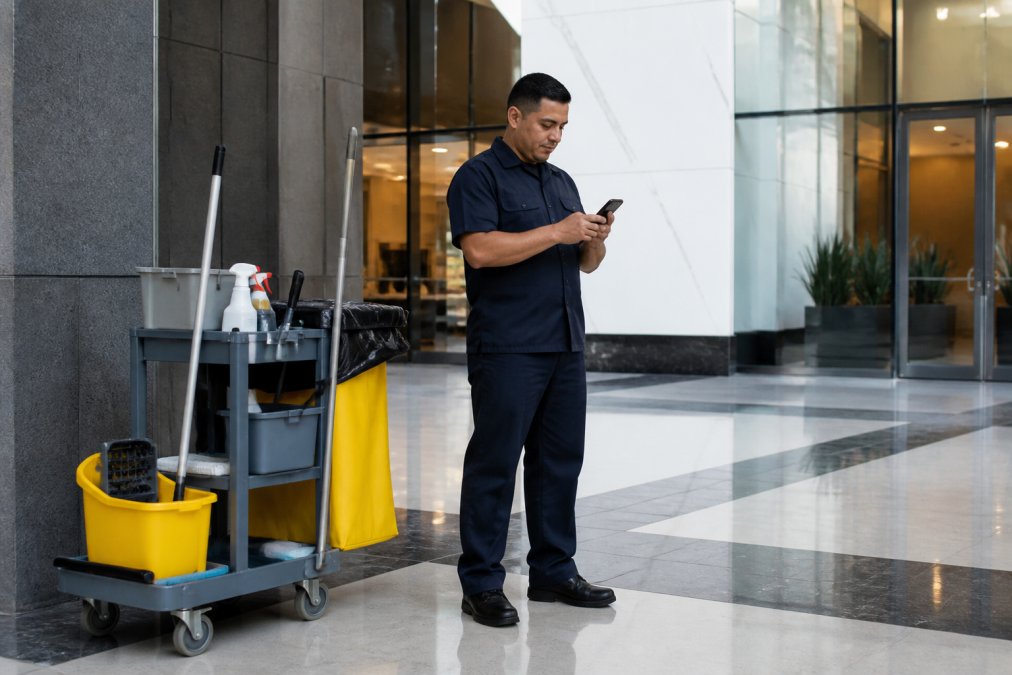
Route optimization matters more than most operations managers initially realize. Inefficient routing between sites wastes labor hours and increases fatigue, which directly affects quality at later stops.
Staff Accountability and Conflict Resolution in Remote Teams
Remote team accountability is where multi-location operations most commonly fail silently. A crew member who underperforms at a site with no supervisor present will not self-report. The problem surfaces in client complaints or lost contracts.
The most effective accountability structure combines technology with clear expectations:
- GPS-verified clock-in and clock-out at each site
- Photo documentation of completed work submitted through the mobile app
- Regular supervisor spot-checks on a randomized, unannounced schedule
- A written performance standard that every crew member signs at onboarding
Conflict resolution in remote teams requires a documented process. When a client reports an issue at a specific site, the investigation must follow a consistent sequence: review the digital clock-in record, review the submitted checklist photos, speak with the assigned crew lead, and document the outcome.
Step 5: How to Handle Janitorial Service Complaints Across Sites
Handling janitorial service complaints effectively requires a response framework that is fast, consistent, and site-specific. The most common complaint from facility managers isn't that problems occur. It's that the response takes days and nothing changes.
A functional complaint resolution process for multi-location operations:
- Acknowledge within 2 hours. The client needs to know the complaint was received and is being addressed.
- Investigate within 24 hours. Pull the digital records: clock-in logs, checklist submissions, and any photo documentation from that service visit.
- Respond with findings within 48 hours. Tell the client what the records show and what corrective action is being taken. Be specific.
- Implement a site-specific corrective measure. If the issue is structural, update the site SOP. If it's a crew issue, address it directly with documentation.
- Follow up after the next service visit. Confirm the issue was resolved.
As noted by ISSA, the worldwide cleaning industry association, service recovery done well typically strengthens client retention more than error-free service alone.
Step 6: Automate Invoicing, Recurring Jobs, and Client Communication
Invoicing automation and recurring job management are the operational backbone of a scalable multi-location cleaning business. Manual invoicing across multiple locations introduces errors, delays, and administrative overhead that compounds as you grow.
The core automation stack for a multi-location operation:
- Recurring job templates: Set up each location's service schedule once. The software generates work orders automatically for each visit.
- Automated invoicing: Invoices trigger on job completion, not on a manual billing cycle.
- Client booking portal: Clients can request additional services, view service history, and submit questions without calling your office.
- Automated reminders: Payment reminders, upcoming service notifications, and renewal alerts reduce administrative follow-up.
Jobber and Housecall Pro both handle this workflow well for small to mid-sized operations. ServiceTitan adds deeper job costing and commission tracking for larger teams.
When job completion data flows automatically into your reporting dashboard, you can see which sites are consuming more labor hours than budgeted. That's the data you need to renegotiate contracts or adjust staffing before a site becomes unprofitable.
Managing Cleaning Services for Multiple Locations: When to Consolidate Providers
Managing cleaning services for multiple locations with a patchwork of different vendors is a common starting point and a difficult long-term strategy. Each vendor has different SOPs, different communication protocols, and different quality standards. Coordinating them is a part-time job.
The case for consolidating to a single provider becomes clear when you're spending more time managing vendor relationships than reviewing outcomes. A single provider with documented multi-location capability offers a unified SOP framework, one point of contact for complaints, consistent crew training standards, and consolidated invoicing.
According to Building Owners and Managers Association's property management guidance, multi-location service consistency is the primary evaluation criterion when property managers assess vendor contracts.
Managing cleaning services for multiple locations requires a provider with the infrastructure to match. That means documented SOPs per site, trained crews who follow them, a complaint response process with teeth, and the operational depth to maintain quality whether they're servicing one building or fifteen.
Robert K., who manages multiple properties, put it directly: "Managing multiple properties means I need a cleaning company I can count on. Rangel delivers consistent quality across all our buildings."
Managing cleaning services for multiple locations comes down to one decision made repeatedly: build the system, or manage the chaos. The system is always faster in the long run.
Frequently Asked Questions
Q: How do you maintain consistent cleaning standards across multiple facilities?
A: Consistency starts with documented site-specific SOPs that every crew follows, regardless of location. Pair those with a digital quality control checklist completed after each visit, regular supervisory inspections, and a centralized platform where managers can review time-stamped reports by site. Recurring service schedules reduce variability, and a single provider accountable across all locations eliminates the coordination gaps that appear when you split contracts between vendors.
Q: What metrics should I track to evaluate multi-site cleaning performance?
A: Track inspection pass rates per location, complaint frequency and resolution time, crew attendance and on-time arrival rates, client satisfaction scores, and labor utilization against scheduled hours. For medical or high-traffic facilities, also monitor disinfection compliance rates. Reviewing these KPIs monthly by site lets you spot underperforming locations before small issues become service failures, and gives your provider clear benchmarks to meet under any service level agreement.
Q: What are the benefits of using a single provider for all facility locations?
A: A single provider simplifies accountability significantly. One point of contact handles scheduling, complaints, and quality control across every site, which cuts administrative overhead and prevents the finger-pointing that happens between multiple vendors. Crews trained under one set of standards deliver more predictable results. For property managers overseeing several buildings, consolidated billing and unified reporting also make it easier to compare performance across locations and hold the provider to consistent expectations.
Q: How do you handle janitorial service complaints in a multi-location setup?
A: Establish a single escalation channel, such as a dedicated email or client portal, so complaints from any site reach the right person immediately rather than getting lost in text threads. Log every complaint with the site name, date, issue type, and resolution time. Require a response acknowledgment within a set window, typically two to four hours, and a corrective action within 24 hours. Review complaint logs monthly by location to identify patterns and address root causes before they repeat.
Multi-location facility management is demanding, and the cost of inconsistent cleaning compounds quickly across sites. Rangel Janitorial brings over 30 years of experience, fully bonded and insured crews, and tailored cleaning plans to every location we service, from corporate offices to medical facilities requiring specialized electrostatic disinfection. Get a free quote from Rangel Janitorial and see what consistent, site-specific quality looks like across your entire portfolio.