 Comparison
Janitorial Software vs Service Providers: Which to Choose
Last Updated: November 2, 2026
Quick Summary
Choosing between janitorial software and service providers depends on whether you need a tool to manage cleaning or the cleaning itself. Janitorial software suits established in-house teams with 3+ sites, while a service provider supplies trained, bonded crews and supervision under a recurring contract. Software is cheaper only if you already have the labor.
- Software does not reduce headcount; it makes existing headcount more accountable.
- Normalize both options to an annual cost per square foot before deciding.
- Employee adoption is the make-or-break variable for any janitorial software platform.
- Small single sites with no cleaning staff should choose a service provider.
- The most common service contract failure is a vague scope of work.
Table of Contents
- Software or Service Provider: The Core Decision
- Side-by-Side Comparison: Cost, Control, and Coverage
- What Janitorial Management Software Actually Does
- Janitorial Inspection Software and Quality Assurance
- Janitorial Bidding Software and Job Costing
- What Commercial Cleaning Service Providers Deliver
- Decision Matrix by Business Size and Operating Model
- Vendor Due Diligence and Contract Risks to Watch
- Frequently Asked Questions
Software or Service Provider: The Core Decision
Choosing between janitorial software and service providers comes down to one question: are you buying a tool to manage cleaning, or buying the cleaning itself? Janitorial software gives your team scheduling, inspections, and billing tools. A commercial cleaning service provider supplies trained crews, supplies, and supervision.
The distinction matters because the two options solve different problems. Software helps you run a cleaning operation you already have. A service provider replaces the need to run one at all.
Below, we break down the real costs, the control trade-offs, and a decision matrix by business size so you can pick with confidence.
Side-by-Side Comparison: Cost, Control, and Coverage
Neither option wins on every measure. Software gives you control and data; outsourcing gives you coverage and fewer moving parts. The table below frames the trade-offs, and the sections that follow break down the cost math most guides skip.
| Factor | Janitorial Software | Service Provider |
|---|---|---|
| Upfront cost | Subscription plus setup and training time | No software cost; pay for service |
| Ongoing cost | Per-user or per-location licenses, admin labor, integration upkeep | Recurring contract fee covering labor, supplies, supervision, insurance |
| Control | High: you set every process, schedule, and inspection standard | Moderate: you set the scope and service level, they execute |
| Staffing burden | Yours to hire, train, and manage | Provider supplies, trains, and backfills crews |
| Quality assurance | You build inspection routines and scoring criteria | Provider handles supervision; you audit against the contract |
| Technology risk | Yours: adoption, data migration, vendor continuity | Provider's: you inherit their tools and processes |
| Best for | Established in-house teams with 3+ sites | Facilities without cleaning staff or that want to exit the staffing business |
The honest trade-off: software is cheaper only if you already have the labor. Add staffing costs and the gap closes fast.
Total Cost Comparison Across In-House, Software, and Outsourcing
Three paths, three cost structures. Most buyers compare sticker prices and miss the largest line items. Here is what actually belongs in each column.
Outsourced service provider. Labor, supplies, supervision, insurance, bonding, and equipment are typically folded into one recurring contract fee.
A common pattern: facility managers compare a software subscription to a cleaning contract and conclude software is "cheaper" without counting the payroll behind it.
Watch out: comparing a per-user software quote to a per-square-foot cleaning contract is apples to oranges. Normalize both to an annual cost per square foot before you decide.
Where the Control Trade-Off Actually Bites
Control sounds like a pure win for software until you count what it costs to exercise it. With software, you own every scheduling decision, every inspection standard, and every hiring and firing call, which is an advantage if you have management depth and a liability if you do not. With a provider, you trade day-to-day control for contractual control: service-level agreements, inspection rights, and cancellation terms become your levers. Buyers who regret outsourcing usually negotiated a weak scope; buyers who regret software usually underestimated the management hours required to run it.
What Janitorial Management Software Actually Does
Janitorial management software is a cloud-based platform that organizes scheduling, timekeeping, inspections, and billing for a cleaning operation. It does not clean anything. It tracks, documents, and reports on the work your own crews perform.
The core modules typically include crew scheduling and dispatching, mobile time tracking, inspection checklists with photo capture, invoicing, and job costing. Some platforms add bidding tools and client portals. Products in this space include janitorial management platforms that bundle scheduling, time tracking, inspections, and billing.
The catch most guides skip: software only pays off if your staff actually adopt it. Employee adoption is the make-or-break variable. A platform nobody opens is a subscription with no return.
Janitorial Inspection Software and Quality Assurance
Janitorial inspection software turns quality assurance into a repeatable record instead of a walkthrough you forget by Friday. Inspectors score restrooms, floors, and common areas against a checklist, attach photos, and log deficiencies.
This is where software genuinely beats a paper binder. You get a documented trail for client disputes and a way to catch a slipping crew before the client calls. For multi-site operations, inspection dashboards show which buildings are consistently underperforming.
Watch out: inspections only work when the scoring criteria match what the client actually cares about. A perfect score on a checklist nobody values is theater. Build the checklist from the contract scope, then inspect against it.
Janitorial Bidding Software and Job Costing
Janitorial bidding software helps you estimate a job's labor hours and price it before you sign. Job costing then compares estimated hours to actual hours once the work starts, which is where profitability lives or dies.
The value here is honest math. A bid built on guesswork wins contracts that lose money. Bidding tools force you to break a building down by square footage, fixture counts, and frequency, then price labor realistically.
For an in-house operation, this matters when you bid on new work or justify your budget internally. For a service provider, it is survival.
What Commercial Cleaning Service Providers Deliver
Commercial cleaning service providers deliver trained, bonded crews, supplies, equipment, and supervision under a recurring contract. You buy an outcome, a consistently clean facility, rather than the tools to produce it.
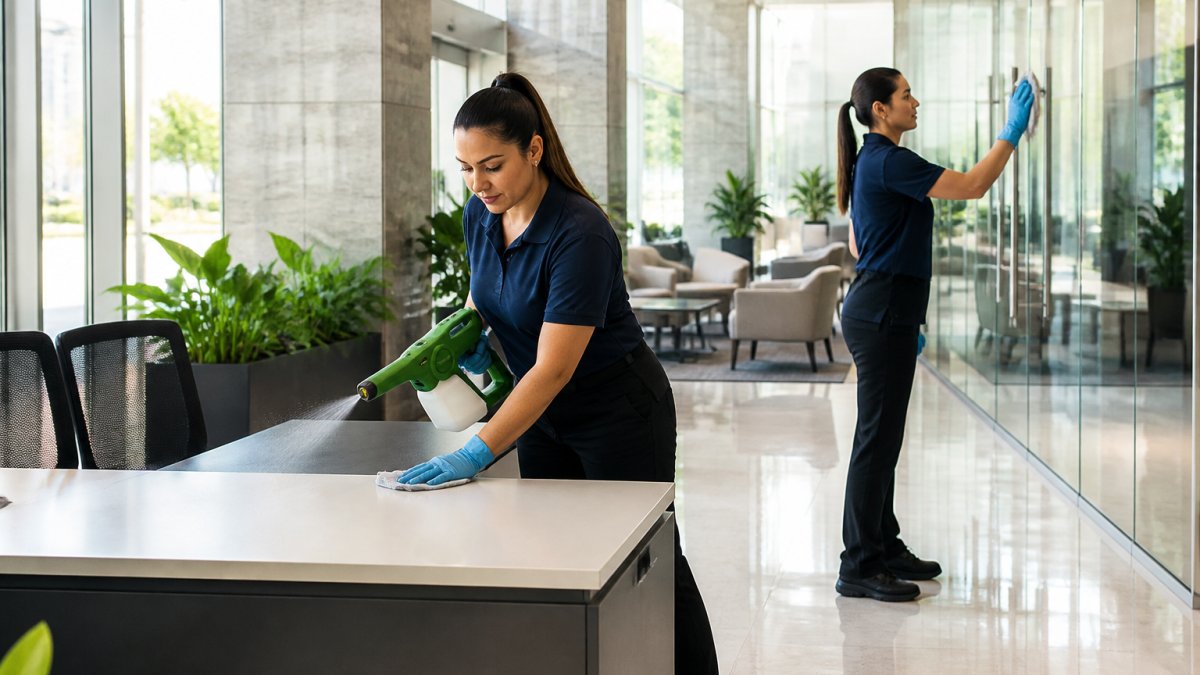
A good provider handles the parts most facility managers underestimate: hiring, turnover, training, callouts, and quality supervision. When a crew member is absent, the provider backfills the shift. Rangel Janitorial provides trained, bonded and insured crews and specialized electrostatic disinfection.
If you want to see what a full janitorial program looks like in practice, you can explore our janitorial cleaning services and request a quote. For facilities weighing sustainability, it helps to understand green cleaning methods and certifications before you compare proposals.
Decision Matrix by Business Size and Operating Model
Match the option to your situation, not to a generic "best of" list. Here is how we would decide.
| Your Situation | Recommended Path | Why |
|---|---|---|
| Small single site, no cleaning staff | Service provider | No hiring or software overhead |
| Growing multi-site operator | Janitorial software | Scheduling and inspections scale across sites |
| Established in-house team, 3+ buildings | Software plus training | You already carry the labor cost |
| Medical or regulated facility | Service provider with documented protocols | Compliance and disinfection expertise |
| Cost-focused, high-turnover operation | Service provider | Removes staffing and turnover risk |
The pattern: software rewards operations that already have crews; outsourcing rewards operations that would rather not build one. If you are leaning toward hiring a service and want to plan the switch well, read our guidance on when to hire a janitorial service and how to time the transition.
Vendor Due Diligence and Contract Risks to Watch
Vendor due diligence separates a reliable partner from a contract you regret, and the checklist differs depending on whether you are buying software or a service. Facilities directors in public-sector settings can also review Murrieta school district cleaning vendor selection for RFP, SLA, and prevailing-wage guidance. Most guides cover only the service side. Here is both.
Diligence on a Janitorial Software Vendor
Software diligence is about data, continuity, and exit. Ask these before you sign:
- Data ownership and export. Confirm in writing that your scheduling, inspection, and client data are yours and that you can export it in a usable format on demand, not just at contract end. Ask what happens to photos and inspection records if you leave.
- Service-level agreement. Look for uptime commitments, support response times, and remedies if the platform is down during a shift. A cleaning operation runs early mornings and nights; confirm support hours match your crews' schedules.
- Implementation commitments. Clarify what onboarding includes, data migration, training sessions, configuration, and what is billed separately. Get a written go-live date and a named implementation contact.
- Cancellation and renewal terms. Check notice periods, auto-renewal clauses, and whether unused licenses are refundable. Multi-year discounts are common; make sure the exit terms match the commitment.
- Vendor continuity. Ask how long the vendor has operated, who owns the company, and what happens to your data if the product is acquired or discontinued. A platform that disappears takes your inspection history with it.
- Security and access controls. Confirm role-based permissions, audit logs, and backup frequency. Your crews and clients are in the system; treat access accordingly.
Diligence on a Commercial Cleaning Service Provider
Service diligence is about coverage, compliance, and accountability. Verify insurance and bonding certificates directly with the issuer rather than accepting copies, and check references for facilities similar to yours in size and use.
Watch out: the most common contract failure is a vague scope. "General cleaning" invites disputes over what is included. Specify restroom frequency, floor care, consumable supplies, response times for complaints, and the process for backfilling an absent crew member.
Ask how fast the provider responds to complaints, what happens when a crew member is absent, and whether disinfection protocols meet your facility's requirements. For a deeper checklist of insurance, references, and red flags, see how to choose the right commercial cleaning company.
The Transition Plan Belongs in the Contract
Whichever path you choose, treat implementation as a project with milestones. For software, that means a phased rollout, one site or one crew first, then expand, with a training plan and an adoption metric you actually track (logins, inspections completed, schedules published). For a service provider, that means a written transition plan covering the first 30 days, a site walkthrough with the incoming supervisor, and a defined point at which you will review performance against the scope.
Frequently Asked Questions
Should a business hire a janitorial service or manage cleaning in-house with software?
It depends on whether you want to run the operation or buy the outcome. Janitorial software suits organizations that already employ cleaning staff and need scheduling, time tracking, and inspections in one place. Hiring commercial cleaning service providers suits facility managers who would rather hand off staffing, training, bonding, and coverage to a dedicated crew. Compare the fully loaded cost of wages, benefits, turnover, and management time against a service contract before deciding.
How does janitorial management software help facility managers?
Janitorial management software centralizes crew scheduling, dispatching, timekeeping, and attendance so supervisors stop rebuilding spreadsheets each week. It also ties inspections and service requests to specific sites, which makes recurring programs easier to audit. The catch is that the software only reports what your team does; it does not supply the labor. If you do not already run a cleaning operation, the tool adds administrative work without solving coverage.
What should you compare when choosing a commercial cleaning provider?
Check four things: proof of bonding and insurance, crew training and turnover, response times for complaints, and how quality is measured. Ask for the certificate of insurance directly rather than accepting a verbal claim. Request a sample inspection report and a named account contact. For medical or gym facilities, confirm the provider's disinfection method and whether it covers high-touch equipment and locker rooms, not just floors and trash.
Can janitorial software manage inspections and service requests?
Yes. Janitorial inspection software lets supervisors score completed work on a phone, attach photos, and route deficiencies back to the crew or account manager. That creates a record you can review with a client or use to catch recurring misses. The limitation is adoption: if cleaning staff do not consistently log inspections, the data is incomplete. Plan for onboarding and training time before you rely on the reports.
When should a business outsource its cleaning services?
Outsourcing makes sense when cleaning is not your core operation and managing crews distracts from your main business. Multi-site property managers, medical practices, and gym operators often fit this profile because coverage, compliance, and consistency matter more than direct control. Rangel Janitorial, for example, provides bonded and insured crews with tailored plans across multiple properties. If you already have a strong in-house team and want better reporting, software is the lighter step.