 How-to
How to Verify Bonded and Insured Cleaners
Table of Contents
- What Does Bonded and Insured Mean?
- The Difference Between Bonded and Insured
- Janitorial Service Insurance Requirements Explained
- Step-by-Step Verification Process for Bonded and Insured Cleaners
- How to Request a Certificate of Insurance from Vendors
- Verifying Contractor Licenses Through CSLB
- Why You Should Hire Bonded and Insured Cleaners
- Risks of Hiring Uninsured Cleaners
- Frequently Asked Questions
Last Updated: September 1, 2026
What Does Bonded and Insured Mean?
Bonded means a cleaning company has purchased a surety bond, a financial guarantee backed by a third party that covers losses if the company fails to perform contracted work or causes damage. Insured means the company carries general liability insurance and worker's compensation coverage, protecting clients and employees in case of accidents or property damage.
These are two separate protections. A surety bond protects you if the contractor doesn't complete the job or steals from your facility. General liability insurance covers accidental damage like a broken window or spilled chemicals. Worker's compensation insurance ensures the cleaning crew's medical bills are covered if someone gets hurt on the job, protecting you from liability claims.
Many business owners confuse these terms or assume one covers the other. They don't. A bonded company isn't automatically insured, and an insured company isn't necessarily bonded. Both matter when hiring a professional cleaning service.
The Difference Between Bonded and Insured
Bonded coverage is a three-party agreement: you (the client), the cleaning company, and the bonding agency. If the company damages your property or fails to deliver services, you file a claim with the bonding agency. The bonding agency investigates and pays legitimate claims, then the company reimburses the bonding agency. This creates accountability because the bond can be revoked if claims pile up.
Insurance coverage is a two-party agreement between the cleaning company and their insurance provider. If a crew member breaks equipment, gets injured, or causes property damage, the insurance company pays for covered losses. You benefit because the company's insurance covers your facility and protects you from being sued directly.
In practice: if a cleaner damages your carpet during a job, general liability insurance covers the repair cost. If the same cleaner doesn't show up for three scheduled cleanings and you hire someone else at premium rates, the surety bond covers that financial loss.
| Coverage Type | Protects Against | Who Pays | Claim Process |
|---|---|---|---|
| Surety Bond | Non-performance, theft, contract breaches | Bonding agency (company reimburses) | File with bonding agency |
| General Liability Insurance | Property damage, accidental injury | Insurance company | File with insurance company |
| Worker's Compensation | Employee injuries on the job | Insurance company | Company's insurer covers |
Rangel Janitorial maintains both surety bonds and comprehensive general liability coverage across all operations. This dual protection means your facility is covered whether the issue stems from performance failures or unexpected accidents during service delivery.
Janitorial Service Insurance Requirements Explained
Commercial cleaning operations typically carry three types of insurance: general liability, worker's compensation, and sometimes commercial property coverage.
General liability insurance is the foundation. It covers bodily injury, property damage, and personal injury claims. Reputable companies carry at least $1 million in general liability per occurrence (the American Dental Association).
Worker's compensation insurance is legally required in most states for any company with employees. It covers medical expenses and lost wages if a crew member is injured while working at your facility. Without it, you could face liability if a cleaner gets hurt and sues your business directly. If a company claims they don't have it because their workers are "independent contractors," that's a red flag.
Surety bonds are often required by contract or facility management companies. They guarantee the cleaning company will perform the agreed services.
Some facilities, particularly medical offices and healthcare settings, require additional specialized coverage. Ask your facility management team or insurance broker what specific coverage your building requires before hiring any cleaning service.
The California Contractors State License Board (CSLB) requires licensed contractors to carry liability insurance as a condition of licensure.
Step-by-Step Verification Process for Bonded and Insured Cleaners
Verifying that a cleaning company is actually bonded and insured requires more than accepting their word.

Step 1: Request Documentation Directly
Contact the cleaning company and request copies of their current certificate of insurance (COI) and surety bond documentation. A legitimate company will have these ready to send within 24 hours. If they hesitate or delay, that's a warning sign.
Ask for:
- Certificate of Insurance showing general liability coverage
- Certificate of Insurance showing worker's compensation coverage
- Copy of their surety bond or bonding agency contact information
- Business license and proof of contractor licensing (if applicable)
Request that documents be sent via email with the company's official letterhead.
Step 2: Examine the Certificate of Insurance
When you receive the COI, look for these critical details:
Verify the company name matches exactly what you're hiring.
Check the policy dates. The effective and expiration dates must show current coverage. If expiration is within 30 days, ask when renewal is scheduled.
Confirm coverage limits. General liability should be at least $1 million per occurrence.
Identify the insurance carrier. The carrier name should be a recognizable insurance company. Verify it through the National Association of Insurance Commissioners (NAIC) database at NAIC insurance company lookup.
Look for "additional insured" language. Some COIs list your facility as an "additional insured," which means you're protected under their policy.
A legitimate COI includes the insurance broker's contact information, which is your verification pathway.
Step 3: Contact the Insurance Provider
Don't rely solely on documentation the cleaning company provides. Contact the insurance company directly to verify the policy is active and coverage limits are accurate.
Call the insurance company's main line (look up the carrier's number independently). Ask to verify:
- Is there an active general liability policy for [company name]?
- What are the current coverage limits?
- What is the policy expiration date?
- Is [your facility name] listed as an additional insured?
Insurance companies will confirm basic policy details over the phone. If the insurance company cannot find a policy matching the company name and policy number on the COI, the documentation is fraudulent. Stop the engagement immediately.
How to Request a Certificate of Insurance from Vendors
When vetting a new cleaning company or requiring proof from an existing vendor, use this process to request documentation professionally.
Send a formal request email:
Subject: Certificate of Insurance Request
Dear [Company Name],
We are considering your company for cleaning services at [Facility Name/Address]. Before we proceed, we require current documentation of your insurance and bonding coverage.
Please provide:
- Certificate of Insurance (COI) showing general liability coverage with [Your Facility Name] listed as additional insured
- Certificate of Insurance showing worker's compensation coverage
- Copy of your surety bond or bonding agency contact information
- Proof of business license and any contractor licensing
Please send these documents within 2 business days. The coverage must be current and valid for the full term of our service agreement.
Thank you, [Your Name] [Your Title] [Facility Name]
Set a deadline. Request documents within 2 business days. If they can't meet this timeline, they're either disorganized or don't have the documentation.
Specify additional insured status. Ask that your facility be named as an additional insured on their general liability policy.
Request renewal reminders. Ask the company to notify you 30 days before their insurance and bonding expire.
Document everything. Keep copies of all documentation in your vendor file and update it annually. Set calendar reminders to request updated COIs 60 days before expiration.
Verifying Contractor Licenses Through CSLB
If you're hiring a contractor-licensed cleaning company in California, the Contractors State License Board (CSLB) maintains a public database where you can verify licensing status and disciplinary history.
Visit the CSLB website at CSLB license lookup database. Search by company name, license number, or owner name.
The database shows:
- Current license status (active, inactive, or expired)
- License classification
- License expiration date
- Disciplinary actions or complaints
- Whether they have a current bond on file
An active license means the company has passed background checks and carries required insurance. If the license is inactive or expired, the company is not legally authorized to operate as a licensed contractor. Check the disciplinary history for patterns of problems.
This verification applies specifically to California. If your facility is in another state, check that state's contractor licensing board.
Why You Should Hire Bonded and Insured Cleaners
Hiring bonded and insured cleaners protects your facility, your employees, and your business from financial and legal exposure.
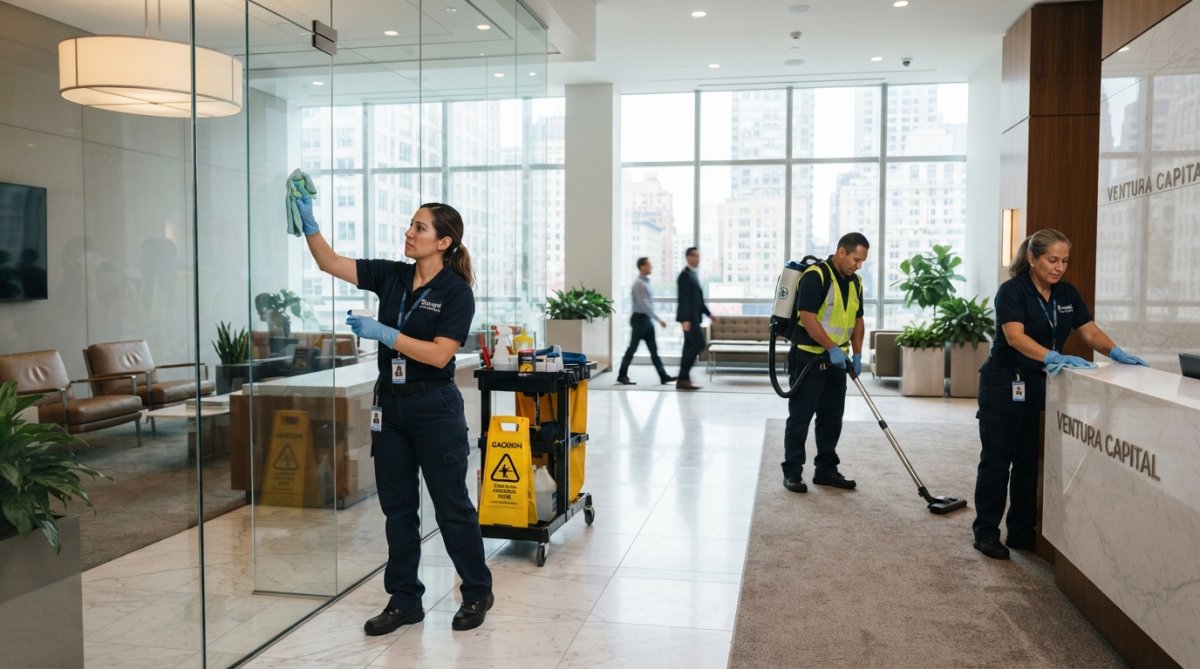
Protection from property damage. Accidents happen, spilled bleach, damaged door frames, broken equipment. General liability insurance covers repair or replacement costs. Without it, you're paying out of pocket.
Coverage for employee injuries. If a cleaner gets hurt at your facility and you hired an uninsured contractor, you could face a lawsuit. Worker's compensation insurance protects you from liability claims and covers medical expenses.
Assurance of performance. A surety bond means the cleaning company has financial incentive to show up and do the job right. If they don't, the bond reimburses you for costs to hire a replacement service.
Compliance with facility requirements. Many corporate office buildings, medical facilities, and industrial parks require proof of bonding and insurance as a condition of service.
Professional credibility. A company willing to invest in bonding and insurance demonstrates they're established and professional.
Peace of mind. When something goes wrong, you know there's a financial backstop. You're not left arguing with the cleaning company or absorbing the cost yourself.
At Rangel Janitorial, our fully bonded and insured crews operate across California with comprehensive coverage. This commitment to proper insurance and bonding is part of how we guarantee satisfaction and protect the facilities we serve.
Risks of Hiring Uninsured Cleaners
Hiring an uninsured or unbonded cleaning company might seem cheaper upfront, but the financial and legal risks far outweigh any savings.
Direct liability exposure. If an uninsured cleaner causes property damage, you have no insurance claim to file. You either absorb the cost or pursue a lawsuit, which is expensive and often unproductive.
Employee injury liability. If a cleaner without worker's compensation gets hurt at your facility, they can sue your business directly. You could face a six-figure judgment.
Theft and property loss. An unbonded cleaner who steals from your facility leaves you with no recourse. A bonded company's surety bond covers this loss.
Regulatory penalties. Some facility management agreements require proof of bonding and insurance. Hiring uninsured contractors violates those agreements.
Service interruption. An uninsured operator has no financial incentive to complete contracted work. If they stop showing up, you have limited recourse.
Reputational damage. If an uninsured cleaner causes an incident at your facility, your business bears the reputational cost.
Hidden costs. One incident, a broken window, slip-and-fall injury, or stolen equipment, can cost thousands. Insurance costs a fraction of that.
Rangel Janitorial's commitment to comprehensive bonding and insurance reflects our understanding that proper coverage is a fundamental part of professional service.
Protecting your facility starts with hiring cleaners you can verify and trust. Bonded and insured cleaners demonstrate professionalism, accountability, and financial responsibility. By following the verification steps outlined here, requesting documentation, examining certificates, contacting insurance providers, and checking licensing records, you ensure your facility is in capable hands.
Rangel Janitorial brings 30 years of experience delivering fully bonded and insured cleaning services across California. Our crews are trained, credentialed, and backed by comprehensive coverage that protects your facility and your business. When you need cleaning services you can count on, get a free quote from Rangel Janitorial and experience the difference professional, properly insured service makes.
Frequently Asked Questions
How can I verify if a cleaning company is truly bonded and insured?
Request a certificate of insurance (COI) directly from the cleaning company and verify the policy details match their claims. Contact the insurance provider listed on the certificate to confirm active coverage. For surety bonds, ask for the bonding agency's name and policy number, then call the agency to confirm the bond is current. Check the contractor's license status through your state's licensing board. These three steps, COI verification, provider confirmation, and license lookup, form the complete verification process.
What is the difference between being bonded and being insured?
Insurance protects you if the cleaning company causes property damage or theft occurs during service. A surety bond guarantees the cleaning company will complete work according to the service agreement; if they don't, the bonding agency covers losses up to the bond amount. Both are important: insurance covers accidents and damage, while a surety bond ensures contractual compliance. Many reputable cleaning services carry both to demonstrate full liability protection and professional accountability.
What documents should I request from a commercial cleaning contractor?
Request a current certificate of insurance showing general liability coverage with your facility listed as an additional insured. Ask for proof of worker's compensation insurance if they employ staff. Request their business license and contractor license number. For janitorial service insurance requirements, verify coverage limits meet your facility's standards, typically $1 million general liability minimum for commercial properties. Request a copy of their service agreement outlining coverage details and claims procedures. Keep copies on file for your records.
Why is it risky to hire a cleaning service without proper coverage?
Uninsured cleaners leave your facility exposed to liability if they're injured on your property, damage equipment, or cause property damage. You could face legal claims, medical bills, and repair costs without recourse. Uninsured companies may cut corners on training and safety protocols, increasing accident risk. If theft occurs during service, you have no coverage or recovery option. Hiring bonded and insured cleaners transfers liability risk to their insurance provider and ensures professional standards are maintained.