 How-to
How to Improve Office Hygiene Standards in 2026
Table of Contents
- Why Standard Cleaning Routines Fall Short of True Office Hygiene
- Step 1: Define Your Office Hygiene Standards with a Written Policy
- Step 2: Establish a Daily and Weekly Office Cleaning Checklist for Employees
- Step 3: Prioritize High-Touch Surfaces and Germ Hotspots
- Step 4: An Electrostatic Disinfection for Small Businesses Guide
- Step 5: How to Handle Hygiene Issues in the Workplace Professionally
- Sustaining High Standards Through Training and Auditing
- Frequently Asked Questions
Last Updated: September 9, 2026
Office hygiene is the foundation of workplace safety, directly influencing employee health, productivity, and retention. Yet most facilities fall short because they treat cleaning as a cosmetic task rather than a systematic infection control process. At Rangel Janitorial, we have spent over 30 years refining how to improve office hygiene standards for corporate, medical, and industrial clients across California.
Standard cleaning routines focus on making spaces look tidy. True office hygiene is about microbial control: removing pathogens from surfaces, maintaining air quality, and preventing cross-contamination between people and shared equipment. This guide outlines a practical, step-by-step framework for improving your facility's hygiene protocols, from written policies to advanced disinfection technology.
Why Standard Cleaning Routines Fall Short of True Office Hygiene
The biggest mistake facilities make is equating visible cleanliness with biological safety. A desk can look spotless while harboring active pathogens on the keyboard, phone, and mouse. Standard routines often miss the distinction between cleaning, which removes dirt and some germs, and sanitization, which reduces pathogens to safe levels, and disinfection, which destroys them entirely.
Most basic contracts focus on emptying trash and vacuuming floors. These tasks matter for aesthetics but do little for infection control. High-touch surfaces like door handles, elevator buttons, and breakroom appliances require a deliberate disinfection schedule with appropriate cleaning supplies. Without this focus, the office becomes a vector for seasonal illness that drives absenteeism and disrupts operations.
Step 1: Define Your Office Hygiene Standards with a Written Policy
Office hygiene standards begin with a documented policy that states expectations clearly. This document should define cleaning frequency, assign responsibility, and list the specific disinfectants approved for use. A written policy transforms vague intentions into enforceable workplace safety rules.
Start by mapping every area of your facility: workstations, meeting rooms, restrooms, breakrooms, and shared equipment. For each zone, specify the required cleaning tasks and how often they occur. Restrooms require daily disinfection of fixtures and floors, while individual workstations may need only scheduled weekly deep cleaning with daily spot checks (the CDC). The CDC guidelines on cleaning and disinfecting facilities provide a useful baseline for determining which surfaces need routine disinfection versus routine cleaning.
Your policy must also address waste disposal and personal hygiene expectations. Clearly state that employees should wash hands regularly, cover coughs, and stay home when ill. Respiratory etiquette and hand hygiene are preventative measures that reduce the pathogen load your cleaning team must manage.
Step 2: Establish a Daily and Weekly Office Cleaning Checklist for Employees
A practical office cleaning checklist for employees bridges the gap between professional janitorial service and daily upkeep. Professional crews handle deep cleaning, but employees contribute by maintaining their immediate environment between visits. However, the traditional model of assigning a fixed desk to each employee is fading. In a hybrid or hot-desking setup, the responsibility for hygiene becomes diffuse, and a static checklist fails to address the reality that a desk might have three different occupants in a single week.
To close this gap, your checklist must be designed for a fluid environment. Instead of assigning tasks to a specific person for a specific desk, assign them to a zone or a team for a period. For example, a 'Zone Captain' for the fourth-floor breakout area is responsible for ensuring that the shared monitor stands, desk phones, and chair arms are wiped down at the end of each day, regardless of who used them. This prevents the 'not my desk' excuse that undermines hygiene in shared spaces.
Your daily checklist should include:
- End-of-Day Desk Reset: Employees using a shared desk must wipe down the keyboard, mouse, and desk surface with a disinfectant wipe before leaving. This is a non-negotiable rule for hot-desking.
- Personal Item Management: Encourage employees to keep personal items (headsets, pens, water bottles) in a locker or bag rather than leaving them on a shared desk overnight. This reduces the surface area that requires disinfection and minimizes the risk of cross-contamination.
- Spill and Trash Protocol: Spills should be reported immediately via a facility management app or to the front desk, not just left for the nightly crew. Food waste should be removed from desks and taken to the central waste station daily.
For weekly tasks, the focus shifts to items that are frequently touched but often overlooked in daily cleaning:
| Task | Frequency | Responsible Party | Supplies Needed |
|---|---|---|---|
| Wipe keyboard, mouse, phone | Daily (End of Day) | Employee (Desk User) | Disinfectant wipes |
| Clear trash and food waste | Daily | Employee | Trash bags |
| Disinfect shared printers and copiers | Daily | Janitorial crew | Disinfectant spray, cloths |
| Deep clean workstations | Weekly | Janitorial crew | Multi-surface cleaner |
| Sanitize breakroom appliances | Weekly | Janitorial crew | Food-safe disinfectant |
| Wipe down chair arms and armrests | Weekly | Zone Captain | Disinfectant wipes |
| Disinfect shared monitor stands and cables | Weekly | Zone Captain | Disinfectant wipes |
This shared model works because it distributes the workload and assigns clear ownership to shared spaces. It moves beyond the simple 'wipe your desk' advice found in generic guides and addresses the specific hygiene risks introduced by flexible seating arrangements. By integrating this into your onboarding and periodic training, you turn the checklist from a piece of paper into a behavioral standard.
Step 3: Prioritize High-Touch Surfaces and Germ Hotspots
High-touch surfaces are the primary transmission points for illness in any office. Door handles, light switches, elevator buttons, handrails, and shared keyboards are touched by dozens of people daily. These germ hotspots require disinfection multiple times per day, not just during the nightly cleaning pass. But identifying these hotspots is only the first step; the real challenge is measuring whether your disinfection frequency actually matches the traffic each surface receives.
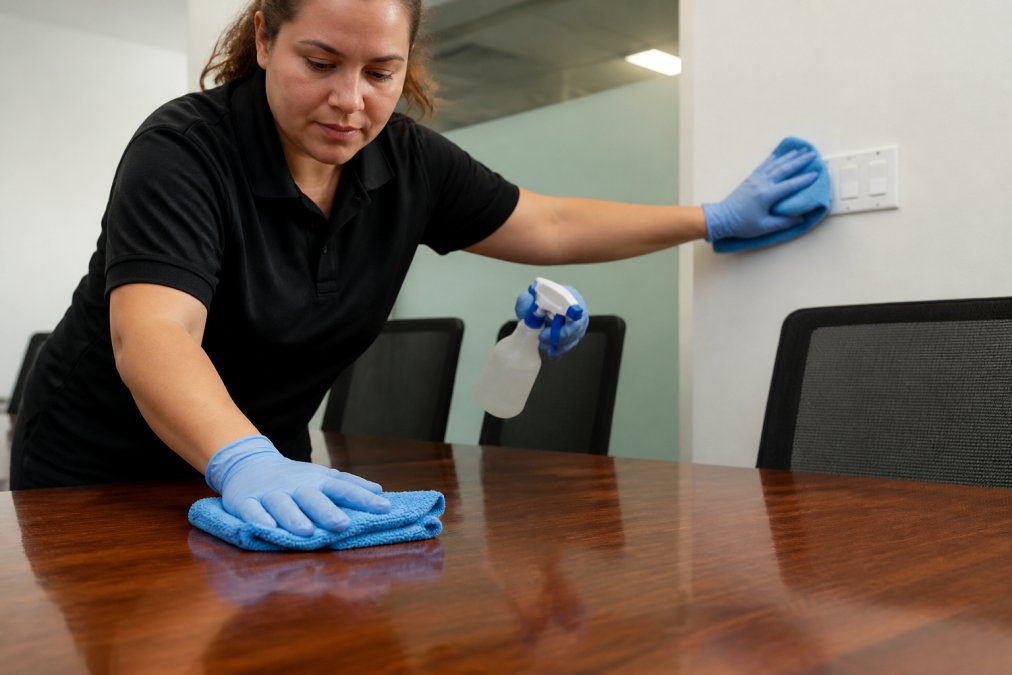
A common approach is to create a focused disinfection list separate from the general cleaning schedule. This list should include reception counters, restroom door pulls, faucet handles, vending machines, and conference room AV controls. Your janitorial team should hit these points at least twice daily, with additional passes during cold and flu season. Cross-contamination is a real risk here, so crews must use color-coded cloths, one for restrooms and another for general areas, to avoid spreading pathogens between zones.
However, a static list becomes outdated quickly. A conference room used for two hours a day has a different risk profile than a main entrance lobby that sees constant foot traffic. To move beyond guesswork, leading facility managers are turning to sensor technology to track usage patterns. For instance, IoT-enabled door sensors can log the number of times a restroom door is opened per hour. This data allows you to adjust disinfection frequency dynamically, if a restroom near the breakroom sees 200 touches by 10 a.m., a midday disinfection pass is justified; if a rarely used meeting room sees only 10 touches all day, a nightly clean is sufficient.
This data-driven approach is the core of a modern hygiene protocol. It shifts the conversation from 'we clean everything twice a day' to 'we clean high-traffic zones three times a day and low-traffic zones once, based on actual usage data.'
For surfaces that are difficult to clean manually, such as elevator buttons or keypads, consider supplementing chemical disinfection with UV-C light devices. These portable wands or fixed fixtures can provide a secondary layer of microbial reduction on electronics that cannot be soaked with liquid disinfectants. While UV-C is not a replacement for cleaning, it is an effective addition for items that are both high-touch and sensitive to moisture.
Finally, do not forget the 'forgotten' hotspots that are unique to modern offices: the touchscreen on the conference room scheduling panel, the handles of the coffee machine, and the shared phone chargers at a charging station. These items are frequently touched but rarely appear on a standard cleaning checklist. Add them to your list and ensure your janitorial crew knows they are part of the scope.
By combining a detailed hotspot map with usage data and targeted technology, you move beyond the generic advice to a systematic, risk-based disinfection strategy that protects employees where they actually interact with the environment.
Step 4: An Electrostatic Disinfection for Small Businesses Guide
Electrostatic disinfection is a technology that applies a positive electrical charge to disinfectant as it leaves the sprayer. The charged particles are attracted to negatively charged surfaces, wrapping around objects and coating all sides, including the undersides that manual wiping misses. This provides true 360-degree coverage that is difficult to achieve with cloths and spray bottles.
For small businesses, this method is particularly valuable for periodic deep cleans and outbreak response. Unlike daily spot cleaning, electrostatic disinfection is a scheduled event that should occur quarterly, or immediately after a confirmed illness in the building.
Rangel Janitorial offers specialized electrostatic disinfection with trained professional crews who understand how to apply the technology safely and effectively. This service delivers consistent quality across multiple properties, ensuring that every chair, desk, and piece of shared equipment receives thorough coverage. For facility managers weighing options, this approach improves the consistency of the result.
Step 5: How to Handle Hygiene Issues in the Workplace Professionally
Eventually, every facility manager must address how to handle hygiene issues in the workplace, from an employee who leaves a messy kitchen to a vendor who misses a cleaning milestone. The professional approach is to rely on your written policy rather than personal confrontation.
When an issue arises, reference the documented standard and explain the gap objectively. For employee messes, a brief private conversation that points to the policy usually resolves the problem. For recurring issues with your cleaning provider, schedule a walkthrough and document the specific deficiencies with photos. This creates an audit trail that holds the vendor accountable.
Occupational health depends on consistent enforcement. If you tolerate a dirty breakroom or a skipped restroom disinfection, you signal that hygiene standards are optional. Facility maintenance requires the same rigor as any other compliance activity, with clear expectations, regular checks, and consequences for non-compliance.
Sustaining High Standards Through Training and Auditing
High standards erode quickly without active management. The final step in improving office hygiene is building a feedback loop that includes employee training and routine auditing. Employees need to understand why the protocols exist, not just what to do. Short training sessions on hand hygiene, respiratory etiquette, and workstation cleanliness reinforce the importance of their role.
Auditing should be scheduled and systematic. Use a cleaning checklist to score each zone on a pass or fail basis for visible cleanliness, odor, and supply levels. Many facility managers conduct these audits monthly and share results with their janitorial partner to drive continuous improvement. The OSHA guidelines on workplace housekeeping emphasize that good housekeeping is a fundamental part of infection control and accident prevention.
Sustaining these efforts requires a partner who treats your facility as their own. Rangel Janitorial provides tailored cleaning and real-time facility upkeep, backed by fully bonded and insured crews and a satisfaction guarantee that has earned the trust of more than 500 California businesses. Our consistent quality across multiple properties means you can focus on operations while we maintain the environmental health of your workspace.
Frequently Asked Questions
What are the OSHA requirements for office cleanliness?
OSHA requires employers to maintain workplaces that are clean, orderly, and sanitary under the General Duty Clause and housekeeping standards. This means regular waste disposal, proper storage of materials, and keeping floors dry and free of hazards. While OSHA does not dictate specific cleaning frequencies, it mandates that surfaces and facilities be maintained to prevent health risks. Your written hygiene policy should align with these requirements, covering restroom sanitation, breakroom cleanliness, and the safe handling of cleaning supplies.
How often should high-touch surfaces be disinfected in an office?
High-touch surfaces like doorknobs, light switches, elevator buttons, and shared keyboards should be disinfected at least once daily, and more often in high-traffic areas or during cold and flu season. Breakroom appliances and restroom fixtures may need attention multiple times per day. Your office cleaning checklist for employees should assign daily disinfection of personal workstations, while professional crews handle common areas on a more frequent schedule to reduce cross-contamination risks.
What is the difference between cleaning, sanitizing, and disinfecting?
Cleaning removes visible dirt and debris using soap or detergent and water. Sanitizing reduces germs on surfaces to a safe level, as defined by public health standards. Disinfecting kills pathogens on surfaces using EPA-registered chemicals. For office hygiene standards, you need all three: cleaning first to remove soil, then sanitizing or disinfecting depending on the surface. High-touch areas require disinfecting, while general floors and windows may only need cleaning and occasional sanitizing.
How do you address hygiene concerns with employees professionally?
Start with a private, respectful conversation focused on workplace impact rather than personal criticism. Reference your written hygiene policy and remind the employee of shared expectations like hand hygiene and workstation cleanliness. If the issue involves illness, encourage them to use sick leave and follow respiratory etiquette. For persistent problems, document the discussions and involve HR to ensure consistent, compliant handling. This approach maintains dignity while protecting team health and office hygiene standards.
Improving office hygiene standards is a continuous process of policy, execution, and verification. The challenge is maintaining momentum when other priorities compete for your attention. Rangel Janitorial simplifies this with over 30 years of experience, trained professional crews, and specialized electrostatic disinfection that delivers 360-degree coverage for a pristine environment. Get a free quote today and let our team handle the details of your facility maintenance.