 How-to
How to Handle Janitorial Service Complaints
Table of Contents
- Common Commercial Cleaning Service Issues
- How to Respond to a Cleaning Complaint
- How to Handle Janitorial Service Complaints with a Complaint Letter Template
- Using a Janitorial Service Quality Assurance Checklist to Prevent Issues
- Setting Clear Expectations to Prevent Future Complaints
- Handling Unreasonable Demands and De-Escalation Tactics
- Post-Resolution Follow-Up and Client Retention
- Frequently Asked Questions
Last Updated: August 25, 2026
Common Commercial Cleaning Service Issues
Cleaning complaints rarely emerge from nowhere. They're typically symptoms of deeper operational misalignment: unclear expectations, inconsistent staffing, or communication breakdowns. Understanding common issues helps you diagnose problems before they escalate into contract disputes.
Inconsistent cleaning quality tops the list. A facility looks pristine Monday morning, then mediocre by Wednesday, usually signaling rotating crew assignments without proper handoff documentation or crews rushing through tasks to meet unrealistic timelines. Medical facilities and corporate offices are especially sensitive to this because cleanliness directly impacts client perception and regulatory compliance.
Missed shifts and reliability issues create immediate friction. When a janitorial crew doesn't show, your facility becomes a liability. For a medical practice, missed disinfection cycles can jeopardize patient safety protocols (the CDC). For a corporate office, it damages your professional image in front of clients.
Inadequate attention to high-traffic areas represents another frequent complaint. Entryways, restrooms, and common areas accumulate dirt and germs faster than other spaces, yet crews sometimes treat them as secondary. This is particularly problematic in gyms and fitness centers where equipment sanitization directly affects member health and retention (peer-reviewed research).
Damage to facility surfaces or equipment during cleaning operations creates legal and financial complications. A crew uses the wrong chemical on marble flooring, or pressure-washing equipment damages landscaping. These incidents require documentation, accountability, and swift remediation.
Finally, poor communication during the service relationship generates frustration. When facility managers can't reach supervisors, don't receive status updates on complaint resolution, or discover issues only through tenant complaints, the service relationship deteriorates. The best janitorial providers treat communication as part of the service itself.
How to Respond to a Cleaning Complaint
Responding effectively to janitorial service complaints requires a structured process that balances immediate action with thorough investigation. Your response sets the tone for whether this becomes a one-time issue or a recurring pattern.

Step 1: Listen and Acknowledge
The first response to any complaint should be to listen without defensiveness. Acknowledge the problem immediately, even if you don't yet know the cause. A simple statement like "I understand this isn't meeting your standards, and I want to fix it" prevents escalation.
Ask clarifying questions: When did you notice this? What specifically fell short? Is this recurring or a one-time problem? These details determine whether you're fixing a one-day failure or a systemic problem.
Document the complaint in writing immediately. Email confirmation back to the complainant with specifics: date, time, location, and nature of the issue. This creates a clear record and demonstrates that you're taking the concern seriously.
Step 2: Document the Issue
Create a formal complaint record that includes date, time, location, specific area affected, description of the problem, and the name of the person reporting it. Include photos if the issue is visible. This documentation helps your janitorial provider understand exactly what went wrong, protects you legally, and creates a baseline for measuring whether corrective action worked.
For recurring complaints about the same area or issue, flag the pattern immediately. If you've documented three complaints about a specific restroom within two weeks, that's a systemic problem requiring supervisory intervention.
Step 3: Investigate and Inspect
Don't rely solely on the complaint report. Visit the facility yourself and inspect the area in question. Your assessment determines whether this is a legitimate service failure or a mismatch between client expectations and what was contracted.
Compare the actual condition against your documented standards. Ask your janitorial supervisor to walk the facility with you. Their perspective on what's realistic versus what's a genuine miss matters.
Step 4: Communicate Your Findings
After investigation, communicate results back to the complainant and your janitorial service provider simultaneously. Be specific: "The restroom was not restocked with paper towels as scheduled. Our crew supervisor confirms this was missed on Tuesday at 2 PM due to a scheduling conflict." Specific findings create accountability.
If the issue is legitimate, outline exactly what corrective action you're taking. If it's a mismatch between expectations and service scope, explain that clearly too.
Step 5: Execute the Remedy
For legitimate service failures, the remedy should match the severity. A missed cleaning on one occasion might warrant a re-clean at no charge and a brief conversation with the crew. A pattern of missed high-touch areas in a medical facility requires retraining, schedule adjustment, or potentially a crew change.
Set a follow-up inspection date. Don't assume the problem is fixed; verify it. This demonstrates commitment to resolution and gives you data on whether your corrective action actually worked.
How to Handle Janitorial Service Complaints with a Complaint Letter Template
A formal complaint letter creates a clear record and forces both parties to articulate the problem and expected resolution in writing. Use this template when verbal communication hasn't resolved an issue or when you need documented evidence for contract enforcement.
Janitorial Service Complaint Letter Template:
[Your Facility Name] [Date]
[Janitorial Service Provider Name] [Service Provider Address]
RE: Formal Complaint, Service Failure at [Facility Location]
Dear [Service Provider Supervisor/Manager]:
I am writing to formally document a service failure that occurred on [date] at [specific location/area within facility]. This letter serves as official notice of the issue and our expectation for remediation.
Issue Description: [Specific details: What was wrong? Which area? What was the impact? Include time of day if relevant.]
Contract Reference: This failure violates our Service Level Agreement, specifically Section [X], which requires [specific contractual obligation].
Documentation: [Reference any photos, inspection reports, or other evidence attached.]
Impact: [How did this affect your facility operations, tenant experience, or compliance? Be specific.]
Requested Remedy: [What specific action you need taken? Re-cleaning? Crew reassignment? Retraining? Timeline?]
Timeline for Resolution: We expect this issue to be resolved by [specific date]. Please confirm receipt of this letter and your remediation plan within [24-48 hours].
If this issue recurs, we reserve the right to [specify consequence: charge for re-cleaning, reduce payment, terminate contract, etc.] as outlined in our service agreement.
Please contact me at [phone/email] to discuss this matter.
Sincerely, [Your Name] [Your Title] [Contact Information]
Send this letter via email with read receipt and keep a copy in your complaint file. The formality of a written complaint often prompts faster, more serious response than verbal complaints alone.
Using a Janitorial Service Quality Assurance Checklist to Prevent Issues
Prevention is always more cost-effective than remediation. A structured quality assurance checklist gives your janitorial crews clear standards and gives you a measurable way to verify they're meeting them.
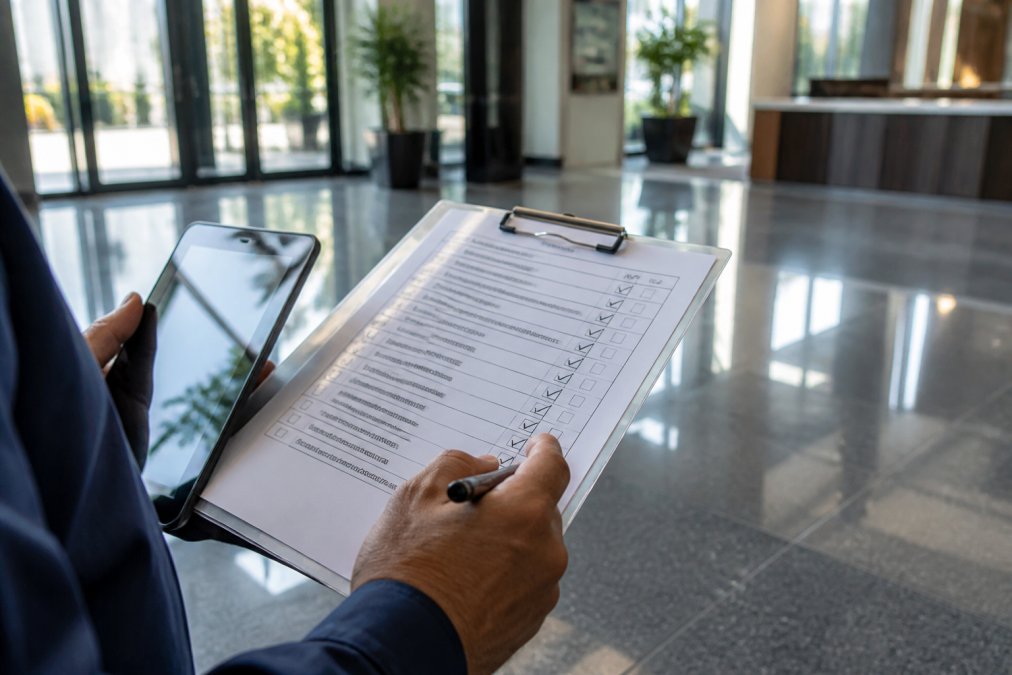
An effective checklist should be specific to your facility type. A medical office checklist looks different from a corporate office or gym. The checklist guides crew behavior during cleaning and provides objective criteria for your inspections.
Sample Quality Assurance Checklist for Commercial Offices:
| Area | Standard | Frequency | Pass/Fail |
|---|---|---|---|
| Entryways | Floors swept and mopped, mats in place, glass clean | Daily | ☐ |
| Restrooms | Toilets cleaned, sinks sanitized, mirrors streak-free, supplies stocked | 3x daily | ☐ |
| Common areas | Dust surfaces, vacuum carpets, empty trash | Daily | ☐ |
| High-touch surfaces | Door handles, light switches, railings sanitized | 2x daily | ☐ |
| Conference rooms | Vacuumed, tables wiped, trash emptied | Daily after hours | ☐ |
| Break rooms | Appliances wiped, floors mopped, trash removed | Daily | ☐ |
Conduct inspections on a random schedule, not at the same time every week. Crews who know exactly when you're inspecting will perform better during those windows and potentially cut corners other times. When you find items that fail the checklist, address them immediately with the crew supervisor.
Setting Clear Expectations to Prevent Future Complaints
Most janitorial service complaints stem from misaligned expectations, not malicious intent. Your cleaning crew thinks they're meeting the standard. You think they're falling short. This gap creates frustration and erodes the relationship.
Prevent this by documenting expectations in writing before service begins. Your service level agreement should specify exactly what "clean" means for each area, how often cleaning occurs, response time for issues, and what constitutes acceptable performance.
Instead of saying "restrooms should be clean," specify: "Restrooms will be cleaned at 8 AM, 12 PM, and 4 PM daily. Toilets will be scrubbed and disinfected. Sinks will be sanitized. Mirrors will be cleaned streak-free. Paper towel and soap dispensers will be checked and refilled. Trash will be emptied. Any issues will be reported to the facility manager within 2 hours."
For specialized services like electrostatic disinfection, include technical specifications. What surfaces will be treated? How often? What disinfectant is used? Medical facilities especially need this clarity because disinfection standards carry regulatory implications (osha.gov).
Schedule regular check-in meetings, monthly for new relationships and quarterly once established, to discuss performance, address minor issues before they become complaints, and adjust expectations if needed.
Handling Unreasonable Demands and De-Escalation Tactics
Not every complaint is legitimate. Some clients have unrealistic expectations about what cleaning can achieve or how quickly issues can be resolved. You need to distinguish between genuine service failures and unreasonable demands.
When facing an escalated complaint, stay calm and professional. Acknowledge their frustration: "I understand this is frustrating. Let's work through exactly what happened and what we can realistically fix."
Ask clarifying questions: "Is this happening every day or occasionally?" "Are other areas meeting your standards?" "What would resolution look like to you?" These questions often reveal whether the issue is systemic or isolated, and whether expectations are realistic.
If expectations genuinely don't match what's contracted or what's operationally feasible, have that conversation clearly. You might say: "Your facility is in a high-traffic area with 200 people moving through daily. Maintaining pristine conditions during business hours isn't realistic. We can increase cleaning frequency during off-hours and add midday touch-ups to high-traffic zones. Give them options, not ultimatums."
Document these conversations in writing. If a client continues making unreasonable demands after you've explained limitations, that's a contract management issue.
Post-Resolution Follow-Up and Client Retention
After you've resolved a complaint, follow up. A simple check-in, "We re-cleaned that area on Tuesday. How does it look now?", demonstrates commitment to client satisfaction and gives you early warning if your remedy didn't work.
For serious complaints, schedule a follow-up inspection with the client present. Walk the facility together, verify that the issue is resolved, and discuss any adjustments needed going forward.
Track complaint patterns over time. If the same facility reports issues repeatedly, you're either dealing with a difficult client or a genuine service problem. Data helps you distinguish between the two. A facility that complains once every six months about different issues might be communicating important feedback. A facility that complains weekly about the same problem needs either retraining, crew changes, or a contract review.
Use resolved complaints as learning opportunities. If a crew missed an area consistently, other crews probably do too. That's a training issue. Each complaint is data about your operation.
For clients who've had complaints resolved well, they often become more loyal than those who never complained. When a facility manager sees that you respond professionally to problems, that builds trust.
At Rangel Janitorial, we've spent 30 years managing these dynamics across hundreds of California facilities. The pattern is consistent: transparent communication, documented standards, and swift professional response transform complaints from relationship threats into relationship strengtheners.
Handling janitorial service complaints effectively requires balancing immediate responsiveness with systematic investigation. Listen without defensiveness, document thoroughly, investigate independently, communicate findings clearly, and execute remedies that match the severity of the issue. Use checklists and written agreements to prevent complaints from occurring in the first place. When complaints do arise, see them as opportunities to demonstrate reliability and professionalism.
For facilities in California managing multiple locations or specialized needs like medical office sanitization, working with a provider experienced in complaint resolution matters. The International Facility Management Association (IFMA) emphasizes that service quality and customer satisfaction directly impact facility operations and tenant retention. Rangel Janitorial brings 30 years of experience handling these dynamics across corporate offices, medical facilities, and industrial parks, with fully bonded and insured crews trained in professional service recovery. When issues do occur, our systematic approach to investigation and remediation means problems get resolved, not repeated. Get a free quote and discuss your facility's specific standards and expectations.
=== FAQ ANSWERS (audit these too, same rules) ===
[1] Q: What are the most common janitorial service complaints? A: The most common complaints include inconsistent cleaning quality, missed areas, missed scheduled service appointments, inadequate disinfection in high-traffic zones, and poor communication. Facility managers often report that crews skip corners, leave equipment unclean, or fail to follow specific protocols for restrooms and break rooms. Documentation of these recurring issues helps establish patterns and justifies corrective action or service provider changes.
[2] Q: How should I document a janitorial service complaint? A: Document complaints immediately with the date, time, location, specific issue, and photos if applicable. Note which areas were affected and whether the problem affects client satisfaction or compliance standards. Use a janitorial service quality assurance checklist to standardize documentation. Keep records organized by location and service provider for pattern analysis. This documentation supports accountability conversations and protects you if disputes arise over service level agreement violations.
[3] Q: What should a janitorial service complaint letter include? A: A professional janitorial service complaint letter should include the date of service, specific areas or tasks that failed to meet standards, the impact on your facility, reference to your service contract terms, and a clear request for remediation with a deadline. Be factual rather than emotional, cite your service level agreement, and propose a solution. Keep the tone professional and businesslike to maintain the relationship while establishing accountability and expectations for resolution.
[4] Q: How quickly should a cleaning service respond to complaints? A: Most commercial service providers should acknowledge complaints within 24 hours and complete remediation within 48 to 72 hours, depending on the severity. Critical issues affecting client operations, health standards, or compliance should be addressed the same day. Your service contract should specify response times. Delays in addressing complaints signal poor accountability and may justify escalation or service provider evaluation. Rangel Janitorial prioritizes rapid response to ensure your facility maintains professional standards.
Frequently Asked Questions
What are the most common janitorial service complaints?
The most common complaints include inconsistent cleaning quality, missed areas, missed scheduled service appointments, inadequate disinfection in high-traffic zones, and poor communication. Facility managers often report that crews skip corners, leave equipment unclean, or fail to follow specific protocols for restrooms and break rooms. Documentation of these recurring issues helps establish patterns and justifies corrective action or service provider changes.
How should I document a janitorial service complaint?
Document complaints immediately with the date, time, location, specific issue, and photos if applicable. Note which areas were affected and whether the problem affects client satisfaction or compliance standards. Use a janitorial service quality assurance checklist to standardize documentation. Keep records organized by location and service provider for pattern analysis. This documentation supports accountability conversations and protects you if disputes arise over service level agreement violations.
What should a janitorial service complaint letter include?
A professional janitorial service complaint letter should include the date of service, specific areas or tasks that failed to meet standards, the impact on your facility, reference to your service contract terms, and a clear request for remediation with a deadline. Be factual rather than emotional, cite your service level agreement, and propose a solution. Keep the tone professional and businesslike to maintain the relationship while establishing accountability and expectations for resolution.
How quickly should a cleaning service respond to complaints?
Most commercial service providers should acknowledge complaints within 24 hours and complete remediation within 48 to 72 hours, depending on the severity. Critical issues affecting client operations, health standards, or compliance should be addressed the same day. Your service contract should specify response times. Delays in addressing complaints signal poor accountability and may justify escalation or service provider evaluation. Rangel Janitorial prioritizes rapid response to ensure your facility maintains professional standards.