 How-to
How to Conduct a Commercial Cleaning Site Audit in 7 Steps
Quick Summary
A commercial cleaning site audit is a structured walk-through that checks whether a building meets the cleaning standard its contract promises. Conduct one by defining the scope, building a checklist, walking the site in a fixed order, scoring each area, and tracking corrective actions.
- Set audit frequency by traffic: high-traffic areas monthly, lower-traffic areas quarterly.
- Write checklist items as observable pass/fail criteria so two inspectors reach the same result.
- Audit unannounced and after the crew finishes, so results reflect the standard the building holds.
- Rate each area on a 1 to 5 scale and track scores across months to spot declines early.
- Match corrective deadlines to severity: safety hazards get same-day attention, cosmetic items can wait.
Table of Contents
- Why a Commercial Cleaning Site Audit Matters
- Step 1: Define the Scope and Audit Frequency
- Step 2: Build a Commercial Cleaning Inspection Checklist
- Step 3: Walk the Site and Record Findings on a Commercial Cleaning Audit Form
- Step 4: Score Each Area With a Cleaning Inspection Scorecard
- Step 5: Document Deficiencies and Set Corrective Actions
- Applying Cleaning Quality Assurance Best Practices After the Audit
- Scheduling Your Next Audit With Rangel Janitorial
- Frequently Asked Questions
Last Updated: November 5, 2026
How to Conduct a Commercial Cleaning Site Audit in 7 Steps
A commercial cleaning site audit is a structured walk-through that checks whether a building meets the cleaning standard the contract promises. The process is simpler than most managers expect. This guide from Rangel Janitorial walks you through seven steps, from setting the scope to correcting what you find.
Why a Commercial Cleaning Site Audit Matters
Cleaning problems rarely show up in a single dramatic failure. They build up as missed restrooms, dusty vents, and tired floors that nobody notices until a tenant complains. A regular audit catches those gaps early, while they are still cheap to fix.
It also gives you evidence. When a vendor says the work is done, the audit form tells you exactly what was checked and what passed. That record protects both sides of the contract and makes review conversations much faster.
Step 1: Define the Scope and Audit Frequency
Start by listing every area the cleaning contract covers. Include restrooms, break rooms, lobbies, offices, stairwells, and exterior entrances. Note which areas get daily, weekly, or monthly service.
Most managers audit high-traffic areas every month and lower-traffic areas every quarter. Pick a schedule you can keep, then stick to it.
- List every area covered by the contract
- Mark each area's required service frequency
- Set a monthly or quarterly audit calendar
Step 2: Build a Commercial Cleaning Inspection Checklist
A commercial cleaning inspection checklist turns vague expectations into specific items. Write one line per task, such as "restroom sinks wiped and sanitized" or "trash liners replaced." Specific items make results easier to compare from one audit to the next.
Group items by area so the inspector can work through the building in a logical route. A workable structure is one checklist section per area, restrooms, break rooms, lobby and entrances, offices and workstations, stairwells and corridors, elevators, exterior walkways, and trash and recycling, with each section listing only the tasks the contract requires for that area at that frequency.
Build the checklist in three passes:
- Pull from the contract scope. Every line item should trace back to a task the contract names. If the contract says "high-touch surfaces disinfected daily," the checklist needs a line for door handles, light switches, and shared keyboards, not a generic "disinfect surfaces" line.
- Write observable pass/fail criteria. "Restroom clean" is not auditable. "No visible soil on sinks, mirrors free of spots, soap and paper stocked, no odor" is. Each line should describe what a passing result looks like so two different inspectors reach the same conclusion.
- Set the inspection method. Note whether an item is checked visually, by touch (dust on ledges, grit on floors), or by smell (restroom odor, trash). Method notes keep inspectors consistent and make findings defensible in a vendor conversation.
Match checklist length to frequency. Checklist length should match service frequency: daily-service areas such as restrooms and break rooms need more detail than quarterly areas such as stairwells and storage rooms. A checklist that runs 200 lines for a small office will not get used; one that runs 10 lines will miss the problems tenants call about.
Include a small set of cross-area items that apply everywhere: trash removed and liners replaced, floors free of debris and spills, horizontal surfaces dust-free, glass and mirrors streak-free, and supplies stocked. These become the backbone of your scorecard in Step 4.
Watch out: Do not copy a generic checklist from the internet and run it unchanged. A checklist that tests tasks outside the contract produces findings the vendor can legitimately dispute, and it trains crews to ignore the audit.
Keep the checklist versioned. Date each revision and note what changed, so a score decline can be traced to a real service problem rather than a checklist that quietly got stricter.
Step 3: Walk the Site and Record Findings on a Commercial Cleaning Audit Form
Walk the building in the same order every time. Check each item on the checklist and note what you see on a commercial cleaning audit form. Take photos of any problem so the vendor knows exactly what to fix.
Keep notes factual. Write "trash overflowing in third-floor break room" rather than "bad cleaning." Facts are easier to act on and harder to dispute.
The difference between an audit that changes behavior and one that gets filed and forgotten is the form design and the sampling method behind it. Treat the audit form as a data-collection tool, not a clipboard of complaints.
Sample the same way every visit. You cannot inspect every restroom stall and every office on a large site, so decide in advance what gets sampled and hold it constant. A common pattern is to inspect every restroom on the floor plan, a fixed percentage of offices (for example, every fifth office on a route), all entrances and lobbies, and one stairwell per floor. Record the sample in the form header, date, time, inspector, building, floors inspected, and areas skipped, so month-over-month scores compare like with like. If the sample changes, the score change may be an artifact of the sample, not the cleaning.
Time the walk to the service window. Inspect after the crew has finished and before the building opens, or during the shift for day-porter service. Auditing a restroom mid-morning after 200 employees have used it measures traffic, not cleaning quality. Note the inspection time on the form and keep it consistent.
Capture evidence in a standard format. Each deficiency entry should carry five fields: location (building, floor, room), checklist item, observed condition, photo reference, and severity. Severity drives the corrective-action deadline in Step 5, a blocked exit or a wet floor without signage is a safety item and gets same-day attention, while a dusty vent cover can wait for the next scheduled service. Photos should be dated and named by location so they can be attached to the vendor report without explanation.
Score on the spot, not from memory. Rate each checklist item pass, partial, or fail as you stand in the area, and let the form calculate the area score. Deferring scores to the end of the walk is where audits drift toward impression and away from evidence.
Track the metrics that make the program measurable. Beyond the area score, log the number of deficiencies by severity, the percentage of items passed, repeat deficiencies (same item, same location, two audits running), and the time from finding to verified correction. These four numbers turn the audit into a retention and vendor-management tool: a site with rising repeat deficiencies and slow correction times is a site where the crew is understaffed, undersupplied, or undertrained, and the audit gives you the evidence to raise it before tenants do.
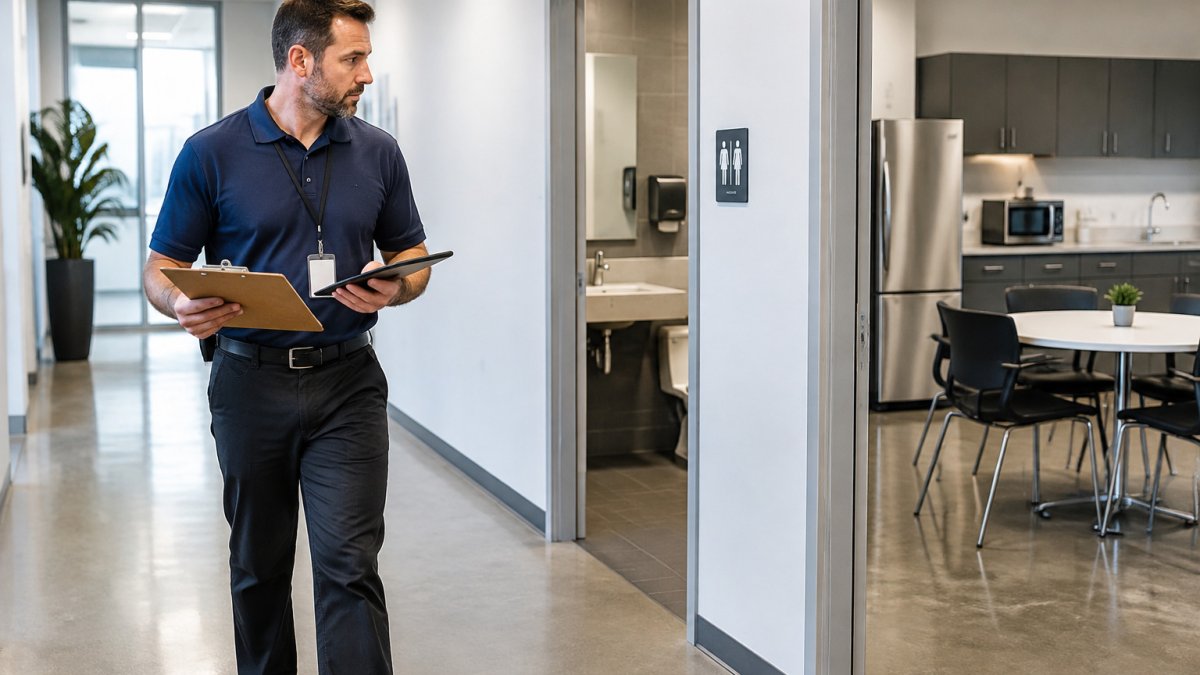
Watch out: Do not let the crew know the exact inspection route in advance. Announced audits measure how the building looks on its best day; unannounced audits measure the standard the building actually holds.
Step 4: Score Each Area With a Cleaning Inspection Scorecard
A cleaning inspection scorecard gives each area a simple rating. Many teams use a 1 to 5 scale, where 5 means the area meets every checklist item. Add the scores to see trends across buildings and months.
Scores also help with vendor conversations. A declining score in one area is a clear signal to raise the issue before it becomes a larger problem.
The article describes how scores are assigned, so the scorecard summarises the rating approach.
| Item | Value | Note |
|---|---|---|
| Scale | 1 to 5 | 5 means every checklist item is met |
| Scoring purpose | Trends | Add scores across buildings and months |
| Declining score | Early warning | Raise with vendor before it grows |
Step 5: Document Deficiencies and Set Corrective Actions
For each deficiency, record what is wrong, where it is, and who is responsible for fixing it. Set a deadline that matches the severity. A spill in a lobby needs same-day attention, while a dusty light fixture may wait until the next scheduled service.
Watch out: Do not wait for the next audit to report a safety problem such as a slip hazard or blocked exit. Report it the same day.
Share the findings with your cleaning provider in writing. Ask for a short corrective plan and confirm that it was completed.
Applying Cleaning Quality Assurance Best Practices After the Audit
Audit results only help if they lead to lasting change. Use the findings to tighten your cleaning quality assurance best practices. Review repeat problems each quarter, adjust service frequencies where needed, and retrain crews on areas that keep failing.
Many managers also compare results across buildings. If one site scores consistently lower, the cause is often staffing, supplies, or unclear instructions rather than the crew itself. Facility managers who need floor repairs found during an audit can request professional VCT strip and wax or floor maintenance from Rangel Janitorial's floor care services. For a deeper look at standards that apply across office settings, read the complete guide to office cleaning best practices.
Scheduling Your Next Audit With Rangel Janitorial
Put the next audit on the calendar before you finish this one. A recurring date keeps the process from slipping when the team gets busy. Track scores over time so you can show improvement, or spot a decline early.
Rangel Janitorial serves commercial offices, medical facilities, and industrial sites across California, with fully bonded and insured professional crews. Request a free quote to get started.
Frequently Asked Questions
What should be included in a commercial cleaning site audit?
A complete commercial cleaning site audit covers every zone the janitorial crew services: restrooms, break rooms, entry points, floors, glass, high-touch surfaces, trash areas, and any specialized spaces such as medical exam rooms or gym locker rooms. The auditor checks cleanliness, odor, supply levels, equipment condition, and whether the crew followed the agreed scope of work. Results should be recorded on a standard audit form so that each visit can be compared against previous ones and against the contracted service standard.
How often should a commercial cleaning site be audited?
Most facilities benefit from a formal audit monthly or quarterly, with informal walkthroughs weekly. High-traffic or regulated environments, such as medical and dental practices, often justify more frequent inspections. New contracts or recent complaints are good reasons to audit sooner. The right cadence depends on the facility's risk profile and the level of service specified in the contract.
How do you score a commercial cleaning inspection?
Use a cleaning inspection scorecard that assigns points to each zone and each cleaning task, then total the points and convert them to a percentage. Weighting matters: restrooms and food or patient-contact surfaces should carry more weight than low-traffic storage areas. Record pass, minor deficiency, and major deficiency separately so that trends are visible over time, and compare scores across visits and across buildings.
What should you do after a cleaning site audit?
Share the findings with the janitorial provider within a few business days, prioritizing major deficiencies. Agree on specific corrective actions, responsible parties, and deadlines. Re-inspect the flagged areas after the deadline, update the scorecard, and note whether the issue recurred. Keeping a dated record of every audit and corrective action protects both the facility and the service provider if disputes arise later.