 How-to
How to Choose the Right Electrostatic Disinfection Company
Table of Contents
- Understand How Electrostatic Sprayers Work
- Verify EPA-Registered Disinfectant List Compliance
- Check Electrical Safety Certifications and Insurance
- Evaluate Commercial Disinfection Protocols
- Assess Electrostatic Disinfection Service Cost and Value
- Confirm Post-Disinfection Verification Methods
- Choose the Right Electrostatic Disinfection Company for Your Facility
- Frequently Asked Questions
Last Updated: September 30, 2026
Understand How Electrostatic Sprayers Work
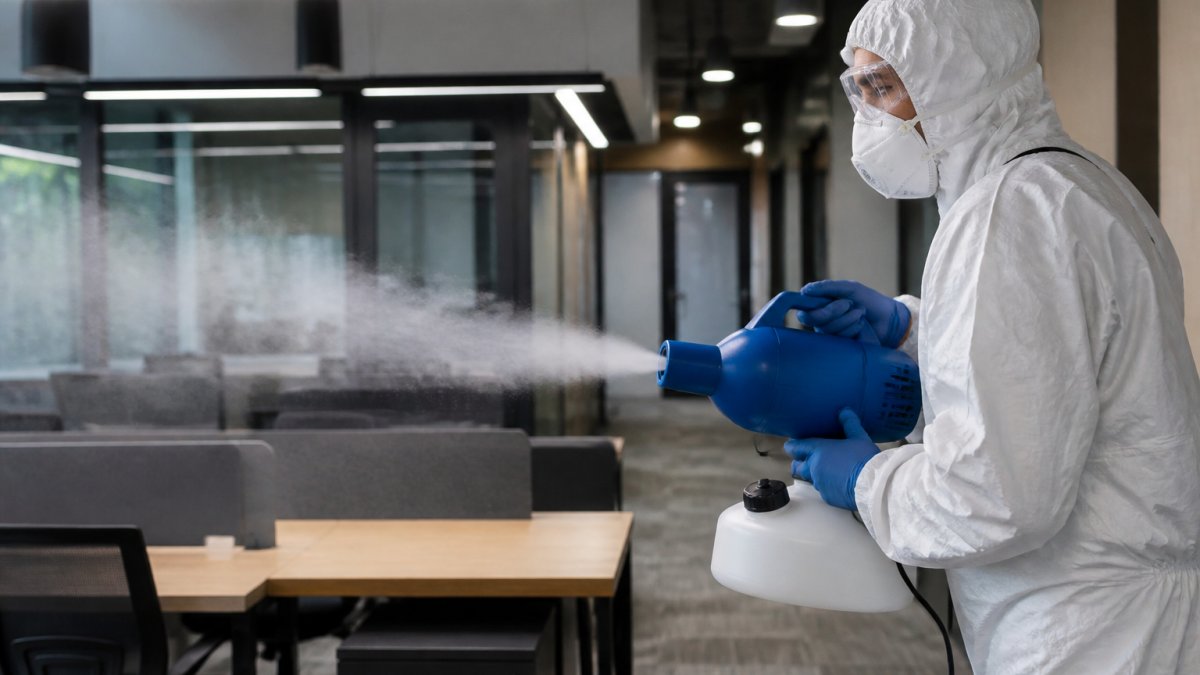
Electrostatic sprayers apply disinfectant as charged droplets that cling to surfaces from multiple angles. The technology uses electrical charge to wrap coverage around objects, reaching areas that traditional spray bottles miss. This 360-degree approach makes electrostatic disinfection more efficient than standard application methods.
The sprayer charges disinfectant particles as they leave the nozzle, causing them to attract to surfaces and wrap around them, even underneath and behind objects. A single pass covers more area with less chemical waste than manual spraying.
Particle size affects effectiveness: smaller droplets spread faster and settle evenly, while larger droplets provide better dwell time on vertical surfaces. A qualified electrostatic disinfection company adjusts these parameters based on your facility's layout.
Electrostatic sprayers require trained operators and proper maintenance. Poor calibration leads to inconsistent coverage and wasted disinfectant, making operator training essential.
Verify EPA-Registered Disinfectant List Compliance
The EPA maintains a list of registered disinfectants approved for use against specific pathogens (the EPA). Any electrostatic disinfection company you hire must use products on this list. Using unregistered or improper disinfectants puts your facility at risk and may violate health codes.
Check the EPA-registered disinfectant list before signing a contract. Ask your potential provider which specific products they use. Request the EPA registration number for each product. Legitimate companies provide this information without hesitation.
Different disinfectants target different pathogens, some bacteria only, others viruses and fungi. Your facility type determines which products are needed; medical facilities require broader-spectrum protection than offices.
Surface compatibility is critical, some disinfectants damage wood finishes, corrode metal, or leave residue on glass. A professional electrostatic disinfection company knows which products work on your specific surfaces.
Ask about dwell time, how long disinfectant must stay wet on a surface to kill pathogens. EPA-registered products have specific dwell times; providers who don't mention this may not understand proper protocols.
Check Electrical Safety Certifications and Insurance
Electrostatic equipment operates at high voltage. Operators must be trained and certified to use it safely. Look for companies whose equipment carries certifications from nationally recognized testing laboratories like UL or ETL (E-Bikes Certification: Evaluating and Testing to UL 2849).
Equipment without proper certification poses shock and fire hazards. Certified equipment meets strict safety standards and protects your employees and visitors.
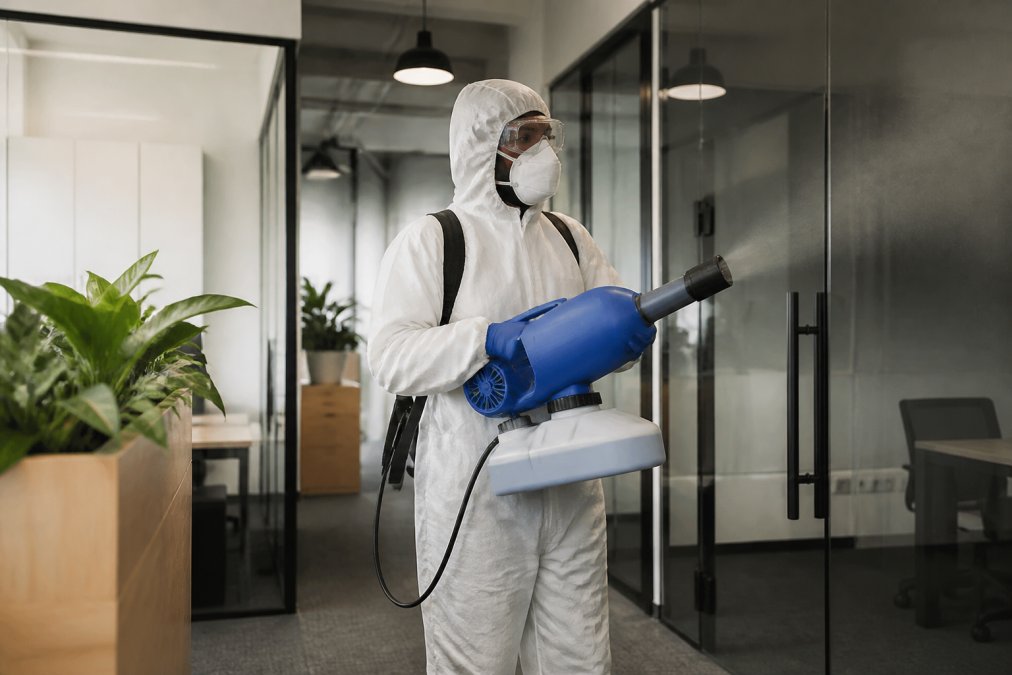
A fully bonded and insured company covers damage to your facility, injury to staff, or property loss. Request proof of general liability insurance, workers' compensation coverage, and a certificate naming your facility.
Verify insurance limits match your facility size and risk profile. Large corporate offices or medical facilities need higher limits than small retail spaces.
Ask about response times to claims or damage reports. Fast response shows they take liability seriously.
Evaluate Commercial Disinfection Protocols
A strong protocol documents what areas get treated, when, and with which products. Written protocols prevent missed areas and ensure consistency.
Ask about pre-treatment inspection. They should assess your facility layout, identify high-touch surfaces, and note special-attention areas. Companies that skip this step often miss critical areas.
High-touch surfaces (doorknobs, light switches, handrails, equipment controls) require more frequent treatment. A professional electrostatic disinfection company prioritizes these based on facility type.
Frequency matters as much as technique. Daily traffic and facility type determine needs, gyms with heavy use need more frequent service than offices with moderate traffic.
Ask about cross-contamination prevention. The provider should change PPE between areas and use separate equipment for different zones. Poor protocols spread pathogens instead of eliminating them.
Assess Electrostatic Disinfection Service Cost and Value
Pricing depends on facility size, frequency, and product selection. The key decision is whether outsourcing makes financial sense compared to buying equipment and training staff in-house.
In-House Equipment vs. Outsourced Service: The Financial Breakdown
In-house equipment requires upfront investment, plus operator training, maintenance, and replacement parts. You also assume liability for operator safety and disinfection effectiveness.
Outsourced services eliminate capital expenses and shift liability to the contractor. Pricing depends on facility size, frequency, and product selection.
Small offices (under 5,000 sq ft) benefit from outsourcing, equipment and training costs exceed service fees. Medium facilities (5,000-20,000 sq ft) may justify in-house equipment after 18-24 months. Large facilities (over 50,000 sq ft) with daily disinfection often see faster ROI on equipment purchase.
Consider hidden costs: operator downtime, lost productivity during training, and staff replacement costs. Outsourced providers absorb these risks.
Evaluating Service Quotes
Request detailed quotes from multiple providers. Some bundle equipment, labor, and products; others charge separately. Transparent pricing shows exactly what you're paying for.
Ask about volume discounts for multiple locations. Bundling services can lower costs significantly.
Don't choose based on price alone. The cheapest option often cuts corners on product quality, operator training, or coverage consistency. Mid-range providers typically offer better value than budget options. Evaluate what you're actually getting for the price.
Consider the cost of downtime. If disinfection requires facility closure, factor that into your decision. Some companies work during off-hours to minimize disruption. Others can treat occupied spaces safely with proper protocols. Scheduling flexibility affects your true cost.
Ask about contract terms and minimum commitments. Some providers require 12-month contracts; others offer month-to-month flexibility. Longer commitments sometimes include service discounts. Short-term flexibility costs more but lets you switch providers if performance declines.
Confirm Post-Disinfection Verification Methods
Verification proves that disinfection actually happened and meets effectiveness standards. Without it, you're relying entirely on the provider's word. Verification also protects you legally if a pathogen outbreak occurs, documentation proves you took reasonable precautions.
ATP Testing and Microbial Verification
ATP (adenosine triphosphate) testing measures organic residue on surfaces, indicating whether disinfection reduced microbial load. A technician swabs a treated surface and uses a luminometer to measure ATP levels. Results are quantified in relative light units (RLU).
Ask if your provider offers ATP testing after service. Not all companies do this. Those that do demonstrate confidence in their work. ATP results give you objective proof of disinfection quality. Request testing on high-touch surfaces (doorknobs, light switches, handrails) and in high-risk areas (restrooms, break rooms, medical facilities).
Better providers conduct ATP testing on a percentage of treated areas and provide written results. They should also establish baseline readings before the first service, then track improvement over multiple visits.
For medical facilities and regulated environments, ask about microbial culture testing. This is more expensive but definitively identifies pathogens. Culture results take 48-72 hours, so they're not practical for routine verification but valuable for compliance audits or outbreak investigations.
Visual Inspection and Coverage Documentation
After spraying, surfaces should show no visible residue or wet spots. Proper dwell time means the disinfectant has dried. Wet surfaces indicate incomplete application or wrong product selection. Ask the provider to photograph treated areas before and after disinfection. Photos document coverage and create a record if disputes arise.
Verify that the provider's crew actually treated all areas you specified. Ask for a detailed service report listing:
- Specific areas treated (by room or zone)
- Time spent in each area
- Disinfectant product used and concentration
- Dwell time observed
- Any areas skipped or requiring special handling
- Operator name and certification number
Legitimate providers provide this documentation within 24 hours of service. If a provider gives vague reports like "entire facility treated" without specifics, they're not tracking coverage and you have no proof of what was actually done.
Liability and Verification Records
Documentation protects you during health inspections, insurance claims, or liability disputes. If an outbreak occurs and you're sued, your disinfection records prove you took reasonable precautions.
Verification as a Performance Metric
Choose the Right Electrostatic Disinfection Company for Your Facility
Selecting the right provider requires evaluating multiple factors beyond price. Technical knowledge, safety certifications, and verification methods separate quality companies from budget options. The decision directly affects your facility's hygiene standards and your team's confidence.
Frequently Asked Questions
What certifications should an electrostatic disinfection company have?
Look for technicians certified by nationally recognized testing laboratories and trained in equipment operation. The company should carry electrical safety certifications (NRTL-listed equipment), proof of bonding and insurance coverage, and training documentation for all operators. Ask for evidence of OSHA compliance and any industry-specific certifications relevant to your facility type, such as healthcare or food service standards.
How do I know if an electrostatic disinfection service is using EPA-approved products?
Request a copy of the EPA-registered disinfectant list they use. All disinfectants must carry EPA registration numbers and be approved for your facility type. Ask the company to provide product Safety Data Sheets (SDS) and verify that dwell times match EPA requirements for pathogen reduction. Cross-reference product names against the EPA's official disinfectant database to confirm registration status before signing a contract.
How often should a facility undergo electrostatic disinfection?
Frequency depends on facility type, traffic volume, and contamination risk. High-touch areas in medical facilities may need weekly or bi-weekly disinfection, while corporate offices typically benefit from monthly or quarterly applications. Ask your provider to recommend a schedule based on your specific facility's microbial load and occupancy patterns. More frequent applications provide better pathogen reduction over time.
What should I ask before hiring a commercial disinfection company?
Ask about their experience with your facility type, proof of insurance and bonding, equipment maintenance schedules, operator training credentials, and post-disinfection verification methods (ATP testing). Request references from similar facilities, clarify their response time for complaints, and confirm they follow EPA-registered commercial disinfection protocols. Also ask about surface compatibility to ensure their process won't damage electronics or sensitive equipment.
Choosing an electrostatic disinfection company protects your facility and your team. The right provider combines technical expertise, safety compliance, and reliable service. Rangel Janitorial delivers comprehensive disinfection with 360-degree coverage, full insurance protection, and transparent documentation. Get a free quote to see how we can maintain your facility's hygiene standards with proven, professional electrostatic disinfection service.