 How-to
How Long Medical Office Cleaning Takes
Table of Contents
- Typical Medical Office Cleaning Duration by Size
- Medical Exam Room Cleaning Time and Process
- Medical Office Cleaning Checklist and Task Breakdown
- Medical Office Cleaning Frequency and Schedule
- Medical Office Cleaning Frequency Requirements
- Factors That Affect Medical Office Cleaning Time
- How to Estimate Cleaning Time for Your Medical Practice
- Frequently Asked Questions
Last Updated: October 8, 2026
Typical Medical Office Cleaning Duration by Size
Medical office cleaning time depends on practice size and layout. Use these ranges to plan staffing and schedules.
Small practices (1-3 exam rooms)
A small practice with 1-3 exam rooms typically needs 2-4 hours of daily cleaning for the waiting area, restrooms, hallways, and treatment spaces. One cleaner usually handles a compact layout.
The key tasks for small offices include:
- Disinfecting all high-touch surfaces (door handles, light switches, countertops)
- Cleaning and sanitizing exam room equipment
- Mopping floors in patient areas
Staff who know the space work faster and catch details others miss.
Medium practices (4-8 exam rooms)
Medium clinics with 4-8 exam rooms usually need 4-8 hours daily. A crew of 2-3 can work off-hours; more rooms mean more high-touch surfaces and equipment to disinfect.
For medium practices, the cleaning process expands to cover:
- Multiple exam and treatment rooms requiring individual attention
- Larger waiting areas with more seating and surfaces
- More extensive floor care across greater square footage
Two cleaners often finish faster than one by dividing tasks by area.
Large practices (9+ exam rooms)
Large medical offices with 9+ exam rooms typically require 8-16 hours of daily cleaning. Most hire crews of 3-5, and complex layouts add time for movement between areas.
Large practices include:
- Multiple treatment zones requiring separate attention
- Extensive waiting and common areas
- Staff break rooms and administrative spaces
Larger crews work in parallel, reducing elapsed time but increasing labor hours.
Medical Exam Room Cleaning Time and Process
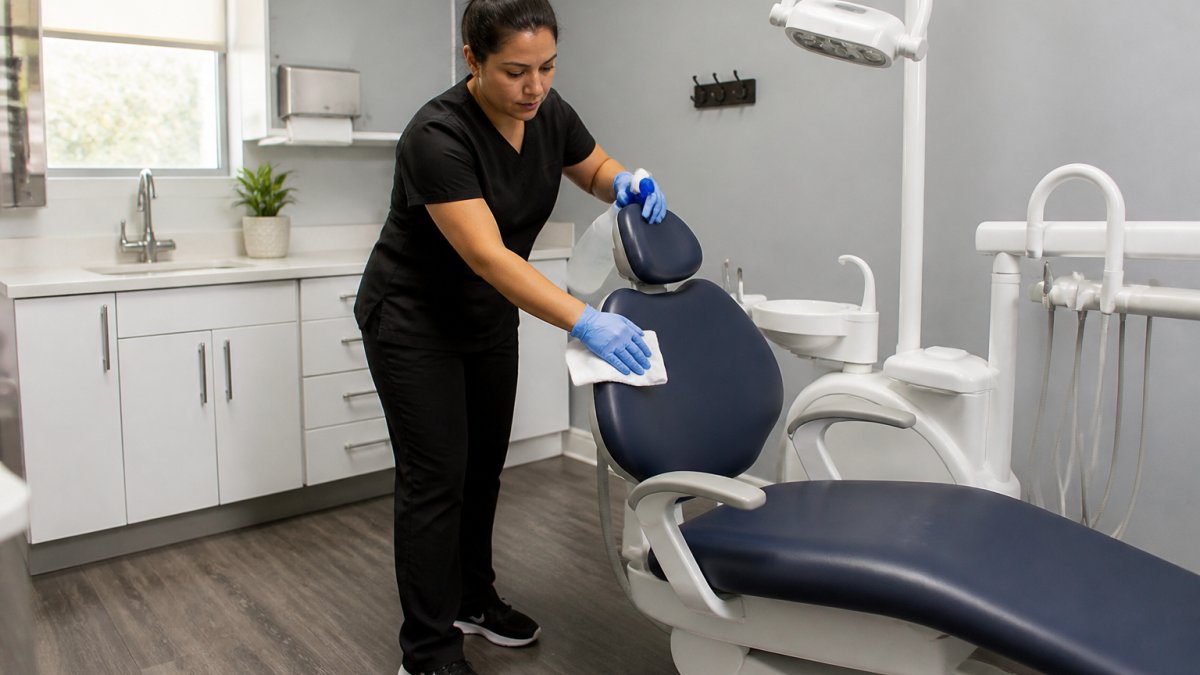
Exam rooms demand the most attention during medical office cleaning because patients with various conditions use them, and infection control standards require specific protocols.
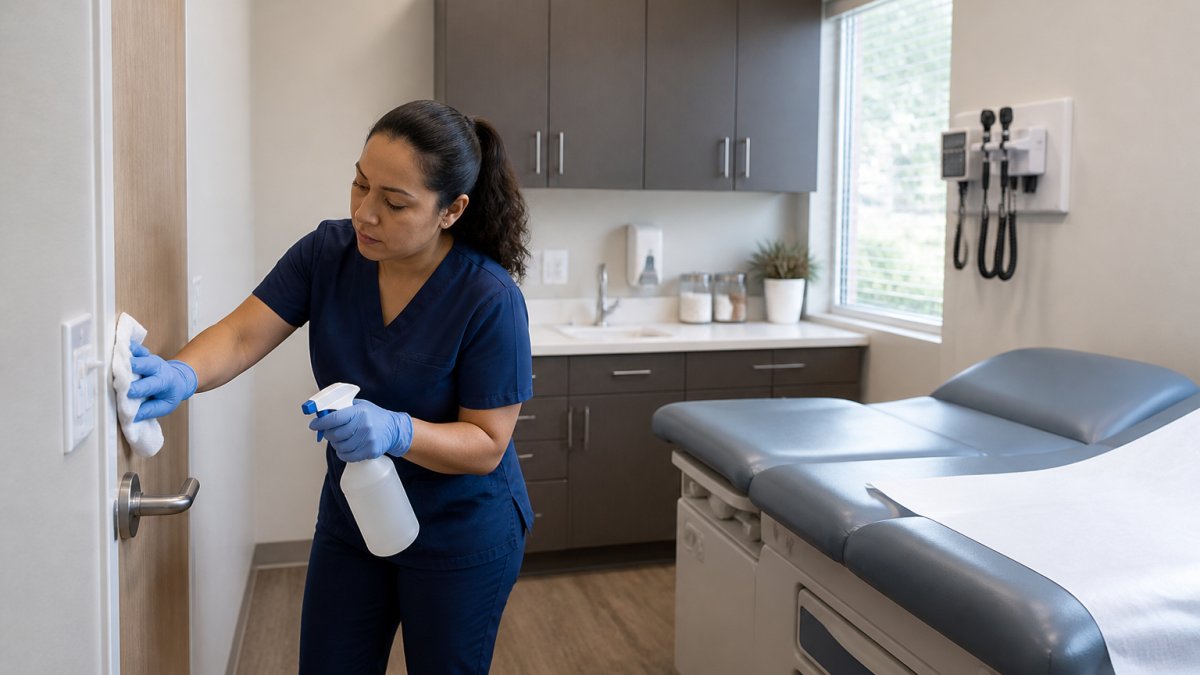
High-touch surface disinfection
High-touch surfaces in exam rooms, door handles, light switches, countertops, are the primary vector for cross-contamination. Disinfecting them takes 15-20 minutes per exam room.
The process requires:
- Identifying all high-touch points (often overlooked: sink faucets, cabinet handles, computer keyboards)
- Applying EPA-approved disinfectant with appropriate contact time (typically 10 seconds to 10 minutes depending on the product) (the EPA)
- Allowing surfaces to dry or wiping with clean cloths
Contact time matters: wiping a 60-second product after 10 seconds defeats the purpose. Proper technique takes longer but delivers real infection control.
Equipment and medical instrument areas
Medical equipment and instruments, stethoscopes, blood pressure cuffs, otoscopes, touch patients directly and need disinfection after each use or at minimum daily.
Equipment cleaning includes:
- Wiping down non-electronic instruments with appropriate disinfectant
- Cleaning equipment surfaces without damaging sensitive components
- Replacing or sanitizing protective covers (blood pressure cuff covers, for example)
This adds 10-15 minutes per exam room. Electronic equipment needs extra care to avoid water damage; many practices use quaternary ammonium or alcohol-based disinfectants that dry quickly.
Medical Office Cleaning Checklist and Task Breakdown
A structured checklist ensures nothing gets missed during medical office cleaning. Tasks fall into daily routines and deeper weekly or monthly work.
Daily cleaning tasks
Daily cleaning keeps the practice sanitary and ready for patient care, ideally during off-hours or between patient sessions.
Daily cleaning checklist:
- Disinfect all exam room high-touch surfaces
- Clean and sanitize treatment tables and chairs
- Wipe down countertops and sinks in all areas
Daily tasks typically take 2-4 hours for a small practice, 4-8 for medium, and 8-16 for large facilities, depending on square footage, room count, and patient volume.
Weekly and deep cleaning tasks
Weekly deep cleaning addresses areas that don't need daily attention but require regular thorough cleaning.
Weekly deep cleaning includes:
- Strip and wax or polish floors (or use appropriate floor treatment)
- Clean inside cabinets and drawers
- Wipe down walls and baseboards
Weekly deep cleaning typically adds 4-8 hours depending on facility size, often scheduled after hours on a set day each week.
Medical Office Cleaning Frequency and Schedule
Cleaning frequency determines how often tasks occur; practices must balance thoroughness with operational needs.
Medical Office Cleaning Frequency Requirements
Daily sanitation is the baseline for any medical practice. Waiting rooms, restrooms, and high-touch areas need daily attention because they see constant traffic.
Daily cleaning ensures:
- Patient safety and confidence
- Compliance with infection control standards
- Removal of visible dirt and biological material
Most practices clean in the evening after the last patient leaves or early morning before the first arrives; larger facilities add midday spot-cleaning.
Daily sanitation for high-traffic areas
High-traffic areas, waiting rooms, restrooms, common hallways, see dozens or hundreds of people daily, so cleaning frequency must match that traffic.
High-traffic areas should be cleaned:
- Morning before patients arrive (basic tidying and surface wipe-down)
- Midday if patient volume is heavy (spot-cleaning and restroom checks)
- Evening after hours (thorough disinfection and restocking)
Restrooms especially need attention: hand-washing areas, toilet seats, and door handles get contaminated throughout the day, so many practices check them every 2-3 hours.
Weekly deep cleaning cycles
Weekly deep cleaning tackles floor care, cabinet cleaning, and wall sanitization.
Most practices schedule weekly deep cleaning:
- One designated evening per week (typically after hours)
- Saturday morning or Sunday (if the practice is closed)
- During a slow patient day if possible
Weekly cycles typically take 4-8 hours depending on facility size, often faster than the daily routine because crews work without patient interruptions.
Seasonal and terminal cleaning
Seasonal cleaning happens quarterly or semi-annually. Terminal cleaning is deep disinfection after a communicable disease exposure or when transitioning spaces between departments.
Seasonal cleaning includes:
- Carpet shampooing or deep extraction
- HVAC vent cleaning and filter replacement
- Detailed equipment sanitization
Terminal cleaning requires:
- Full disinfection of affected areas using hospital-grade disinfectants
- Attention to all surfaces, not just high-touch areas
- Extended contact times for disinfectants
Terminal cleaning can take 8-24 hours depending on scope and contamination level. Specialized services like electrostatic disinfection ensure 360-degree coverage and reach areas standard cleaning misses.
Factors That Affect Medical Office Cleaning Time
Several variables change how long medical office cleaning actually takes; understanding them helps you estimate realistic timelines and budgets.
Office layout and square footage
Square footage is the primary driver of cleaning time. A 2,000-square-foot practice takes less time than a 10,000-square-foot facility, but layout matters too: a linear hallway cleans faster than a maze-like floor plan.
Factors affecting time:
- Total square footage (more space = more time)
- Number of rooms and areas (more rooms = more transitions)
- Ceiling height (high ceilings take longer to dust and clean)
A compact 3,000-square-foot practice might clean in 3-4 hours; a sprawling one with a complex layout could take 5-6 hours. Layout efficiency matters significantly.
Staffing levels and crew size
More cleaners don't always mean proportionally less time. A single cleaner might take 6 hours; two might finish in 3.5-4 hours (not 3, because some overlap and coordination is needed); three might finish in 2.5-3 hours.
Crew efficiency depends on:
- Training and familiarity with the space
- Ability to work independently without bottlenecks
- Communication and coordination
Small practices often use one cleaner for cost efficiency. Medium practices benefit from a two-person crew. Large practices typically need 3-5 people to complete work in reasonable timeframes.
Infection control and compliance standards
Different medical specialties have different cleaning demands. A general practice has different requirements than a surgical center or infectious disease clinic. Compliance standards affect cleaning protocols and time requirements.
Standards that affect cleaning time:
- OSHA bloodborne pathogen standards (require specific disinfection protocols)
- CDC infection prevention guidelines (dictate contact times and disinfectant types)
- State health department regulations (vary by location and facility type)
Facilities with higher compliance requirements take longer to clean properly. A surgical center might require 12-16 hours for a space a general practice could clean in 6-8 hours, due to more detailed protocols, longer disinfectant contact times, and more frequent specialized equipment cleaning.
How to Estimate Cleaning Time for Your Medical Practice
Estimating cleaning time accurately helps you budget for service costs and plan staffing. Several methods help you arrive at realistic figures.
Calculate by room count and square footage
Start with room count and square footage as your baseline; together they predict cleaning time reasonably well.
Basic formula approach:
- Small practice (1-3 rooms, under 2,000 sq ft): 2-4 hours daily
- Medium practice (4-8 rooms, 2,000-5,000 sq ft): 4-8 hours daily
- Large practice (9+ rooms, 5,000+ sq ft): 8-16 hours daily
Then adjust for layout efficiency:
- Efficient linear layout: subtract 10-15% from estimate
- Complex or maze-like layout: add 10-20% to estimate
- Multiple floors: add 15-20% to estimate (elevator time, transitions between levels)
Example: A 4,000-square-foot practice with 6 exam rooms in an efficient layout might estimate 5-6 hours as a baseline, then subtract 10% for good layout efficiency, arriving at 4.5-5.5 hours realistic time.
Account for specialized equipment and surfaces
Medical equipment adds cleaning time beyond basic room cleaning. Specialized surfaces require specific disinfectants and techniques.
Equipment that adds cleaning time:
- Surgical equipment or procedure tables (15-20 minutes per item)
- Diagnostic equipment (ultrasound machines, X-ray rooms: 20-30 minutes)
- Sterilization areas (if applicable: 30-45 minutes)
Add 10-30 minutes to your baseline estimate for each specialized area or equipment type. A practice with three specialized areas might add 45-90 minutes to the standard cleaning time.
Plan for patient volume and turnover rate
High patient volume and frequent room turnover require more frequent cleaning.
Turnover considerations:
- High-volume practices (50+ patients daily): consider midday spot-cleaning (add 1-2 hours)
- Medium-volume practices (20-50 patients daily): standard daily cleaning sufficient
- Low-volume practices (under 20 patients daily): daily cleaning may be sufficient with weekly deep cleaning
A high-volume urgent care center might need 2-3 hours of midday cleaning plus 4-6 hours of evening cleaning (6-9 hours daily).
At Rangel Janitorial, we help medical practices estimate accurate cleaning times by analyzing room count, square footage, equipment, and patient volume.
Medical office cleaning time varies based on practice size, layout, and compliance requirements. According to CDC infection prevention standards, proper disinfection protocols require adequate contact time and thorough coverage of all high-touch surfaces.
Frequently Asked Questions
How long does it take to clean a medical office?
Cleaning time depends on office size and scope. Small practices with 1-3 exam rooms typically need 2-4 hours for daily cleaning. Medium practices with 4-8 exam rooms require 4-6 hours. Large practices with 9+ exam rooms need 6-8 hours or more. Deep cleaning and terminal cleaning take significantly longer. Staffing size and the extent of disinfection also affect duration.
What factors affect how long medical office cleaning takes?
Key factors include square footage, number of exam rooms and treatment areas, patient volume, layout complexity, equipment density, and compliance requirements. Staffing levels matter too: a two-person crew covers ground faster than one person working alone. Specialized disinfection methods like electrostatic application add time but ensure thorough coverage. Infection control standards and the scope of high-touch surface disinfection also influence duration.
How long does it take to clean a medical exam room?
A single exam room typically takes 15-30 minutes for routine cleaning and disinfection, depending on the room size and equipment present. This includes wiping high-touch surfaces like door handles, light switches, and examination tables; disinfecting medical equipment and work surfaces; and cleaning floors. Terminal or deep cleaning of an exam room takes 45 minutes to 1 hour. Contact time for disinfectants (the time a surface must remain wet) adds to the overall duration.
How often should a medical office be cleaned?
Most medical offices require daily cleaning of exam rooms, waiting areas, and restrooms to maintain infection control and patient safety. High-touch surfaces need disinfection multiple times daily in high-traffic areas. Weekly deep cleaning targets floors, baseboards, and less-frequently touched surfaces. Seasonal or terminal cleaning happens quarterly or as needed. Frequency depends on patient volume, facility type, and compliance standards for your specialty.