 How-to
How Electrostatic Disinfection Works: A Simple Guide
Table of Contents
- What Is Electrostatic Disinfection?
- How Electrostatic Sprayers Work
- Electrostatic Disinfection vs. Traditional Disinfection
- How to Prepare a Facility for Electrostatic Disinfection
- Electrostatic Disinfectant Contact Time and Effectiveness
- What Electrostatic Disinfection Does Not Guarantee
- Frequently Asked Questions
Last Updated: October 11, 2026
What Is Electrostatic Disinfection?
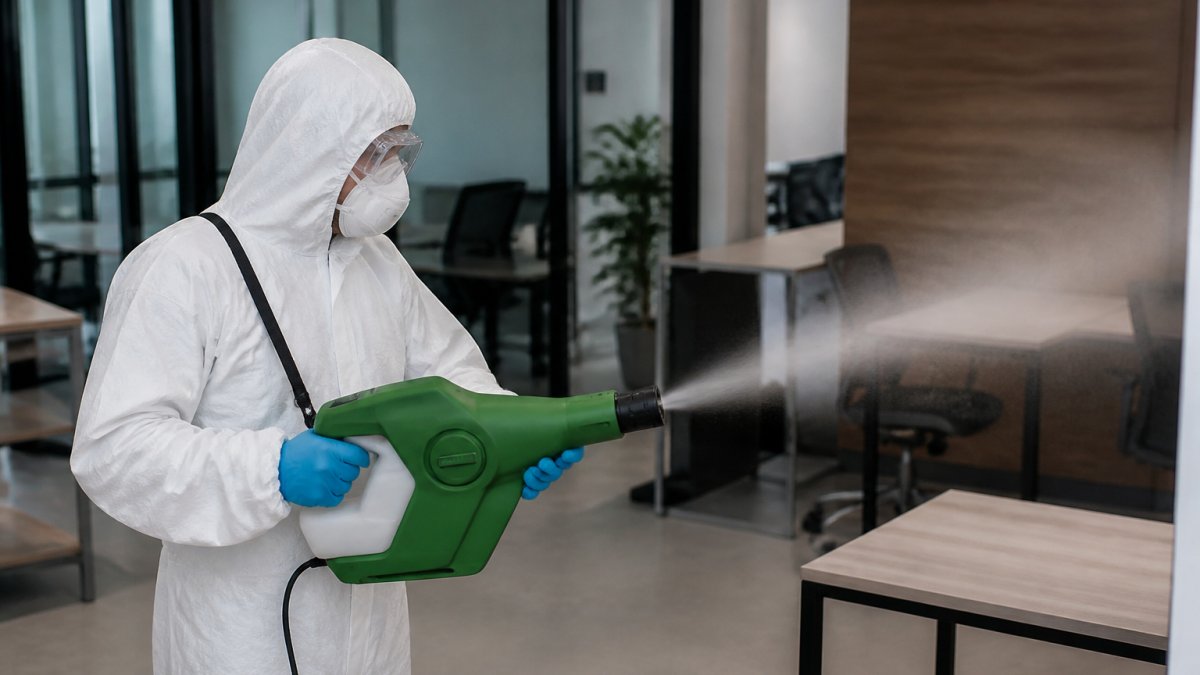
Electrostatic disinfection is a cleaning method that uses electrically charged droplets to coat surfaces with disinfectant. The process sprays a fine mist of cleaning solution through a special nozzle that gives each droplet an electrical charge. These charged particles are naturally attracted to surfaces, where they cling and create even coverage across hard-to-reach areas.
Electrostatic disinfection combines three key elements, disinfectant solution, electrical charge, and gravity, to ensure every surface, including undersides and corners, receives consistent treatment.
Unlike manual wiping (which misses spots) or standard spraying (which falls straight down), electrostatic disinfection works by wrapping around objects and penetrating crevices, delivering more thorough disinfection with less labor.
The method works on most surfaces, desks, chairs, doorknobs, equipment, walls, and floors, across medical facilities, corporate offices, gyms, and industrial spaces.
How Electrostatic Sprayers Work
Electrostatic sprayers load disinfectant into a pressurized tank, atomize it into fine droplets, electrically charge them at the nozzle, and attract them to surfaces where they cling and dry.
Step-by-Step Process
1. Tank preparation and disinfectant loading. The operator fills the reservoir with an approved disinfectant compatible with the sprayer model. Not all disinfectants work, some are too viscous or interfere with charging.
2. Pressurization and atomization. The sprayer is pressurized (typically 20-40 PSI), forcing liquid through a nozzle that breaks it into droplets of 50-100 microns.
3. Electrical charging at the nozzle. As mist exits the nozzle, an electrode applies a positive charge to each droplet (powered by 6,000-8,000 volts).
4. Airborne travel and attraction to surfaces. Charged droplets travel toward grounded surfaces (walls, desks, equipment, floors). Opposite charges attract, so droplets move toward surfaces instead of falling randomly.
5. Deposition and wet contact. Charged droplets stick to surfaces via electrical attraction, coating tops, undersides, edges, and crevices.
6. Evaporation and drying. Small, well-dispersed droplets dry faster than traditional spray-and-wipe methods, typically 15-30 minutes depending on humidity, temperature, and airflow. Once dry, surfaces are safe for re-entry.
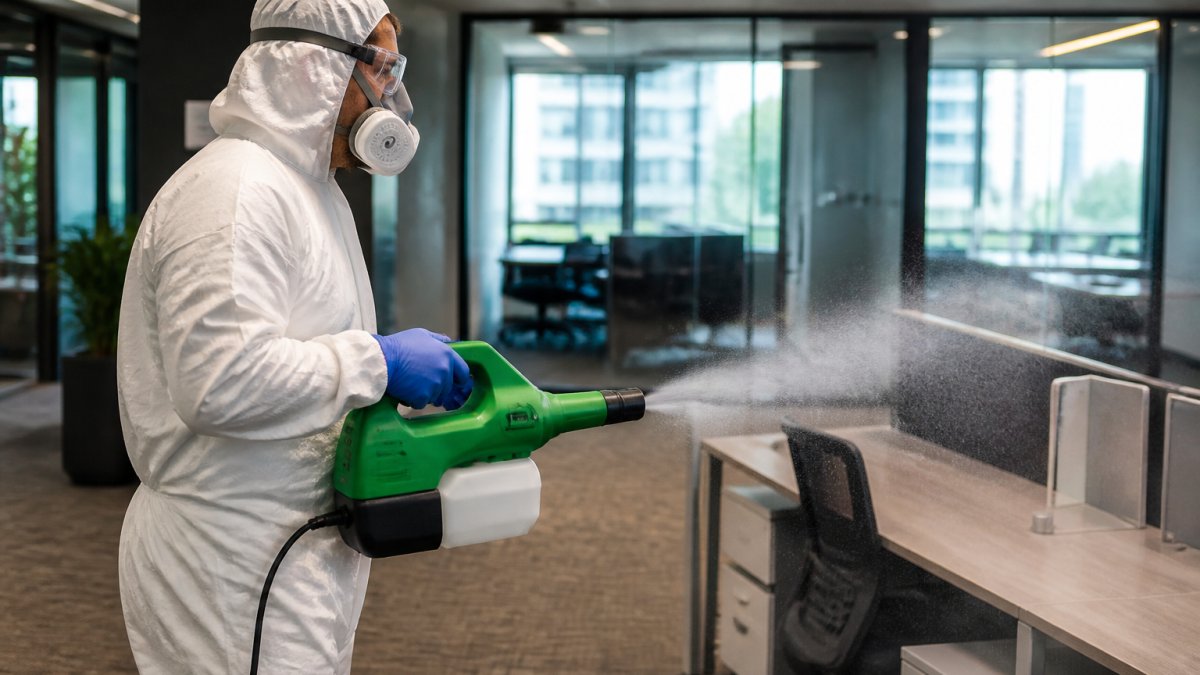
How Operators Control Coverage
Operators control coverage through movement and technique, not electrical charge (which is fixed). They walk at a steady pace, holding the nozzle 6-12 inches from surfaces in a sweeping motion, pausing at high-touch areas (doorknobs, handrails, light switches) and hard-to-reach spots.
The trigger controls flow rate. Operators adjust pressure to balance coverage speed with adequate wetting, too fast risks insufficient disinfectant, too slow causes over-saturation and dripping.
Why Droplet Size and Charge Matter
Professional sprayers produce 50-100 micron droplets, small enough to penetrate crevices and float, large enough to carry sufficient disinfectant. Consumer-grade sprayers produce larger droplets (100-200 microns), reducing penetration and increasing settling time.
Proper charge is equally important. Weak charge causes droplets to behave like regular spray; excessive charge causes clumping or repelling. Professional equipment is factory-calibrated for optimal charge.
Electrostatic Disinfection vs. Traditional Disinfection
Manual wiping reaches only physically touched surfaces, missing corners, edges, and undersurfaces. Electrostatic spraying covers nearly every surface in an enclosed space.
Electrostatic spraying requires one person to move the sprayer through the space while the mist does the work, one pass covers what would take multiple manual passes.
Electrostatic mist dries faster than manual wiping because droplets are smaller and more dispersed, allowing rooms to be ready for use sooner.
The most thorough approach combines both: remove visible soiling first with manual cleaning, then use electrostatic disinfection to eliminate microbial contamination.
Electrostatic sprayers require upfront investment; traditional cleaning requires only basic supplies. For large facilities or high-traffic areas, electrostatic equipment often delivers better value over time.
How to Prepare a Facility for Electrostatic Disinfection
Proper preparation ensures the disinfection process works effectively and safely. Here are the key steps:
Clear the space. Remove people, animals, and food. Electrostatic disinfectant is not designed to be inhaled or ingested.
Remove or cover sensitive items. Ask your provider which items require covering. Typically, computers, phones, and open documents should be moved or shielded.
Ensure good airflow. Open windows if weather permits. Ventilation helps the mist disperse evenly, dry faster, and removes aerosol particles after application.
Clean visible dirt first. Dust and organic matter shield pathogens from disinfectant. Wipe surfaces to remove visible soiling before treatment.
Identify high-touch surfaces. Point out doorknobs, handrails, and light switches so the operator ensures thorough coverage.
Check disinfectant compatibility. Confirm with your provider that the disinfectant is compatible with their equipment.
Plan for drying time. Allow surfaces to dry completely before re-entry (typically 15-30 minutes). During this time, the disinfectant is actively working.
Verify room access. Move obstacles, unlock closets, and ensure doors open freely. Limited access means incomplete coverage.
Electrostatic Disinfectant Contact Time and Effectiveness
Contact time is how long a disinfectant must remain wet to kill pathogens. This is the most commonly overlooked factor in disinfection failure. A disinfectant that dries too quickly will not achieve its intended kill rate, regardless of coverage thoroughness.
What Contact Time Is and Why It Matters
Contact time is specified on the product label and typically ranges from 30 seconds to 10 minutes, depending on the specific pathogen, active ingredients, and concentration (the EPA).
During contact time, active ingredients penetrate the pathogen and disrupt its ability to reproduce. If the surface dries before contact time is complete, the pathogen may survive.
Electrostatic spraying deposits a wet layer necessary for contact time to elapse. However, room conditions, disinfectant choice, and application technique all affect how long surfaces remain wet.
Selecting an Approved Disinfectant and Verifying Compatibility
Not all disinfectants work in electrostatic sprayers. Some solutions are too thick, contain additives that interfere with charging, or are incompatible with the sprayer's internal components. Before purchasing or using a disinfectant, verify compatibility with your specific equipment.
Check the equipment manual. Most manufacturers publish approved disinfectants based on testing for viscosity, conductivity, and compatibility. Unapproved disinfectants may damage the sprayer or cause poor charging.
Confirm EPA approval for your target pathogen. The disinfectant must be EPA-registered and approved for the specific germs or viruses you want to eliminate. A disinfectant approved for general bacteria may not be effective against viruses.
Read the label for contact time. Write down the longest contact time listed (often 5-10 minutes for viruses). This is the minimum time surfaces must remain visibly wet.
Understand dilution requirements. Some disinfectants are concentrates; others are ready-to-use. Always dilute according to the label, as under-dilution damages equipment and over-dilution reduces effectiveness.
Ensuring Adequate Contact Time During Application
Once the correct disinfectant is selected, the next step is ensuring surfaces stay wet long enough. This requires attention to room conditions and application technique.
Temperature and humidity affect drying time. Cool, humid rooms keep surfaces wet longer; hot, dry rooms cause faster evaporation. If your facility is warm and dry, increase flow rate, reduce room temperature, increase humidity, or apply in cooler hours.
Ventilation timing matters. Excessive airflow during application can dry surfaces too quickly. Close windows and reduce HVAC during treatment, then increase ventilation afterward.
Application technique affects coverage and contact time. Operators should move at a steady pace, holding the nozzle 6-12 inches from surfaces to ensure adequate misting without over-saturating.
Plan for drying time after application. Allow surfaces to air-dry completely before re-entry (typically 15-30 minutes). Do not wipe or touch surfaces, as this removes disinfectant before contact time is complete.
Real-World Efficacy vs. Laboratory Claims
Laboratory studies show 99.9% or 99.99% kill rates under controlled conditions. Real-world effectiveness is often lower because facilities have variable conditions and surfaces may not remain wet for the full contact time.
Laboratory efficacy differs from field efficacy. Real-world conditions introduce variables that reduce the kill rate from the laboratory maximum, but this does not mean the disinfectant is ineffective.
Visible soil reduces efficacy. Dirt and organic matter shield pathogens from disinfectant. Pre-cleaning is essential before electrostatic disinfection.
Surface material affects contact time. Porous surfaces (fabric, wood, carpet) absorb disinfectant faster than non-porous surfaces. High-risk porous surfaces may need additional attention or manual spray-and-wipe treatment.
Electrostatic disinfection significantly reduces contamination but does not guarantee sterilization. Research shows electrostatic application improves coverage and contact time compared to manual spraying. However, no disinfection method kills 100% of pathogens. Electrostatic disinfection is most effective as part of a layered approach including regular cleaning, hand hygiene, and ventilation.
Factors That Determine Effectiveness
The effectiveness of electrostatic disinfection depends on several factors working together:
- Disinfectant quality and approval. The solution must be EPA-registered and approved for the specific pathogens you want to eliminate.
- Contact time. The surface must remain visibly wet for the time specified on the product label.
- Coverage. Every surface that could harbor pathogens must be treated. Electrostatic spraying provides superior coverage compared to manual methods, but areas blocked by equipment or sealed containers may be missed.
- Surface cleanliness. Visible dirt and organic matter reduce disinfectant efficacy. Pre-cleaning is essential.
- Room conditions. Temperature, humidity, and ventilation affect how long surfaces remain wet and how quickly the disinfectant works.
- Equipment calibration. The sprayer must be properly maintained and calibrated to produce the correct droplet size and electrical charge.
What Electrostatic Disinfection Does Not Guarantee
Understanding the limits of electrostatic disinfection is as important as understanding its benefits. Here is what this technology cannot do:
It does not eliminate the need for cleaning. Disinfection kills germs but does not remove dirt or organic matter. Disinfection is a supplement to cleaning, not a replacement.
It does not work on surfaces not reached by the mist. Sealed containers, closed drawers, and blocked areas may not receive coverage.
It does not guarantee 100% pathogen elimination. Electrostatic spraying significantly reduces contamination, but some organisms may survive. Ongoing hygiene practices remain important.
It does not prevent new contamination. Surfaces can become contaminated again through normal use. Disinfection is a point-in-time treatment, not permanent protection.
It does not work if contact time requirements are not met. Room conditions and disinfectant choice must align for effectiveness.
It does not eliminate airborne pathogens. For airborne protection, facilities need ventilation, filtration, or other air-handling measures.
It does not replace hand hygiene and other prevention measures. Disinfection is one layer of protection. Hand washing, respiratory etiquette, and vaccination remain essential for infection prevention.
Many facility managers ask whether electrostatic disinfection is worth the investment. The answer depends on your facility type, traffic volume, and regulatory requirements. Medical facilities, gyms, and high-touch office spaces benefit most.
Electrostatic disinfection has become a trusted tool for maintaining safe, sanitized facilities across California. Whether you manage a corporate office, medical practice, gym, or industrial facility, understanding how electrostatic disinfection works helps you make informed decisions about your facility's hygiene strategy.
Rangel Janitorial brings 30 years of experience to electrostatic disinfection service. Ready to upgrade your facility's disinfection? Get a free quote from Rangel Janitorial and discover how professional electrostatic disinfection can protect your space.
Frequently Asked Questions
How does electrostatic disinfection actually kill germs and viruses?
Electrostatic disinfection works by applying an electrically charged disinfectant mist to surfaces. The charged droplets cling to and coat all exposed areas, including hard-to-reach spots. The disinfectant itself, typically a hospital-grade germicide, kills pathogens through chemical action once it makes contact with the surface. The electrical charge ensures even coverage, but the actual pathogen elimination depends on the disinfectant's active ingredients and the required wet contact time, which varies by product.
Do surfaces need to be cleaned before electrostatic disinfection?
Yes, surfaces should be cleaned of visible dirt and debris before electrostatic disinfection. Heavy soil can interfere with droplet adhesion and reduce the effectiveness of the disinfectant. A quick pre-cleaning pass removes dust, food particles, and grime, allowing the charged mist to coat surfaces more evenly. This step is especially important in high-touch areas like gym equipment, medical facilities, and office desks where contamination control is critical.
How long does electrostatic disinfection take to work?
The application itself takes minutes to hours depending on facility size and layout. However, the disinfectant requires a specific wet contact time to kill pathogens, typically 5 to 10 minutes for most hospital-grade solutions, though some require longer. During this contact time, surfaces must remain wet. After contact time expires, the surface can be wiped dry or left to air-dry. Full effectiveness depends on both the application coverage and adherence to the disinfectant's contact time requirements.
What surfaces and objects can be treated with electrostatic disinfection?
Electrostatic disinfection works on most hard surfaces: desks, chairs, door handles, light switches, medical equipment, gym equipment, electronics, and undersides of furniture. It reaches wraparound coverage on complex objects and into crevices that manual wiping misses. However, not all surfaces are suitable, porous materials, fabrics, and certain electronics may be damaged by wet application. Always verify surface compatibility and disinfectant safety with product labels before treatment, especially in medical or sensitive environments.