 How-to
How Do You Manage Commercial Cleaning Budgets?
Last Updated: October 28, 2026
Quick Summary
Manage cleaning budgets by first calculating your cost per square foot as a baseline, then building a zone-by-zone template with defined frequencies and labor hours. Track quality metrics alongside spending, set aside compliance costs separately, and cut waste only where measured quality holds.
- Divide total annual cleaning spend by total square footage cleaned to get your cost per square foot baseline.
- Build a budget template with one row per zone, listing tasks, frequency, labor hours and supply cost.
- Set a separate compliance line for infection-control cleaning rather than burying it in general costs.
- Track surface pass rate and missed-task rate alongside spending to keep quality visible.
- Treat cost cuts as corrective actions with an owner and verification, and reverse any that lower quality.
Table of Contents
- Why Large Facility Cleaning Budgets Get Out of Control
- Step 1: Establish Your Commercial Cleaning Cost per Square Foot Baseline
- Step 2: Build a Janitorial Service Budget Template That Covers Every Zone
- Step 3: Factor in CDC Compliance Cleaning Costs Before You Set Targets
- Step 4: Track Facility Cleaning KPIs to Keep Spending on Target
- Step 5: Cut Waste Without Cutting Quality
- Booking a Budget Review With Rangel Janitorial
- Frequently Asked Questions
Why Large Facility Cleaning Budgets Get Out of Control
Large facility cleaning budgets rarely blow up in one dramatic moment. They drift.
The biggest driver is often unclear scope. When nobody has written down exactly which areas get cleaned, how often, and to what standard, every service visit becomes a negotiation.
Other common culprits include:
- Inconsistent service frequency: Restrooms get cleaned daily in one building and twice weekly in another.
- Supply overspending: Paper products and chemicals get ordered without tracking usage.
- Reactive spending: Emergency deep cleans get booked after complaints instead of planned into the budget.
- Unmeasured quality: Without a standard to check against, managers pay for cleaning they cannot verify.
A common mistake is treating the cleaning budget as a fixed annual number. Facilities change. Tenants move, square footage shifts, and foot traffic rises or falls.
The fix starts with a baseline. Once you know what you are spending per square foot, you can spot drift early and decide where to act.
Step 1: Establish Your Commercial Cleaning Cost per Square Foot Baseline
Your commercial cleaning cost per square foot is the total annual cleaning spend divided by the total square footage you maintain.
Here is a simple way to run the math:
| Item | Example Figure |
|---|---|
| Annual cleaning spend | $96,000 |
| Square footage cleaned | 80,000 sq ft |
| Cost per square foot | $1.20 per sq ft per year |
Break the total down further by building or zone. A single average can hide a lot. One floor might cost more per foot because of heavy medical use or constant foot traffic. That gap is useful information, not a problem by itself.
Watch out: comparing your number to a competitor's quote is only useful when both cover the same scope and frequency. Ask every provider for an itemized price, or the comparison will mislead you.
Step 2: Build a Janitorial Service Budget Template That Covers Every Zone
A janitorial service budget template turns vague spending into a clear plan. Build one row per zone, such as offices, restrooms, lobbies, break rooms, warehouse space, and exterior entrances.
Columns to include:
- Zone name and square footage
- Tasks included (trash removal, floor care, restroom service, dusting)
- Frequency (daily, weekly, monthly, quarterly)
- Labor hours per visit
- Supply cost per month
- Total monthly cost for that zone
Once every zone is listed, add them up. Compare the total against your baseline from Step 1. If the template comes in far above your current spend, the scope may be broader than you thought.
A practical tip: review the template with your provider before signing. Ask them to confirm frequencies and labor hours for each zone. Vague agreements are where scope creep starts.
For more on how zone-level scope should be defined, see our guide on customized cleaning plans for facilities.
Step 3: Factor in CDC Compliance Cleaning Costs Before You Set Targets
Some facilities carry cleaning costs that are not optional. The Centers for Disease Control and Prevention (CDC) publishes guidelines on environmental cleaning and disinfection in healthcare settings, and many facilities also follow standards from their state and accrediting bodies (the CDC).
When you set your budget targets, account for:
- Higher disinfectant use in patient-facing and high-touch areas
- Additional visit frequency for exam rooms and waiting areas
- Documentation time for cleaning logs and audit records
- Specialized methods, such as electrostatic disinfection, where they fit your compliance plan
Many businesses find that compliance costs are the hardest to predict. A common approach is to set a separate compliance line in the budget rather than burying it in general cleaning. That makes it easier to see the true cost of meeting standards and to justify it to leadership.
Confirm current requirements with your facility's compliance officer or the source agency, since rules change.
Step 4: Track Facility Cleaning KPIs to Keep Spending on Target
Budgets only hold when someone checks them, and checking them requires numbers that are defined the same way every month.
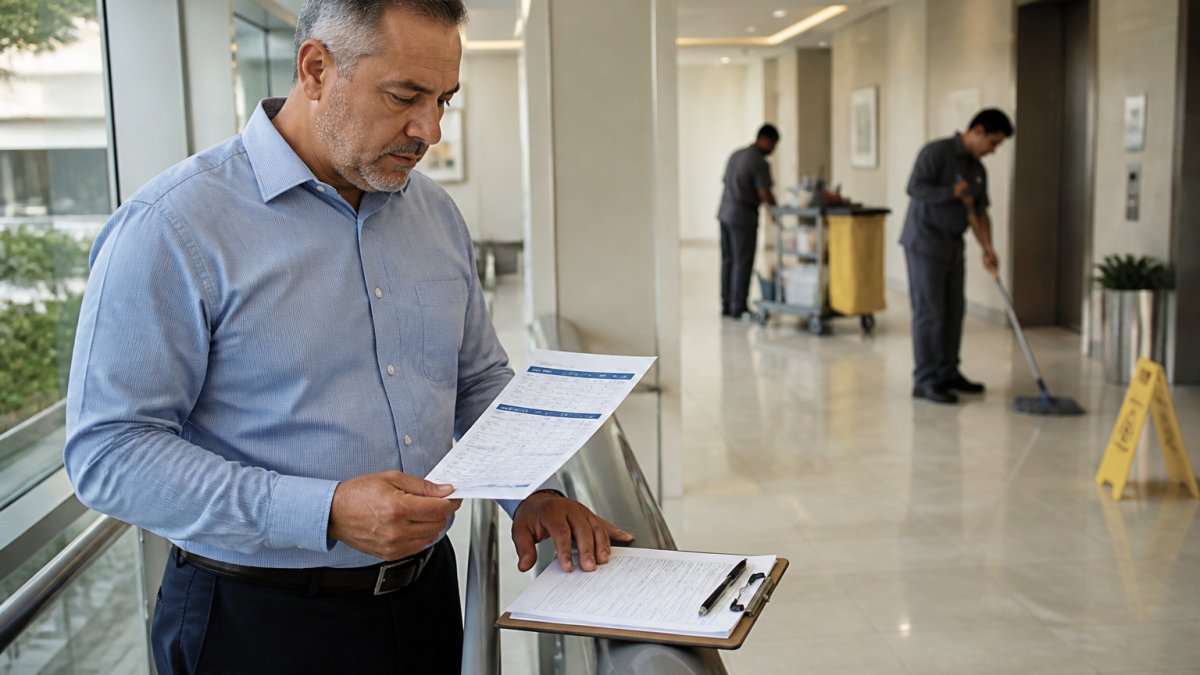
Start with a small set of measures you can track monthly without a lot of paperwork. For each one, write down the formula, the data source, the frequency, and the owner.
Cost and spend metrics
- Cost per square foot = total annual cleaning spend ÷ total square footage cleaned. Track it against your Step 1 baseline and break it out by building or zone so a single average does not hide a costly floor.
- Cost per occupied employee or visitor = total cleaning spend ÷ average daily occupancy. This is more useful than cost per square foot in mixed-use buildings where foot traffic varies widely.
- Supply spend per month compared with the trailing three-month average. A rise of more than 10% above the trailing average is a common trigger to pull usage reports and investigate.
Quality and hygiene metrics
These are the measures that connect spending to outcomes, and they are the ones most budget templates leave out.
- Surface pass rate = number of inspection points that meet the standard ÷ total inspection points sampled, expressed as a percentage. Define the standard in advance (for example, no visible soil on high-touch surfaces, no residue on glass, trash below a set fill line) so two auditors score the same surface the same way.
- Missed-task rate = tasks not completed as scheduled ÷ tasks scheduled, measured over a defined period. This catches scope drift before it shows up as a complaint or an emergency call.
- Time to close corrective actions = average number of days from when a finding is logged to when it is verified as fixed. A rising trend here usually predicts rising emergency spend.
- Repeat-finding rate = findings that recur at the same location or task type ÷ total findings. Repeat findings point to a root cause, a training gap, an unrealistic frequency, or a supply problem, rather than a one-off miss.
How to collect reliable field data
The metrics are only as good as the observations behind them. A few practices make the data trustworthy:
- Use a written sampling plan. Decide in advance how many inspection points per zone, which surfaces, and how often. Randomly rotate the specific points so crews cannot clean only the spots that get checked.
- Score against a rubric. A simple 0-2 scale (0 = fails standard, 1 = marginal, 2 = meets standard) with written descriptions for each score reduces subjective judgment.
- Calibrate auditors. Have two people inspect the same area independently and compare scores before rolling the program out. If they disagree often, the rubric needs tightening.
- Record in the field. Log observations on a tablet or phone at the point of inspection rather than reconstructing them from memory at month-end.
Set targets and review triggers
For each KPI, set a target and a threshold that triggers a review. For example, a surface pass rate below 90% for two consecutive months, or a time-to-close average above 14 days, should prompt a sit-down with the provider.
For more on how zone-level scope should be defined, see our guide on customized cleaning plans for facilities.
Step 5: Cut Waste Without Cutting Quality
Cutting cleaning budgets does not have to mean cleaning less. In most facilities, savings come from removing waste, not from dropping important work.
Where the waste usually sits
Start with the areas that show up most often in budget reviews:
- Consolidate supplies. Standardize on fewer products so bulk purchasing and training both get easier. Fewer SKUs also make usage tracking possible.
- Right-size service frequency. Some areas, such as storage rooms and low-traffic offices, may not need the same schedule as lobbies and restrooms. Use your missed-task and surface pass-rate data to decide which zones can safely move to a lighter schedule.
- Schedule deep cleans. Plan periodic deep cleaning instead of paying premium rates for emergency calls.
- Dispense supplies by usage. Controlled dispensers cut waste on paper and soap and give you a usage baseline to compare against.
- Ask for itemized invoices. Unexplained add-ons are a common source of waste. Require a line-item breakdown for any charge outside the contract.
Turn each idea into a prioritized corrective action
A finding, whether it comes from an inspection, an invoice review, or a complaint, is only useful if it becomes an action someone owns. Use a simple log with these fields:
- Finding: what was observed, where, and when.
- Risk level: high, medium, or low, based on the impact on hygiene, safety, and cost. High-risk findings (restroom sanitation failures, missed disinfection in patient-facing areas) get fixed first regardless of cost.
- Owner: the named person responsible for the fix, not a department.
- Deadline: a specific date, set by risk level. A common pattern is 48 hours for high-risk, two weeks for medium, and the next scheduled review for low.
- Verification method: how completion will be confirmed, a re-inspection, an invoice check, or a usage report.
Verify completion and look for root causes
Closing the loop matters as much as logging the finding. Re-inspect after the deadline and record whether the fix held. If the same finding recurs, the same restroom failing inspection, the same supply item running over budget, stop treating it as a one-off.
Keep quality visible while you cut
The goal is to spend where the facility needs it most. Track your surface pass rate, missed-task rate, and time-to-close alongside the cost metrics for at least two months after any change. If quality holds and spend falls, the saving is real.
Booking a Budget Review With Rangel Janitorial
If your facility's cleaning costs have drifted, a structured review can help you find where the money is going. At Rangel Janitorial, we provide tailored cleaning plans for facilities. We recommend requesting a quote based on your actual facility. You can request a free quote from our team to start the conversation.
Frequently Asked Questions
What are the average commercial cleaning costs per square foot?
Commercial cleaning costs per square foot vary widely with building type, cleaning frequency, the number of restrooms and the level of service required. Rather than relying on a national average, calculate your own baseline by dividing your current annual janitorial spend by the total usable square footage it covers. Compare that figure across buildings with similar layouts to spot outliers. For current pricing for your specific facility, request a quote from Rangel Janitorial.
How do you calculate a janitorial budget for a large facility?
Start by listing every zone, including offices, restrooms, lobbies, break rooms, medical exam rooms and common areas. Assign each zone a cleaning frequency and an estimated labor time per visit. Multiply labor hours by your loaded hourly labor rate, then add supplies, equipment, and specialized services such as electrostatic disinfection. Review the total quarterly against actual invoices and adjust frequencies where the building's use has changed.
How does CDC compliance affect cleaning budget allocations?
Build these requirements into the budget as a separate line rather than absorbing them into general janitorial spend, so the cost of compliance stays visible. Review current CDC guidance and applicable state requirements with your compliance team before finalizing frequencies.
What KPIs should be used to track commercial cleaning performance?
Useful facility cleaning KPIs include cost per square foot, cost per occupied desk or visitor, percentage of scheduled tasks completed on time, inspection scores from periodic audits, number of tenant or staff complaints per month, and response time to reported issues. Pair spending metrics with quality metrics so you do not reduce cost at the expense of results. Review them monthly with your provider and adjust the scope where scores and spending diverge.