 How-to
HIPAA Compliance in Office Cleaning: A Step-by-Step Guide
Table of Contents
- Why HIPAA Compliance Matters for Office Cleaning Staff
- Understanding When Business Associate Agreements for Cleaning Services Apply
- Step 1: Establish Access Controls and Work Procedures
- Step 2: Implement Medical Office Cleaning Staff HIPAA Training
- Step 3: Protecting Patient Information During Office Cleaning
- Step 4: Use a HIPAA-Compliant Medical Office Cleaning Checklist
- Step 5: Monitor Compliance and Handle Incidents
- Common Mistakes to Avoid
- Frequently Asked Questions
Last Updated: October 7, 2026
Why HIPAA Compliance Matters for Office Cleaning Staff
Protected health information (PHI) is everywhere in medical offices, charts on desks, records in filing cabinets, data on screens. Cleaning staff move through these spaces daily, often unsupervised.
This is where HIPAA compliance office cleaning becomes critical.
A single breach can cost thousands in fines and damage patient trust. At Rangel Janitorial, we know HIPAA compliance isn't optional, it protects both patients and your business.
Accidental exposure during cleaning can trigger compliance investigations. Proper procedures prevent these incidents before they happen.
Understanding When Business Associate Agreements for Cleaning Services Apply
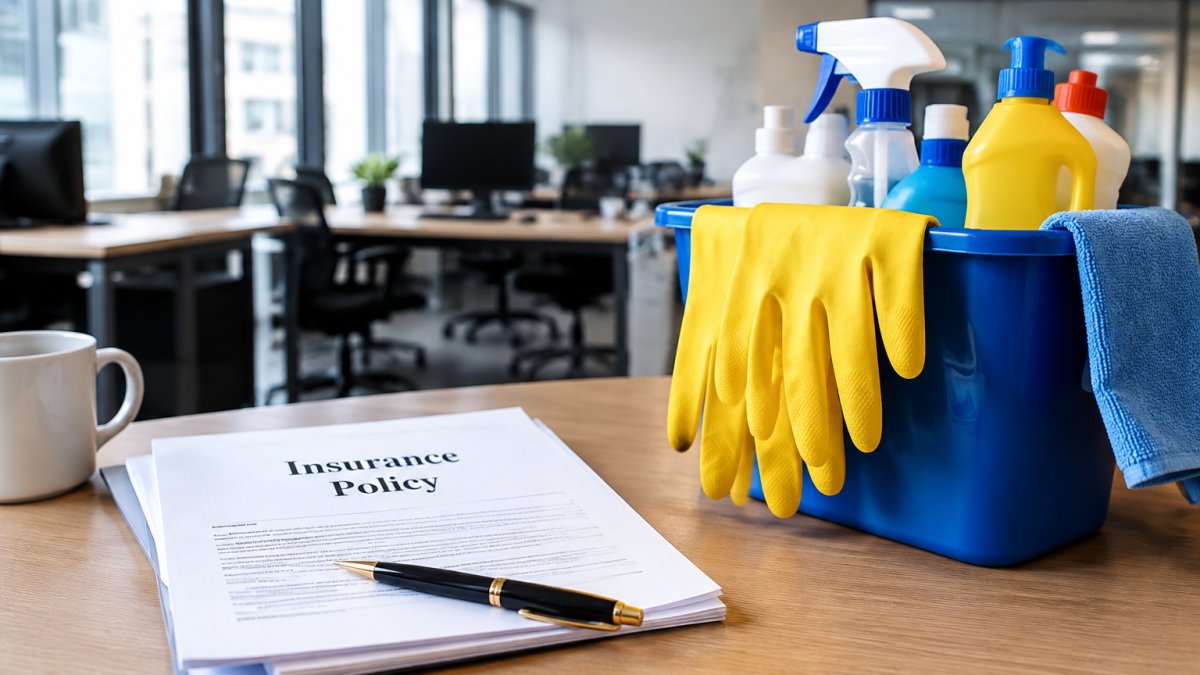
A business associate agreement (BAA) is a contract between a covered entity (like a medical practice) and a vendor who handles PHI. The question many facility managers ask: Does my cleaning company need a BAA?
The answer depends on whether cleaning staff will access PHI. If cleaners work where patient information is visible, stored, or discussed, a business associate agreement for cleaning services is required. This includes:
- Medical offices with patient charts visible on desks
- Facilities where medical records are stored in accessible locations
- Areas where computers display patient data
- Break rooms where staff discuss cases
If cleaning happens only in common areas and staff never encounter PHI, a BAA may not be legally required, but best practice is to have one anyway, since it clarifies expectations and protects both parties.
The business associate agreement for cleaning services should outline:
- What PHI the cleaning crew might encounter
- How they must handle it if they do
- Consequences for breaches or violations
- How incidents will be reported
Without a clear agreement, your cleaning vendor has no legal obligation to protect patient information. With one, they do.
Step 1: Establish Access Controls and Work Procedures
Access control is the foundation of HIPAA compliance in office cleaning. You cannot protect information you cannot control who sees it.
Start by mapping your facility to identify which areas contain PHI. Exam rooms, medical records storage, and administrative offices need restricted access; hallways and restrooms may not require the same control.
Once you know your layout, assign cleaning access accordingly. Not all staff need access to all areas. This principle, called "minimum necessary", is core to HIPAA.
Designated Cleaning Schedules and Restricted Areas
Create a written cleaning schedule specifying which crew members clean which areas and when, ideally when the office is closed or staff can supervise.
After-hours cleaning is safest because it reduces accidental PHI encounters. If daytime cleaning is necessary, designate times when the office is minimally staffed and patient information is secured.
Restricted areas should be clearly marked. Use signs like "Cleaning restricted to [Name]" or "High-sensitivity area, authorized personnel only." This signals to your cleaning crew that certain spaces require extra care.
Access Logs and Badge Systems
For facilities with high PHI density, implement access logs recording who entered restricted areas and when, creating an audit trail if a breach occurs.
Badge systems work well for larger facilities: only authorized cleaning staff receive badges, and badges are deactivated immediately when someone leaves, preventing former employees from accessing your facility.
For smaller practices, a simple sign-in sheet works. Cleaning staff initial when they enter restricted areas and initial when they leave. Keep these logs for at least six years, HIPAA requires it.
Step 2: Implement Medical Office Cleaning Staff HIPAA Training
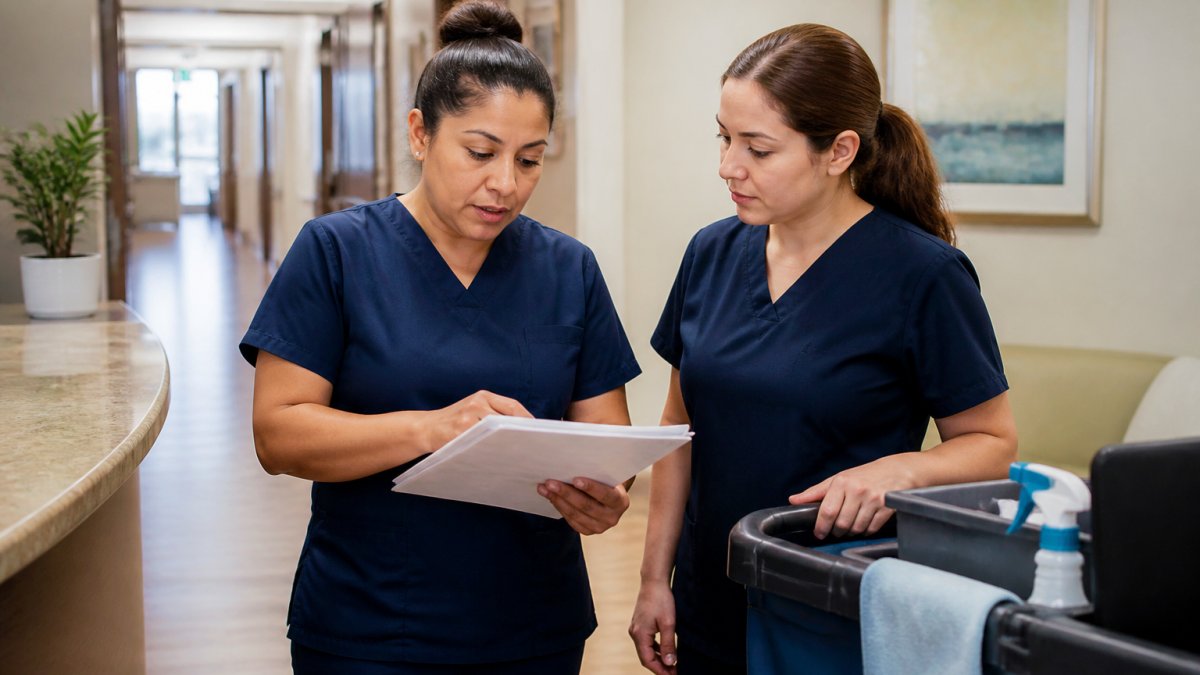
Your cleaning crew cannot protect information they do not understand, which is why HIPAA compliance office cleaning requires training that is non-negotiable.
Every cleaning staff member in a healthcare facility must receive HIPAA awareness training, not a one-time checkbox, but documented and refreshed regularly.
Core Training Topics for Cleaning Crews
Your medical office cleaning staff HIPAA training should cover:
- What PHI is and where it appears in your facility
- The consequences of unauthorized disclosure
- How to handle documents and devices they encounter
- What to do if they accidentally see patient information
- How to report incidents without delay
- The difference between cleaning for appearance and cleaning for compliance
Make training practical with examples specific to your facility, a medical office's procedures differ from a dental office's, and a hospital's from a small practice's.
Use simple language and avoid jargon, since your crew may lack healthcare backgrounds. Explain why HIPAA matters in terms they understand: protecting patients, the practice, and themselves.
Documentation and Refresher Requirements
Document every training session. Record who attended, when, and what was covered. Keep these records for at least six years.
Refresher training should happen annually at minimum, and quarterly or semi-annually if your facility has high turnover or complex PHI procedures.
New employees must complete training before they start cleaning, and must not work unsupervised until trained and signed a confidentiality agreement.
Step 3: Protecting Patient Information During Office Cleaning
Protecting patient information during office cleaning means controlling what cleaning staff see and touch.
The principle is simple: if it contains or might contain PHI, secure it before cleaning begins. This is called the "clean desk policy," and it is one of the most effective HIPAA compliance tools available.
Clean Desk Policies and Document Handling
Implement a clean desk policy requiring staff to secure all patient information before leaving: charts into locked cabinets, papers into shredders or locked bins, whiteboards erased.
Make the policy easy to follow, or staff will ignore it. Place shredders conveniently, provide locked bins for sensitive documents, and post reminders near desks and filing areas.
Train your crew to never touch unsecured documents they find, leave them for office staff to secure and report to a manager immediately.
For documents that must be shredded, use a certified shredding service with cross-cut shredding, which makes reconstruction nearly impossible. Shred anything containing patient names, dates of birth, medical record numbers, or insurance information.
Electronic PHI and Connected Devices
Electronic PHI (ePHI), patient information on computers, tablets, or phones, requires different procedures than paper documents.
Secure mobile devices and tablets in drawers or cabinets rather than leaving them on desks where a cleaner might bump them or see the display.
Connected devices like printers and copiers store data, so set them to auto-delete temporary files and ensure cleaners see no cached patient information when cleaning them.
For facilities with electronic health record (EHR) systems, ensure automatic logout timers are set to 5-10 minutes of inactivity.
Step 4: Use a HIPAA-Compliant Medical Office Cleaning Checklist
A written checklist ensures consistency, reminds staff what to check and avoid, and creates accountability.
Your HIPAA-compliant medical office cleaning checklist should include:
- Check for unsecured documents before cleaning
- Do not move papers, charts, or files
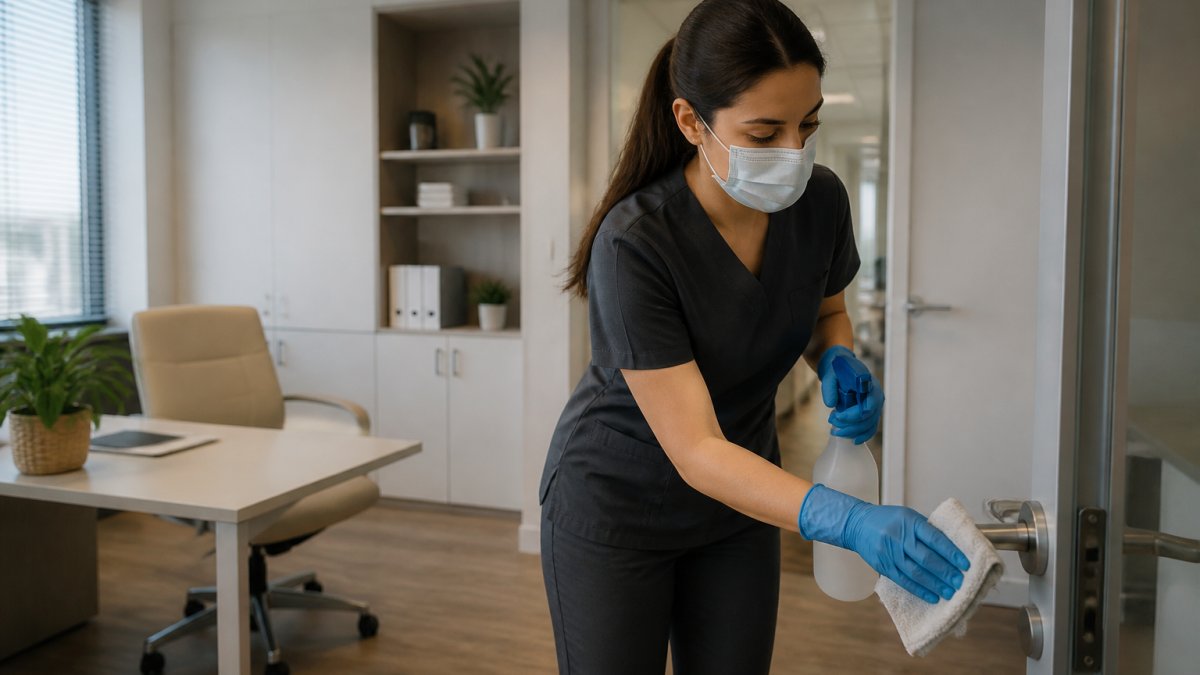
- Wipe high-touch surfaces with appropriate disinfectant
- Empty trash and shred bins into secure bags
- Do not open cabinets or drawers
- Report any PHI you encounter to management
- Log the time you entered and exited restricted areas
- Sign the checklist when done
Keep checklists simple and visual with checkboxes and clear language, and laminate them for repeated use.
Different areas need different checklists, a medical records room carries different risks than an exam room, and a waiting area than an administrative office. Customize by area type.
Review checklists quarterly. Update them if procedures change or if you discover new risks during inspections.
Step 5: Monitor Compliance and Handle Incidents
Compliance is not a one-time setup. It requires ongoing monitoring and rapid response when problems occur.
Routine Inspections and Audits
Conduct monthly inspections of cleaning areas. Check for:
- Unsecured documents left visible
- Unlocked cabinets or drawers
- Computers left logged in
- Devices left unattended on desks
- Shredding bins overflowing or improperly secured
Document findings, photograph problems without capturing PHI, and share results with your cleaning vendor and office staff.
Quarterly audits should review training records, access logs, and incident reports to confirm staff are trained, logs are complete, and incident counts are tracked.
Annual compliance reviews should involve your cleaning vendor, office staff, and ideally a HIPAA compliance consultant to review the entire program, identify gaps, and update procedures.
Incident Reporting and Documentation
An incident is any unauthorized access to or disclosure of PHI. It can happen accidentally. A cleaner might see a document left on a desk. A patient might overhear a conversation during cleaning.
When an incident occurs, document it immediately. Record:
- What happened
- When it happened
- Who was involved
- What information was exposed
- How you discovered it
- What steps you took to contain it
- How you will prevent it in the future
Most incidents require no notification to patients or regulators if contained quickly with no actual harm, but documentation is essential, a pattern signals your procedures need improvement.
Train staff to report incidents without fear of punishment; if cleaners worry they'll be fired for reporting a breach, they'll hide it. Create a culture where reporting is encouraged as a chance to improve.
Keep incident records for at least six years as proof you took compliance seriously and responded appropriately.
Common Mistakes to Avoid
Many practices and cleaning vendors repeat the same HIPAA compliance mistakes. Knowing what to avoid saves time and protects your practice.
Mistake 2: Not having a business associate agreement. A verbal agreement is not enough. Put it in writing.
Mistake 3: Leaving PHI visible during cleaning. The most common breach is a document left on a desk.
Mistake 6: Changing procedures without updating training. If you modify your cleaning schedule or access controls, retrain your crew.
Mistake 7: Ignoring after-hours access. Many breaches happen when the office is closed.
| Common Mistake | Why It Matters | How to Fix It |
|---|---|---|
| No staff training | Cleaners don't know PHI risks | Implement annual HIPAA training for all crew members |
| Missing BAA | No legal protection if breach occurs | Create written business associate agreement with cleaning vendor |
| Visible PHI during cleaning | Easy accidental exposure | Enforce clean desk policy; secure documents before cleaning |
| No background checks | Unknown risk from cleaning staff | Require vendor to screen employees before hire |
| Undocumented procedures | No proof of compliance efforts | Keep training records, access logs, and incident reports for 6 years |
| Infrequent inspections | Drift from procedures over time | Conduct monthly inspections and quarterly audits |
| Poor incident response | Breaches escalate and spread | Document incidents immediately; report to management within 24 hours |
| Inconsistent cleaning schedules | Creates confusion and gaps | Post clear schedule; ensure vendor follows it consistently |
HIPAA compliance in office cleaning protects your patients and your practice. At Rangel Janitorial, we work with healthcare facilities to implement compliant cleaning programs that protect patient information while maintaining spotless facilities.
Frequently Asked Questions
Does a medical office cleaning company need a business associate agreement?
Yes. If cleaning staff may encounter protected health information (PHI) during their work, a business associate agreement (BAA) is required under HIPAA. The BAA establishes obligations for safeguarding PHI, handling incidents, and maintaining confidentiality. Even if staff are trained to avoid PHI, the potential for incidental exposure during routine cleaning makes a BAA necessary. Ensure the agreement addresses minimum necessary access, incident reporting, and compliance monitoring.
What should a HIPAA-compliant medical office cleaning checklist include?
A HIPAA-compliant checklist must cover: designated areas and access restrictions, high-touch surface disinfection, secure handling of visible documents or medical waste, electronic device protection, clean desk verification before and after cleaning, incident reporting procedures, and staff initials or timestamps. The checklist should specify which areas cleaners may access, which require supervision, and how to document any exposure to patient information. Include sections for routine inspections and sign-off by facility management.
How can a medical office prevent cleaners from seeing patient records?
Implement a clean desk policy requiring staff to secure all patient charts, documents, and devices before cleaning begins. Use locked storage or closed drawers for records. Schedule cleaning during off-hours when possible, or assign cleaners to specific workstations under supervision. Train staff on minimum necessary access and what constitutes accidental exposure. Use privacy screens on monitors and ensure electronic PHI is locked or logged out. Document compliance through daily checklists and routine audits.
What are the OSHA cleaning guidelines for medical offices?
OSHA requires cleaning staff to follow bloodborne pathogen standards when handling medical waste or contaminated surfaces. Use EPA-registered disinfectants, follow proper waste separation (regulated waste in designated containers), and provide personal protective equipment. Staff must receive bloodborne pathogen training annually. While OSHA focuses on infection control and worker safety, HIPAA compliance requires additional protections for patient privacy. Both standards must be met in medical facilities.