 How-to
7 Ways to Prevent Cross-Contamination in Busy Commercial Facilities
Last Updated: October 25, 2026
Quick Summary
Effective cross-contamination prevention starts with mapping how contamination moves through your building, then matching cleaning frequency to actual traffic and touch counts. Separate cleaning tools with a color-coded system, write down disinfection protocols with full contact times, and verify the work with spot checks and audit records.
- Walk your facility during peak hours and rank transfer routes by touches per hour.
- Disinfect door handles and elevator buttons every 2 hours during business hours.
- Assign one color per zone: red for restrooms, yellow for wet areas, blue for low-risk areas, green for food prep.
- Disinfectants must stay wet for their full label contact time to actually kill germs.
- Keep audit records for at least a year so seasonal patterns and staffing changes are visible.
Table of Contents
- Start With a Traffic-Flow Risk Assessment
- Build a High-Touch Surface Cleaning Checklist That Actually Gets Used
- Set Commercial Cleaning Frequency for High-Traffic Areas
- Separate Cleaning Tools With a Color-Coded System
- Write Cleaning and Disinfection Protocols for Commercial Facilities
- Verify Cleanliness With Spot Checks and Audit Records
- Respond to Incidents With Corrective Action, Not Apologies
- Get a Free Quote for a Facility-Specific Prevention Plan
- Frequently Asked Questions
Start With a Traffic-Flow Risk Assessment
Preventing cross-contamination in high-traffic commercial facilities starts with a map, not a spray bottle. At Rangel Janitorial, we tell facility managers the same thing: you cannot stop what you have not traced.
Cross-contamination is the spread of germs, pathogens, and other microorganisms from one surface, person, or tool to another. In a busy building it happens constantly: a sick employee touches a door handle, a visitor coughs near an elevator button, a cart rolls from a restroom to a break room unnoticed.
Map How Contamination Moves Through Your Building
Walk your facility during peak hours. Note every shared surface people touch, then where those people go next. Common transfer routes include:
- Entry points: doors, handles, badge readers, elevator buttons
- Shared equipment: printers, coffee stations, shared keyboards
- Wet areas: restrooms, locker rooms, break room sinks
Mark each route on a floor plan and rank them by touches per hour. That ranking becomes your priority list for your high-touch surface cleaning checklist, schedule, and staffing.
The CDC guidance on cleaning and disinfecting facilities recommends focusing first on surfaces people touch often. A map tells you which ones those are in your building, not a generic list.
Build a High-Touch Surface Cleaning Checklist That Actually Gets Used
A checklist only works if a busy crew can finish it on a normal shift. Most cross-contamination prevention plans fail here. The list is too long, too vague, or stored somewhere nobody checks.
Keep it short and specific. Name the surface, the product, and how often. For example:
- Door handles and push plates: disinfect every 2 hours during business hours
- Elevator buttons: disinfect every 2 hours
- Break room counters and faucets: clean and disinfect after each meal period
Post the checklist where the work happens, not in an office binder, so crews can check a box in seconds. A short list that gets done beats a thorough one that gets skipped.
Set Commercial Cleaning Frequency for High-Traffic Areas
Commercial cleaning frequency for high-traffic areas should match traffic, not habit. Many facilities still run the same schedule they used years ago. Meanwhile, their building now holds twice the people.
Set frequency by touch count and risk. A restroom used by 300 people a day needs more attention than a private office used by two. A medical waiting room needs more than a warehouse aisle.
A Usable Cleaning-Frequency Matrix
Use this starting point, then adjust for your traffic patterns:
| Area Type | Clean | Disinfect | Spot Check |
|---|---|---|---|
| Restrooms | 2-3x daily | 3x daily | Every shift |
| Break rooms | 2x daily | After each meal period | Midday |
| Lobby and entry | Daily | Every 2 hours | Midday |
| Shared equipment | Daily | Twice per shift | Every shift |
| Private offices | Daily | Weekly | Weekly |
| Warehouse floors | Daily | As needed | Weekly |
Treat the matrix as a living document. Review it each quarter against actual foot traffic. If a zone gets busier, its frequency goes up.
Separate Cleaning Tools With a Color-Coded System
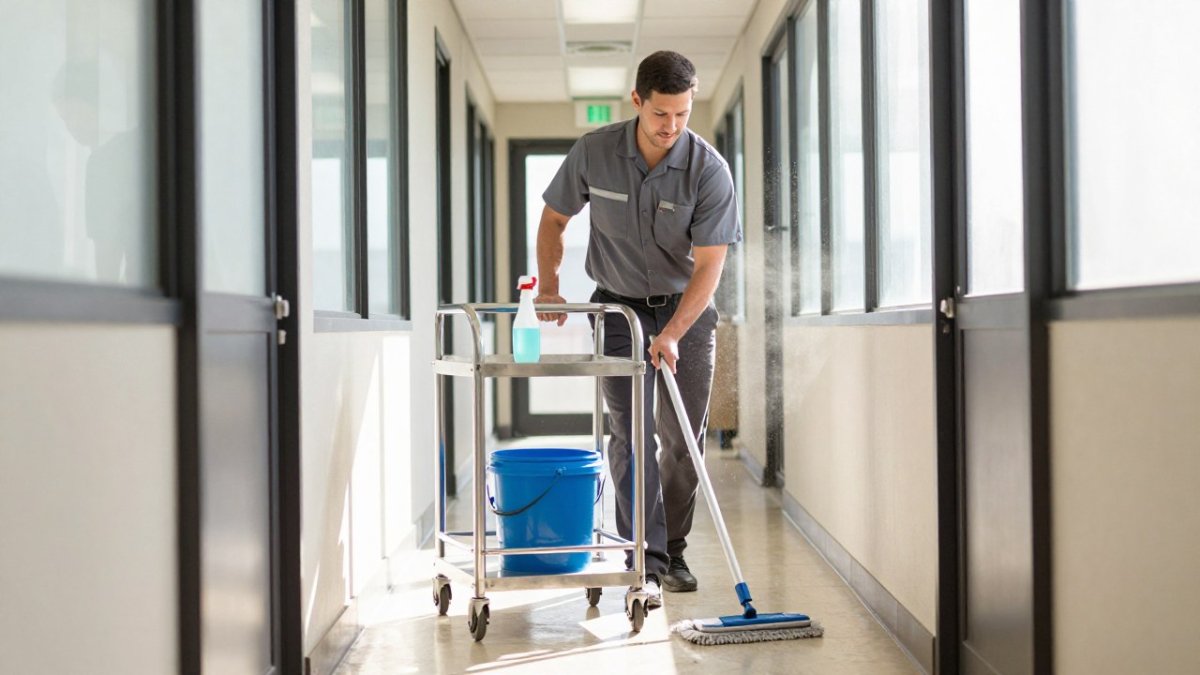
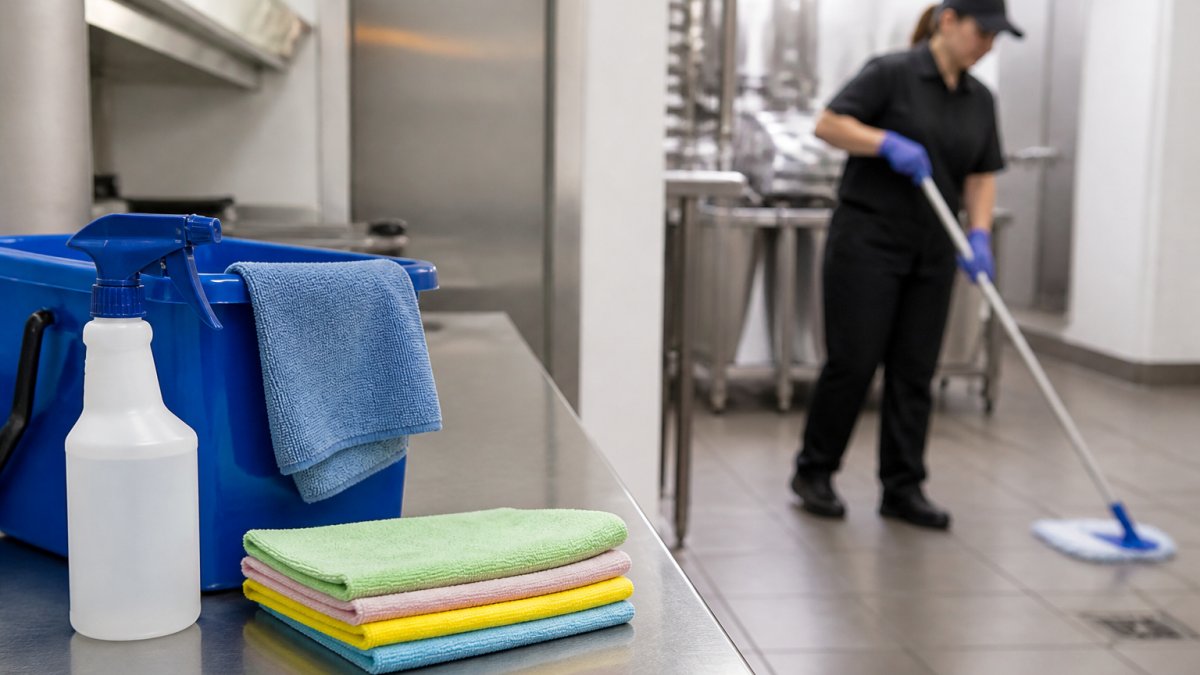
Color-coded cleaning tools stop a mop from carrying restroom germs into a break room.
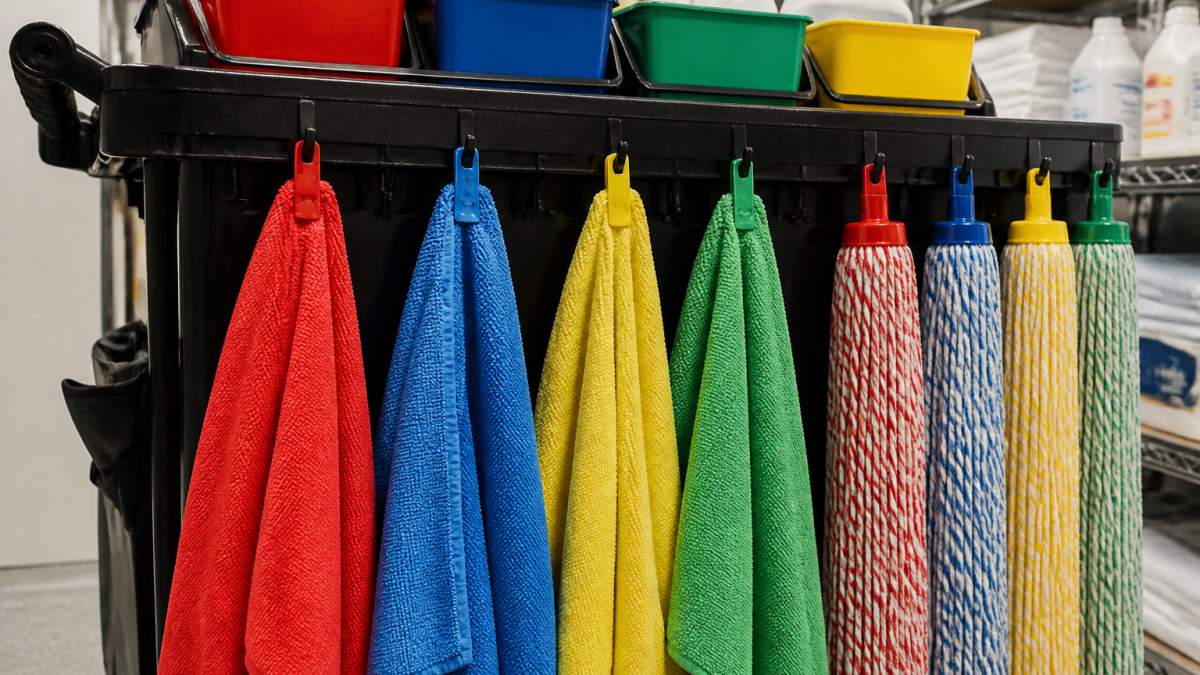
Assign one color per zone and never mix them:
- Red: restrooms and toilets
- Yellow: other wet areas and sinks
- Blue: general low-risk areas like offices and hallways
Label every cloth, mop head, and bucket. Store clean tools apart from dirty ones. Train new crew members on the system on day one.
Facilities that want greener options can pair color coding with environmentally responsible cleaning practices without losing any protection against cross-contamination.
Write Cleaning and Disinfection Protocols for Commercial Facilities
Cleaning and disinfection protocols for commercial facilities should spell out four things: what to use, how much, how long, and in what order. Write them down. Verbal instructions get lost by the second shift.
Contact Time, Dwell Time, and the Step Most Crews Skip
Contact time (or dwell time) is how long a disinfectant must stay wet on a surface to kill germs (the EPA).
That wipe removes dirt but does not disinfect. The product needs its full contact time, stated clearly on the label.
A common mistake is mixing products. Bleach plus ammonia creates dangerous fumes. Stick to one approved product per task, and store them correctly.
For large spaces where coverage is hard to reach, electrostatic disinfection applies an even, 360-degree coating across surfaces. You can read how electrostatic disinfection works to judge whether it fits your facility.
Verify Cleanliness With Spot Checks and Audit Records
Trust does not verify cleanliness. Records do. But a clipboard of checkmarks is not verification either. The strongest programs turn spot checks into a small set of performance indicators a facility manager can read in under a minute and act on the same week.
Build the Verification Loop
A workable verification loop has four parts: a standard, a sample, a record, and a review. Skip any one and the loop breaks.
- Standard: Written pass/fail criteria for each surface type, not a manager's memory. A restroom fixture passes when it is free of visible soil and has received its full contact time.
- Sample: A fixed number of surfaces per shift, chosen at random from the zone list. Five per shift is a common starting point for a mid-size building.
- Record: Pass or fail, time, zone, surface, and initials. Photograph every fail before correction.
Track These Performance Indicators
Pick a handful of measures and keep them visible. Four to six indicators are usually enough to spot a failing zone before a client complaint arrives.
- Inspection pass rate: Passed checks divided by total checks, by zone and by shift.
- Cleaning completion rate: Scheduled tasks marked done divided by tasks scheduled. A completion rate below the pass rate usually means the checklist is too long, not that the crew is lazy.
- Repeat failure count: The same surface or zone failing twice in a rolling 30-day window. Repeat failures are the clearest signal of a training or staffing gap.
Act on What the Numbers Show
Verification only pays off when the data changes behavior. A weekly review answers three questions: Which zone had the lowest pass rate? Which task had the lowest completion rate?
Keep audit records for at least a year so seasonal patterns and staffing changes are visible. The OSHA guidance on workplace sanitation ties clean facilities to employee health, which gives your records a second purpose beyond client reporting.
A Note on Surface Testing
Rapid tests such as ATP meters are useful for relative comparison within your own building, but they are not a pass/fail certificate and do not identify a specific pathogen. Use them to compare zones and shifts over time, paired with visual inspection rather than replacing it. If you use a third-party lab for confirmatory testing, keep the sampling plan and results in the same audit file.
Respond to Incidents With Corrective Action, Not Apologies
When something goes wrong, an apology does not fix it. A corrective action does. An incident is any confirmed miss: a failed spot check, a client complaint, a spill, a reported illness cluster, or a tool-mixing event such as a restroom mop used in a break room.
Run every incident through the same five steps, and write each step down with a date and an owner.
- Contain it. Stop the spread first. Clean and disinfect the affected area, remove and bag any tool that crossed zones, and restrict access until the area is re-checked.
- Document it. Record what happened, where, when, who was involved, and what was observed. Photograph the area before and after correction. A one-page incident form is enough; a blank page is not.
- Find the root cause. Ask why until you reach a fixable cause. A restroom mop in a break room is not the cause; the cause might be an unlabeled mop head, a missing hook in the supply closet, or a new hire who was never trained on the color system.
- Fix the cause. Adjust the checklist, the schedule, the labeling, or the training. Name the change and the person responsible for making it.
- Verify the fix. Re-inspect the area and the related zone for two weeks. Close the incident only when the re-checks pass.
Scenario: Tool-Mixing Incident
A crew member uses a red restroom cloth on a break room counter. Contain by cleaning and disinfecting the counter and removing the cloth from service, then document the time, surface, and crew member. The root cause is rarely one person's carelessness; look for a missing label, colors stored together, or a shift handoff with no briefing.
Scenario: Failed Inspection in a High-Traffic Zone
A lobby entry check fails twice in one week. Contain by re-cleaning the surfaces and posting a temporary increased-frequency note, and document both failures with times and initials. The root cause may be a schedule that assumes one mid-day pass when the building now has a lunch rush. Fix by adding a second mid-day disinfection pass and adjusting the checklist, then verify by tracking the lobby pass rate for 30 days against the prior month.
Scenario: Spill or Suspected Contamination Event
A spill in a shared corridor or a report of illness among staff in one zone calls for the same loop, with two additions. First, expand the containment area to the transfer points the affected people used, such as elevator buttons and shared door handles. Second, check whether the event correlates with a drop in a verification indicator, such as a falling completion rate in that zone.
Feed Incidents Back Into the Program
Every incident should leave the program stronger. Add the root cause to your training notes, add the surface to the checklist if it was missing, and add the zone to next week's spot-check sample.
This turns a one-time problem into a permanent improvement. It also gives you a clear answer when a client asks how quickly issues get resolved: you can show the closure time, the fix, and the re-check that proved it worked.
Get a Free Quote for a Facility-Specific Prevention Plan
Every building spreads germs differently. A plan built for one lobby will not fit a gym locker room or a medical waiting area.
Before you hire anyone, know what to ask. Our guide on how to choose the right commercial cleaning company covers insurance, references, scope, and red flags.
Cross-contamination prevention is a system, not a single product.
Frequently Asked Questions
What is the difference between cleaning, sanitizing, and disinfecting?
Cleaning removes visible soil, dust, and organic matter with soap or detergent. Sanitizing reduces bacteria on a surface to levels considered safe by public health standards. Disinfecting kills nearly all pathogens listed on the product label, but only when the surface stays wet for the full contact time. For cross-contamination prevention, cleaning must come first: disinfectant applied over visible soil or grease will not work as labeled. Build your protocols in that order, and check the EPA-registered label for the required dwell time on every product your crew uses.
How often should high-touch surfaces be disinfected in a busy facility?
Frequency should follow traffic, not habit. In a Class A office, door handles, elevator buttons, and shared break room counters typically need wiping at least two to three times per day during occupied hours. Restrooms in high-traffic buildings often need hourly checks with spot disinfection of flush handles, faucets, and door pulls. A gym locker room or medical waiting area may need more. Set commercial cleaning frequency for high-traffic areas by counting how many people touch a surface per hour, then assign a schedule and log each pass so the interval is verifiable.
How should cleaning tools be separated to prevent cross-contamination?
Use a color-coded cleaning tools system and enforce it in storage as well as on the cart. A common approach assigns one color to restrooms, another to food and break areas, another to general office surfaces, and another to high-risk clinical spaces. Never let a restroom cloth or mop head touch a break room surface, and never launder colors together in a way that blurs the system. Store tools on labeled hooks by color, replace microfiber when it looks worn, and train new crew members on the chart before their first shift.
Does electrostatic disinfection prevent cross-contamination?
Electrostatic disinfection helps by wrapping surfaces with a fine, evenly charged mist, which reaches sides and undersides that a cloth may miss. It supports cross-contamination prevention best as a scheduled layer on top of routine cleaning, not as a replacement for it. Soil still has to be removed first, and the product still needs its full contact time. For medical suites, gyms, and other high-risk rooms, pair electrostatic application with a documented cleaning sequence, tool segregation, and spot checks so you can show the work was done.