 How-to
7 Challenges of Managing Cleaning Services for Distributed Facilities
Table of Contents
- Why Distributed Facilities Break Standard Cleaning Playbooks
- Challenge 1: Labor Shortages and Distributed Workforce Management
- Challenge 2: Centralized Scheduling, Dispatch, and Coverage Planning
- Challenge 3: Rising Operating Costs and Multi-Site Budget Allocation
- Challenge 4: Consistent Quality Control Across Locations
- Challenge 5: Managing Janitorial Service Complaints Without Losing Accounts
- Challenge 6: Writing a Facility Cleaning Service Level Agreement That Holds Up
- Challenge 7: Choosing Cleaning Operations Management Software That Fits
- Frequently Asked Questions
Last Updated: October 19, 2026
Why Distributed Facilities Break Standard Cleaning Playbooks
Most cleaning playbooks assume one building, one crew, and one person watching the lobby. Distributed facilities shatter that model.
At Rangel Janitorial, we have spent more than 30 years cleaning corporate offices, medical facilities, and industrial parks. That work taught us a hard lesson.
Below, we break down seven challenges and give you a practical fix for each. The fixes are steps you can run this quarter, not theory.
Challenge 1: Labor Shortages and Distributed Workforce Management
The first challenge is people. Cleaning crews are spread thin, and a call-out at one site can leave another site short. A distributed workforce is harder to supervise, harder to train, and harder to keep.
Recruitment, Retention, and Morale Across Sites
Recruitment gets harder when sites are far apart. A strong hire near one building may not travel to another. Retention suffers when cleaners feel invisible, because no manager sees their work day to day.
A few practices help:
- Assign each crew a named supervisor they can reach by phone
- Pay travel time fairly between sites
- Recognize good work in writing, site by site
- Cross-train cleaners so they can cover more than one building
Morale is not soft. Teams that feel seen cut corners less. The U.S. Department of Labor guidance on workplace safety also reminds employers that safety training is a legal duty, not a bonus.
Challenge 2: Centralized Scheduling, Dispatch, and Coverage Planning
Scheduling is where distributed cleaning operations succeed or fail. Centralized scheduling means one team plans every site, every shift, and every backup.
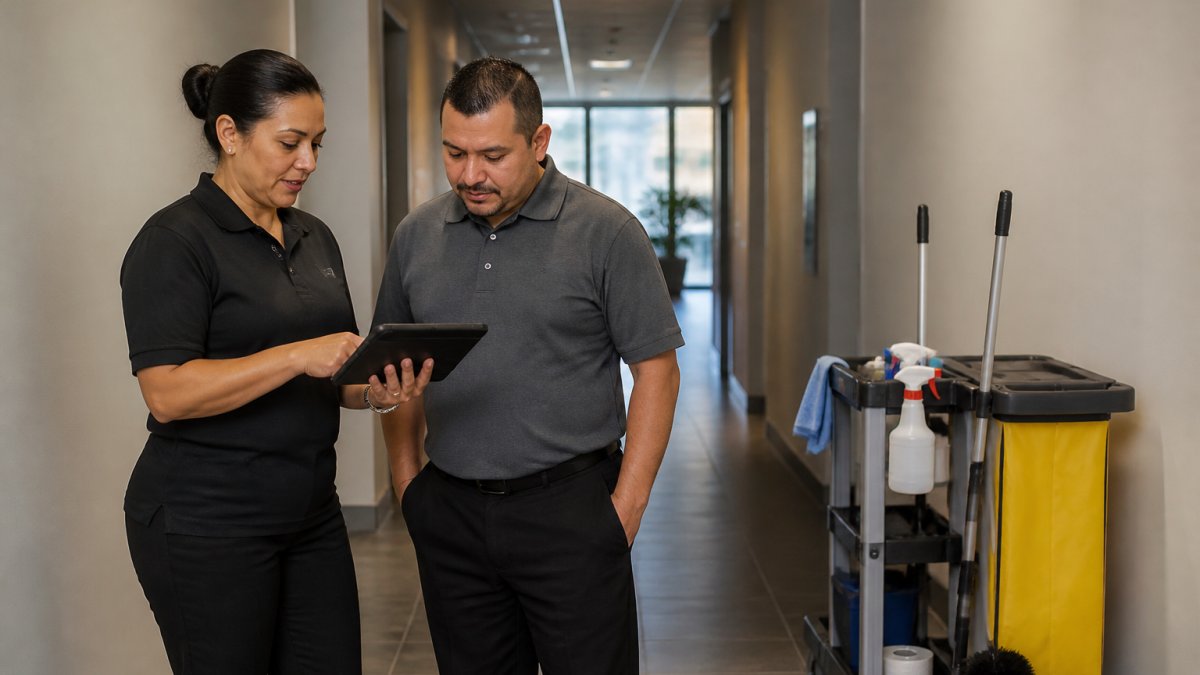
The unique angle here is coverage planning: most providers schedule each site in isolation, then scramble when someone calls out.
Building Cleaning Rotations That Survive Call-Outs
A rotation is only as strong as its backup plan. Build every schedule with a reserve, and treat the reserve as a real line item, not a hope.
- Keep a named floater for each cluster of sites
- Set a call-out deadline, such as two hours before shift
- Publish the backup list so no one guesses
- Track who actually covered each shift
- Log the reason for every call-out so patterns surface (Mondays, one site, one supervisor)
Modeling Travel Time and Cluster Coverage
Travel time is the hidden cost in distributed cleaning. A cleaner who finishes at one site at 10:00 p.m. and starts at another at 6:00 a.m. is not productive for the hours in between, and a floater who drives 45 minutes to cover a two-hour shift burns most of the value of the coverage.
A practical pattern is to cluster sites by drive time, not by geography on a map. Three to five buildings within a 15-minute drive of each other form a cluster. Each cluster gets:
- A primary crew assigned to its home site
- One cross-trained floater who can reach any site in the cluster within the call-out window
- A shared supply cache so a floater does not arrive empty-handed
Absorbing Changing Workloads
Workloads shift with seasons, tenant move-ins, and event calendars. A centralized schedule should carry a weekly capacity review: compare scheduled hours to actual hours per site, and flag any site running more than a set threshold over plan. That flag triggers a reallocation decision before overtime compounds.
Dispatch Mechanics That Prevent Gaps
A dispatch board only works if it is the single source of truth. That means:
- Every shift is entered before the week starts, with a named cleaner
- Every call-out is logged in the same system, not in a text thread
- Every open shift has an owner and a deadline to fill it
- Every fill is confirmed back to the site contact
When those four rules hold, coverage gaps become visible hours before they become client complaints. When they slip, the first sign is usually a missed restroom on a Monday morning.
Challenge 3: Rising Operating Costs and Multi-Site Budget Allocation
Costs climb from every direction: labor, supplies, equipment, and fuel. Multi-site budgeting adds a second layer, because each site wants its own number. A flat split rarely works.
Allocate budget by site, not by average. A high-traffic lobby needs more labor hours than a quiet back office. Track three lines per site:
| Cost Line | What to Track | Why It Matters |
|---|---|---|
| Labor hours | Scheduled vs. actual hours | Shows overruns early |
| Supplies | Usage per site per month | Stops quiet waste |
| Equipment | Repairs and replacements | Flags aging machines |
Review the table monthly. Sites that drift get attention before the annual budget blows up.
Challenge 4: Consistent Quality Control Across Locations
Quality drifts when no one measures it. One site looks spotless, another looks tired, and the brand suffers at both. A commercial cleaning quality control checklist is the simplest fix. It turns "looks clean" into a score.
The unique angle here is site-level performance measurement: a consistent scorecard that lets you compare sites, track trends, and prove service-level agreement compliance with numbers instead of opinions. Most providers inspect, but few report the same way across every building.
Inspections, Scorecards, and Real-Time Reporting
Run inspections on a fixed schedule, and score each site the same way. A simple scorecard works best when every inspector uses the same categories and the same scale.
- Restrooms: fixtures, floors, supplies
- High-traffic areas: lobbies, hallways, break rooms
- Spills and stains: response time
- Trash and recycling: emptied and liners replaced
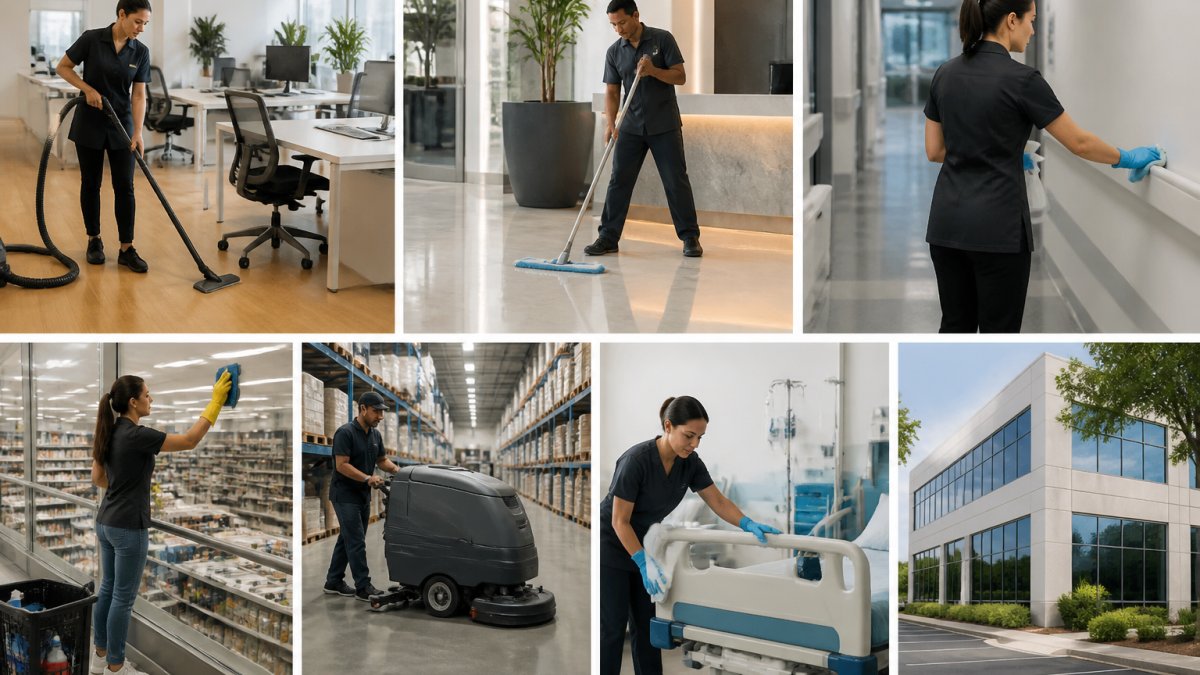
- Specialized areas: medical suites, gyms, locker rooms
A Scorecard That Compares Sites Fairly
Use a 1-to-5 scale per category, with written anchors for what a 1, 3, and 5 look like. Without anchors, two inspectors score the same restroom differently, and the scorecard loses credibility with clients.
A workable structure:
| Category | Weight | What a 5 Looks Like | What a 1 Looks Like |
|---|---|---|---|
| Restrooms | 30% | All fixtures clean, supplies full, no odor | Visible soil, empty dispensers |
| High-traffic areas | 25% | Floors clean, no debris, entry glass clear | Debris in corners, smudged glass |
| Spill response | 20% | Addressed within agreed window | Standing spill at inspection |
| Trash and recycling | 15% | Emptied, liners replaced, area clean | Overflowing, liner missing |
| Specialized areas | 10% | Meets site-specific standard | Fails site-specific standard |
Weight the categories to match each site's use. A medical suite should weight restrooms and specialized areas higher than a warehouse office. The weights change; the scale and anchors do not.
Reporting That Clients Can Read
A scorecard only earns its keep if the client sees it. Send a one-page site report after every inspection with:
- Overall score and category scores
- Photos of any failed item
- Corrective action and owner
- Trend line against the prior four inspections
Real-time reporting matters here. When a score drops, the site manager should know the same day, not at the next quarterly review.
Benchmarking Across Sites
Once every site is scored the same way, you can rank them. A common pattern is to review the bottom two sites each month and the top site as a model. That comparison is what turns quality control from a single-building habit into a multi-site operating system.
Tying Scores to the Service Level Agreement
Every scorecard category should map to a term in the facility cleaning service level agreement. If restrooms are weighted at 30% on the scorecard, the agreement should state the restroom standard and the inspection frequency. When a score falls below the agreed threshold, the corrective action is defined in advance, not negotiated after the fact.
Challenge 5: Managing Janitorial Service Complaints Without Losing Accounts
Complaints are not the problem. Slow replies are. Janitorial service complaint management works when every complaint has an owner, a deadline, and a follow-up.
Set a simple response standard:
- Log the complaint the day it arrives
- Assign an owner within one hour
- Fix the issue within one business day
- Confirm with the client in writing
- Review the cause at the next site check
Clients forgive mistakes. They do not forgive silence. A fast, documented reply keeps accounts that a slow provider would lose.
Challenge 6: Writing a Facility Cleaning Service Level Agreement That Holds Up
A facility cleaning service level agreement defines what "clean" means for each site. Without one, every complaint becomes an argument.
Build the agreement around measurable terms:
- Task frequency per area, room by room
- Response times for spills and complaints
- Inspection schedule and scoring method
- Supplies and equipment responsibilities
- Insurance and bonding requirements
- Termination and renewal terms
Keep it short enough to read. A clear two-page agreement beats a forty-page one nobody opens. The Occupational Safety and Health Administration standards are also worth referencing for safety duties that apply to cleaning crews.
Challenge 7: Choosing Cleaning Operations Management Software That Fits
Cleaning operations management software ties scheduling, inspections, and reporting into one system. The right tool shows every site on one screen. The wrong one adds work without removing any.
Judge tools on four points:
- Does it handle multiple sites with separate schedules?
- Can crews log tasks from a phone?
- Does it produce site-level reports you can share with clients?
- Does it track complaints from report to close?
Skip tools built for a single building. They break the moment you add a second site.
That is the full picture, and it points to one conclusion. Distributed facilities need a partner built for distributed work, not a vendor stretched past its limits.
Frequently Asked Questions
What are the biggest challenges of managing cleaning services across multiple facilities?
The biggest challenges fall into seven areas: labor shortages and staff turnover, scheduling and dispatch across sites, rising operating costs and budget allocation, inconsistent quality control, complaint management delays, weak service level agreements, and choosing the right operations software. Distributed facilities make each one harder because no single supervisor can see every site at once. The fix is usually a written standard applied everywhere, site-level performance data, and a central point of contact for scheduling and complaints.
How do you monitor cleaning quality at multiple facilities?
Use a commercial cleaning quality control checklist at every site with the same scoring scale, then audit each location on a fixed cadence, typically monthly for high-traffic buildings and quarterly for lighter-use sites. Inspections should cover restrooms, high-traffic areas, spills and stains, and supply restocking. Record results in one shared dashboard so facility managers can compare sites and spot trends. Real-time reporting also gives you evidence when a complaint comes in, which makes janitorial service complaint management faster and fairer.
What should a multi-site cleaning services contract include?
A facility cleaning service level agreement should spell out the scope for each site, cleaning frequencies, response times for spills and complaints, inspection and audit schedules, staffing requirements, insurance and bonding coverage, and how pricing adjusts when a site's square footage or traffic changes. Include a clear escalation path for missed areas and a defined remedy, such as a re-clean within a set number of hours. Without those terms, quality disputes across distributed facilities have no objective standard to settle against.
What technology helps manage cleaning operations across multiple facilities?
Cleaning operations management software typically combines scheduling and dispatch, task completion tracking, digital inspections, and a complaint intake log in one system. The most useful feature for distributed facilities is real-time visibility: a facility manager can see whether a crew checked in, which tasks were completed, and whether an inspection passed without calling the site. Look for software that supports multiple buildings under one account and exports site-level reports, so budgeting and performance reviews use the same data.
Managing cleaning across many sites is a coordination problem before it is a cleaning problem. Rangel Janitorial handles that coordination for you, with trained professional crews, fully bonded and insured coverage, and consistent quality across multiple properties. Our specialized electrostatic disinfection gives 360-degree coverage for medical suites, gyms, and high-traffic areas. Get a free quote from Rangel Janitorial and give every site the same standard of clean.